

Data Preparation#
Raw recordings may be sparse, contain failed episodes, or lack visual variety. Here you clean, label, convert, and inspect them as a LeRobot dataset.
Learning Objectives#
By the end of this lesson, you’ll be able to:
Explain the four stages that turn raw recordings into a training-ready dataset.
Run the preparation pipeline from a prompt and review the result in the visualizer.
Run It With a Prompt#
scissor_pick_and_place dataset: the recorded episodes are converted
to a LeRobot dataset, then opened in the LeRobot visualizer. Camera videos appear on the
left and synchronized joint-state and action timelines on the right, so you can confirm the
demonstrations look right before training.
Mimic 3 more episodes and visualize my dataset.
Run Annotation on all recorded episodes and summarize.
What Happens Under the Hood?#
Preparation is a short pipeline. The shipped skills cover mimic, annotate, replay, convert, and visualize; the middle stages are optional and repeatable, and conversion is the hand-off to training.
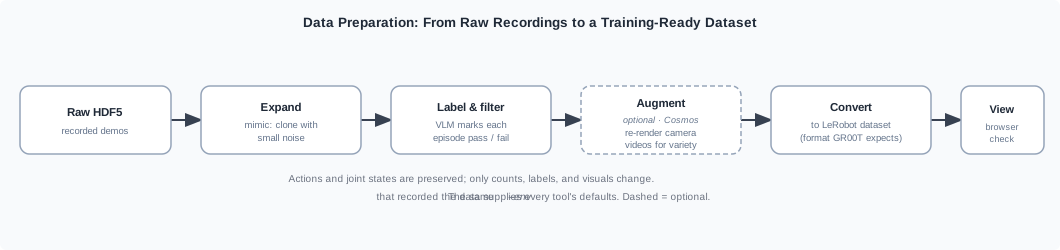
The preparation pipeline preserves the robot’s actions and joint states. Expansion adds lightly jittered copies, labeling tags episodes, and augmentation re-renders camera videos. Each tool reads defaults from the recorded environment.#
Expand: mimic. Clone trajectories with small action and state noise to increase episode count.
Label and filter: VLM annotator. Judge task success so failed episodes can be removed before training.
Augment, optional: Cosmos Transfer. Re-render camera streams with varied lighting and backgrounds while preserving trajectories.
Convert: LeRobot. Package the recording for GR00T or openpi and detect dimensions and camera keys.
Visualize. Review camera videos and joint timelines before using GPU time for training.
Optional deep dive:
Walk me through the data-prep tools (mimic, the VLM annotator, the LeRobot converter) and how each transforms an HDF5 recording while leaving actions and joint states intact.
What’s Next?#
You now have a labeled, converted, and inspected LeRobot dataset. In Imitation Learning with GR00T you’ll fine-tune a policy on it.