

Imitation Learning With GR00T#
Fine-tune NVIDIA GR00T or openpi PI0 on the
demonstrations you collected. The public repository ships scissor_pick_and_place on GR00T
N1.5. You can keep that default or upgrade the task to GR00T N1.7.
Learning Objectives#
By the end of this lesson, you’ll be able to:
Launch a fine-tuning run on a dataset you collected, straight from a prompt.
Explain what a policy stack contains and map each environment to the right one.
Run It With a Prompt#
You launch training by pasting a prompt to your coding agent. It finds the policy stack your environment uses, starts that trainer on your collected LeRobot dataset, and writes a checkpoint you’ll deploy next.
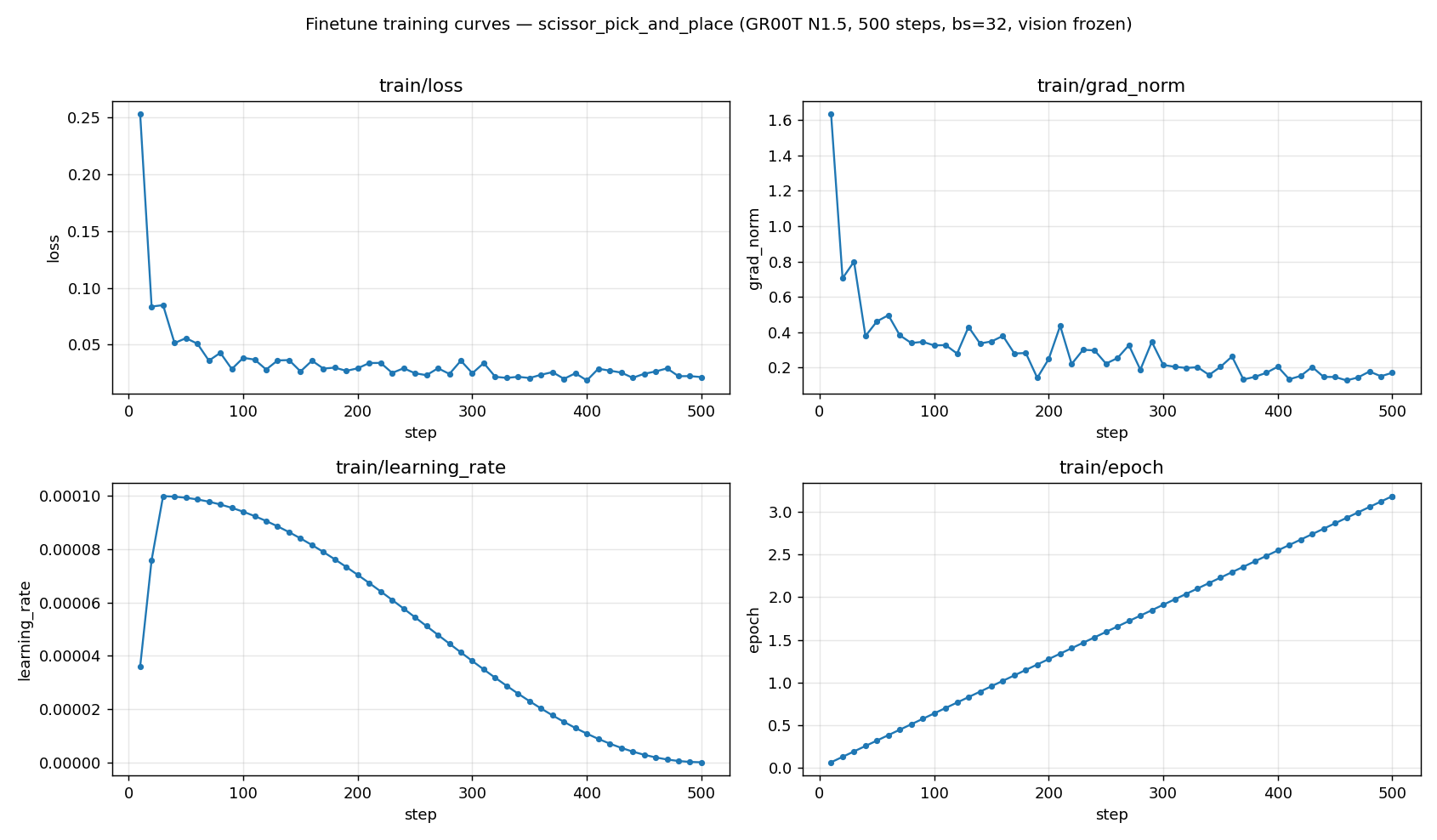
Historical training curves from a 500-step scissor_pick_and_place fine-tune using GR00T
N1.5, batch size 32, and frozen vision. The same metrics are used to inspect an N1.7 run.
See Reading the Training Curves below.#
Fine-tune scissor_pick_and_place on the LeRobot dataset I just prepared for a 200-step
smoke run. Report the checkpoint path.
Update scissor_pick_and_place to policy.stack gr00t_n17 and policy.model_repo
nvidia/SO_ARM_Starter_Gr00tN17. Show me the YAML changes and verify the N1.7 policy and
training routes. Fine-tune GR00T N1.7 on the scissor LeRobot dataset I just prepared for
200 steps with batch size 32 and vision tuning off. Use nvidia/GR00T-N1.7-3B as the base
model and report the checkpoint path.
A 200-step run is a smoke test, not a strong policy. The deployment lesson can use a checkpoint from a longer training run. GR00T N1.7 support is already implemented in the repository, but the shipped scissor YAML and finetune skill select N1.5. The N1.7 option overrides that routing before training.
What Happens Under the Hood?#
Each env YAML selects one policy stack under workflows/agentic/policy/. A stack is a separate
uv project that pins a policy framework and its dependencies, then supplies the task-specific
observation adapters, action format, inference service, and trainer. It is more than a model
name. The stack and checkpoint must use the same model layout.
Which Model Trains Which Environment#
An env YAML selects one model and stack at a time. The dataset must match that environment’s camera, state, and action contract.
Policy stack |
Runtime and data contract |
Course use |
|---|---|---|
GR00T N1.5 ( |
Released SO-101, trocar, and surgical policy adapters. |
Shipped default for |
GR00T N1.7 ( |
Current N1.7 model layout and dependency set; SO-101 room/wrist video, six joint values, and 16-step absolute action chunks. |
Optional upgrade for |
GR00T N1.6 ( |
G1 loco-manipulation adapters; 43-DoF state/actions, head or dual cameras, and navigation/base commands. |
|
openpi PI0 ( |
Separate JAX/OpenPI runtime; Franka room/wrist video and 50-step relative joint-action chunks. |
|
The workshop fine-tune path is verified for scissor_pick_and_place. assemble_trocar
and the surgical environments ship for inference or scripted smoke validation and do not
declare a training module in their env YAMLs.
Command Line: Launch Shipped N1.5 Training Directly
Point --dataset-path at the converted LeRobot dataset:
uv --directory workflows/agentic/policy/gr00t_n15 run i4h-agentic-gr00t-n15-train \
  --env scissor_pick_and_place \
  --dataset-path "${DATASET_PATH}" \
  --output-dir "$PWD/runs/scissor_finetune" \
  --base-model-path nvidia/SO_ARM_Starter_Gr00t \
  --max-steps 200 \
  --batch-size 32 \
  --no-tune-visual \
  --num-gpus 1
The run writes a checkpoint-<N>/ directory and a log with train_loss lines you can inspect.
Optional deep dive:
Explain how policy/run.sh routes an env to its training stack via policy.stack, and how each stack registers its train CLI.
Reading the Training Curves#
The figure at the top of this page plots the four key scalars TensorBoard logged for the run. A healthy fine-tune on a small dataset looks like this:
train/loss: drops from about 0.25 to 0.03 in the first 50 steps, then plateaus near 0.02 to 0.03.train/grad_norm: starts near 1.6 and settles around 0.15 to 0.2 without spikes.train/learning_rate: warms up to about 9e-5, then decays to zero by step 500.train/epoch: rises linearly to about 3.18.
A flat plateau can indicate overfitting on a small dataset. Collect more varied demonstrations or unfreeze the vision backbone when the policy must generalize.
Optional deep dive:
Walk me through the GR00T fine-tuning loop, its TensorBoard logs, and how it produces loss, grad_norm, and the learning-rate schedule.
What’s Next?#
With a checkpoint in hand, you’ll start the matching policy daemon and watch the policy act inside the simulated environment. Continue to Deployment in Simulation.