

Designing Nemotron-Personas: Multi-Locale Synthetic Personas Powering Nemotron Training
Designing Nemotron-Personas: Multi-Locale Synthetic Personas Powering Nemotron Training


The Nemotron-Personas HF collection is a growing family of multilingual, region-specific synthetic persona datasets (currently covering seven countries and nine language variants with roughly 53 million personas in total), each grounded in real-world demographic and geographic distributions. Behind every dataset is the same NeMo Data Designer compound-AI pipeline, adapted per region. And while the public release is a useful artifact in its own right, what’s less visible is just how much these personas show up in Nemotron model training itself: seeding long-context samples, tool-use rollouts, formal-logic data, safety refusals, and general chat. This post pulls back the curtain on both halves of that story: how the collection is built, and how it is used.
Want to dive straight into code? Open the companion Colab notebook — or read on for the full story.
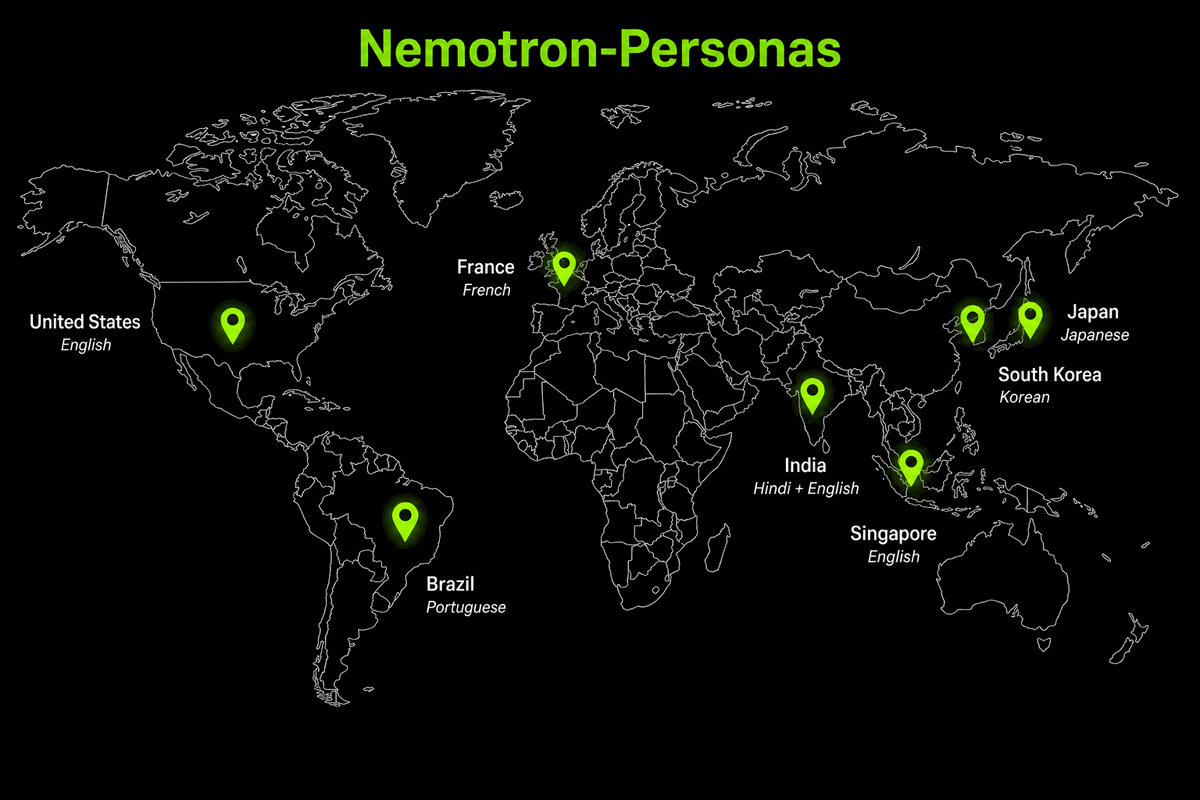
The growing Nemotron-Personas collection powering Nemotron model training. Multi-locale synthetic personas grounded in real demographic, geographic, and personality-trait distributions.
Why grounded synthetic personas matter
It’s easy to underestimate what a really good persona seed buys you. Three angles worth keeping in mind:
-
Distributional faithfulness for sovereign AI. Models trained on synthetic data that doesn’t reflect the actual demographics of a region inherit subtle biases: over-representing some groups, under-representing others, getting cultural context wrong. For sovereign-AI work, this matters a lot. Grounding personas in census + administrative data closes that gap before the LLM ever sees the data.
-
Diversity that random sampling can’t produce. “Generate 10,000 customer queries” with no seed and an LLM will give you 10,000 variations on the same handful of latent personas. Conditioning each query on a distinct, demographically-grounded persona forces the model to span the actual population it’ll be deployed against — the conscientious 62-year-old retired electrician in Pittsburgh, the 24-year-old graduate student in Bengaluru, the elementary-school teacher in Lille. Each yields a meaningfully different prompt.
-
Reusable seed material. Once a persona has a name, a demographic profile, an OCEAN vector, and a coherent backstory, any downstream pipeline can attach to it: a tool-use environment, a long-context construction, a safety-refusal template, a roleplay scenario. The collection acts as a library — generate the personas once, reuse them across training stages.
Nemotron-Personas inside Nemotron training
The Nemotron 3 Super Technical Report shows just how foundational these personas have become. They’re a seeding primitive used across many post-training stages.
Long-context samples
Long-context training data is hard to source. You need genuinely long, coherent sequences that aren’t just concatenations of unrelated documents. Persona records, by virtue of being self-contained narratives with rich attributes, concatenate cleanly:
“We also construct long-context samples by concatenating records from Nemotron-Personas-USA to reach the required sequence length.”
Each persona is internally coherent (the OCEAN traits inform the cultural background, which informs the career goals, which informs the professional persona, etc.), and across personas the records are independent — exactly the right shape to pack into long sequences.
General-purpose tool-use rollouts
Tool-use trajectories require a user with a goal, not just a tool set. The Super pipeline uses a dual-LLM setup where one LLM plays the user and another plays the agent:
“The User-LLM is seeded with the selected tool set, a persona sampled from Nemotron-Personas-USA…”
Seeding the user side with a real persona is what makes the rollouts feel like authentic conversations — the user’s goals, communication style, and frustration patterns all flow from their underlying attributes. The agent has to handle the variance that real users actually produce, not the narrow band of “well-behaved benchmark user” prompts.
A closely related approach was used to build Nemotron-Nano-9B-v2-Japanese, NVIDIA’s Japanese small language model that ranks #1 on the Nejumi LLM Leaderboard. The Japanese instruction-following + general-chat data was seeded by Nemotron-Personas-Japan, with prompts and assistant responses anchored to Japanese-grounded personas. A Japanese persona collection, generated by a localized DD pipeline, becomes the seeding layer for a Japanese model that beats the leaderboard.
The same template is being used across the family — instruction-following and general-chat data going into Nemotron Nano v3 and Super v3 follows the same persona-seeded recipe.
Synthetic formal-logic data
Even abstract reasoning data benefits from persona conditioning:
“We introduced variability into the generated scenarios, premises, and formulas by incorporating random personas, letters, and/or logic connective (i.e., ∧, ∨, ⊃, ≡, ∼) into the prompt.”
Formal-logic problems become more diverse — and more transferable — when the surface scenario shifts. A propositional-logic puzzle about an elementary teacher planning a field trip exercises the same underlying inference as one about a credit-counselor evaluating a loan, but the lexical surface looks completely different. Persona-driven scenario variation breaks the model out of the canonical “Alice and Bob” rut that plagues most synthetic formal-logic datasets.
Sensitive-safety-category-refusals (SSCR)
The SSCR dataset — used in Nemotron’s safety blend — leverages Nemotron-Personas as seed data when constructing prompts that require refusal across sensitive categories. Personas matter here because real-world adversarial / sensitive prompts come from all kinds of users; grounding the synthetic prompts in demographically diverse personas ensures the trained refusal behavior generalizes across user populations rather than overfitting to a narrow band of “obviously suspicious” phrasings. SSCR is included in the broader nemotron-safety-blend.
General chat and instruction following
The same persona-seeding pattern that powers tool-use rollouts also powers the broader general-chat and instruction-following data that flows into Nemotron Nano v3 and Super v3. A chat or instruction sample is a function of who is asking — their goals, their constraints, their communication style — and personas are how the pipeline encodes “who.”
How they’re built: a four-stage compound-AI pipeline
Across all locales, the construction pipeline is the same four-stage shape (the regional adaptations live in the seed distributions, the language of the prompts, and which locale-specific fields get added). NeMo Data Designer orchestrates the pipeline as a column DAG:
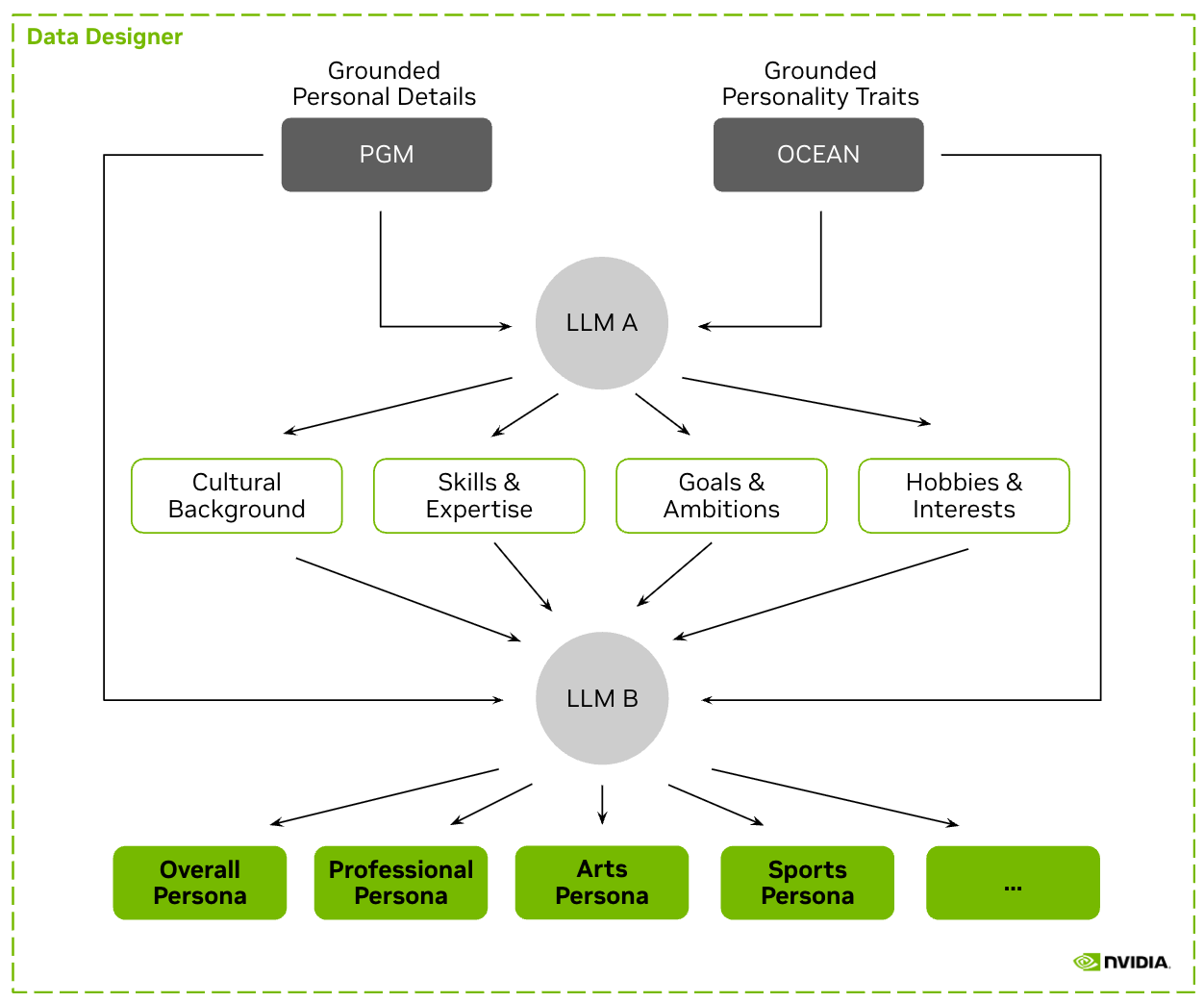
The compound-AI pipeline behind Nemotron-Personas. Multiple models (PGM, OCEAN, LLM A, LLM B) work together to produce internally-coherent and diverse synthetic personas that mirror real-world demographic, geographic, and personality-trait distributions.
Stage 1: OCEAN Big-Five sampling
OCEAN (Big Five personality traits) is the most empirically grounded model of human personality. For each persona we sample five trait T-scores (μ = 50, σ = 10, clipped to [20, 80]), bucket each into a coarse label, and attach a prose description grounded in the personality literature. Working at the description level (rather than raw scores) is what makes the downstream LLM stages produce nuanced, internally-consistent narratives — “highly conscientious” vs “highly extraverted” reads very differently to an LLM than t_score=72.
The score-to-label mapping is shared across all five traits:
Each (trait, label) pair maps to a curated description that captures how that level of the trait actually manifests. A representative slice of the openness mapping:
The other four traits each have their own 5-row description table tuned to their domain (conscientiousness around organization vs spontaneity, extraversion around social energy, agreeableness around cooperation, neuroticism around emotional reactivity). The result is that one sampled persona arrives at Stage 3 with a structured personality block:
…which the downstream LLM prompts reference directly via Jinja templates:
Stage 2: Demographically-grounded sampling
This is the engine of regional fidelity. For each locale, the goal is to produce a demographic record whose attributes correlate with each other the way real populations do — age × education × occupation × marital status × geography, with locale-specific extensions. Naive independent sampling produces nonsensical records (3-year-old surgeon married for 30 years living alone in Singapore); the released artifact pulls from Probabilistic Graphical Models trained on real statistical distributions (census tables, administrative records, public surveys) so the correlations are statistically faithful.
The simplest path to seed your own pipeline today is to consume the released NGC-hosted Nemotron-Personas dataset directly via Data Designer’s built-in PersonSampler. This gives you the full demographic + OCEAN block from a verified PGM-grounded source without rebuilding anything yourself. One SamplerColumnConfig is enough:
{{ person.openness.description }}, {{ person.occupation }}, {{ person.district }} all become available to downstream Jinja templates immediately. See the Person Sampling docs for the full setup walkthrough (NGC API key + data-designer download personas --locale en_US).
Bring your own region: SDG-PGMs is open source
For new locales without a released artifact — or for teams that need full control over the demographic distributions — the underlying engine, SDG-PGMs, was just open-sourced as NVIDIA-NeMo/SDG-PGMs:
“Together with Data Designer, SDG-PGMs helps power the Nemotron-Personas HF collection — multilingual, region-specific synthetic persona datasets for sovereign AI development. The USA dataset alone contains 6M personas grounded in US Census data, with realistic demographic correlations across age, sex, geography, education, marital status, and 560+ occupations.”
Stage 3: Persona attributes via structured outputs
With OCEAN traits and demographic grounding in hand, the pipeline calls a reasoning LLM with a single LLMStructuredColumnConfig that materializes six rich attribute fields in one shot via a Pydantic schema:
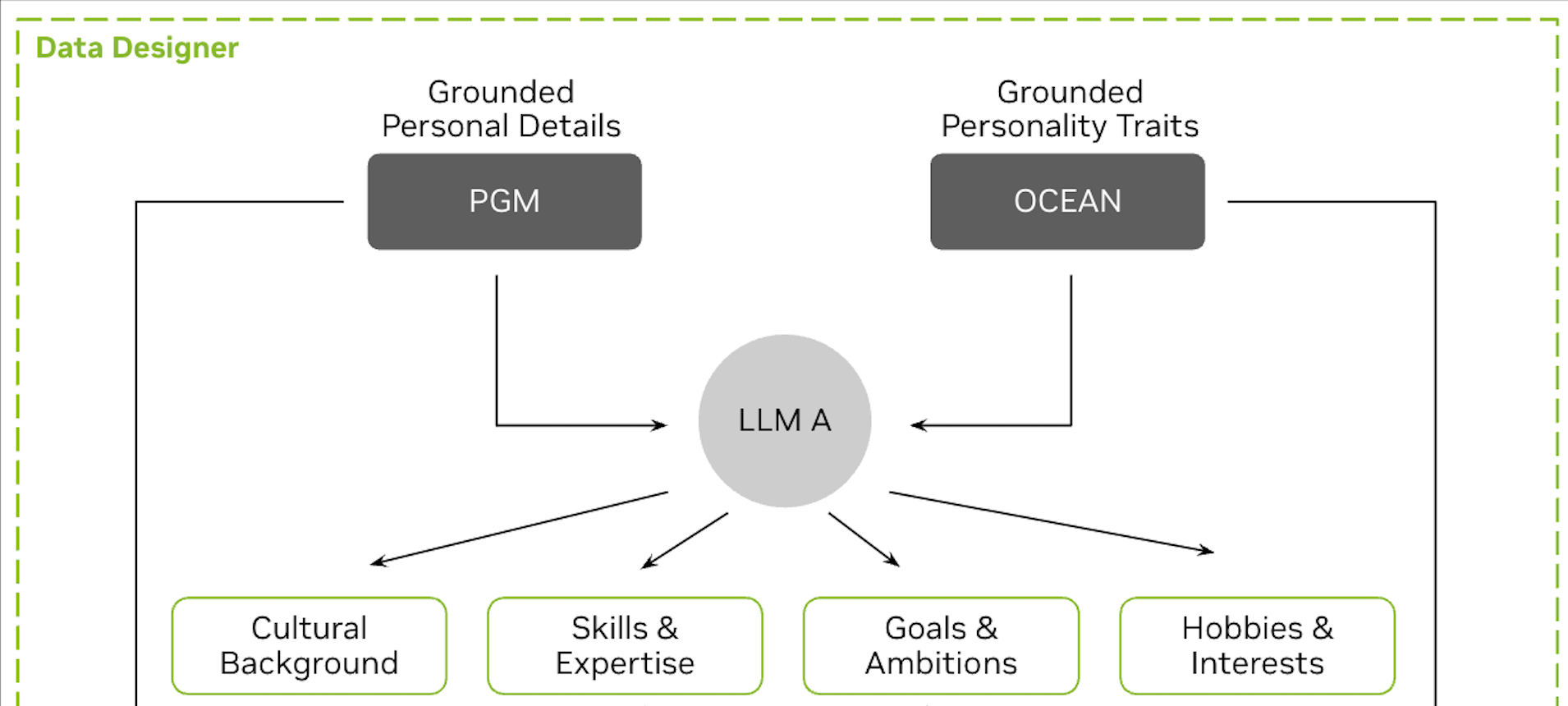
Stage 3: a single LLMStructuredColumnConfig call materializes six persona-attribute fields (cultural background, skills, career goals, hobbies, plus list variants) from the PGM + OCEAN seed.
The system prompt forces internal consistency (“attributes that are internally consistent and logically connected to the base persona details”), cultural sensitivity (“avoid stereotypes while acknowledging cultural influences”), and specificity (“create specific, detailed responses rather than generic ones”). Pydantic schema enforcement means every record’s attributes parse cleanly downstream.
Stage 4: Persona descriptions
The final stage is a second structured-output LLM call that synthesizes everything above into nine cohesive persona descriptions: professional_persona, finance_persona, healthcare_persona, sports_persona, arts_persona, travel_persona, culinary_persona, concise_persona, and a paragraph-length detailed_persona.
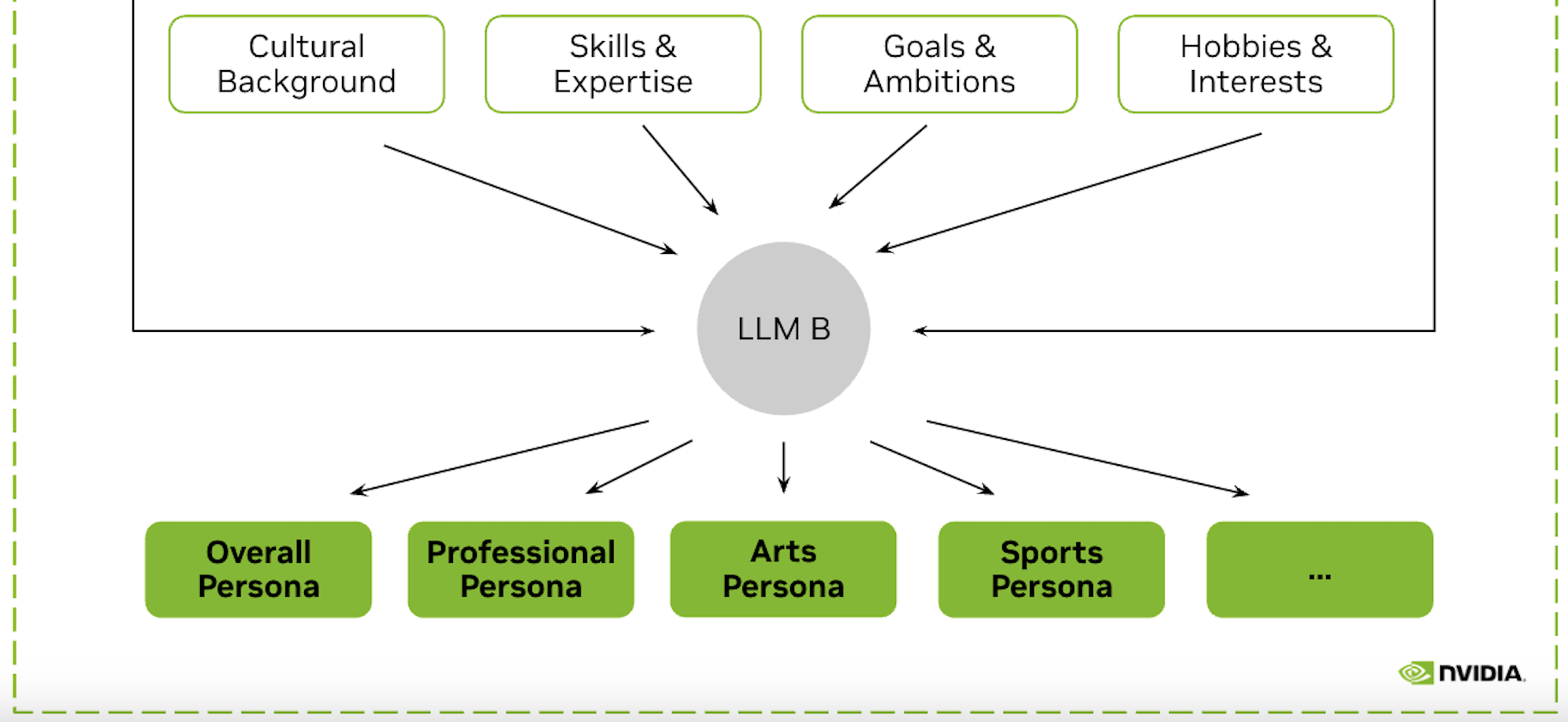
Stage 4: a second structured-output LLM call synthesizes nine cohesive persona descriptions spanning professional, finance, healthcare, lifestyle, and creative dimensions.
The system prompt contains explicit guardrails: include the name in every description, never directly mention cultural heritage (infuse it implicitly through practices and traditions), and always take age into account. The LLM does the synthesis; Pydantic does the validation; Data Designer’s DAG executes the whole thing in parallel across millions of records.
Building your own: the customization story
The released artifact is the general-purpose collection. In practice, most downstream pipelines that use these personas extend them in some way. NeMo Data Designer makes that trivial: the same LLMStructuredColumnConfig + ExpressionColumnConfig pattern that builds the released schema can be used to layer on any custom dimension you need.
The accompanying companion Colab notebook walks through a concrete example. After reproducing the released schema with a PersonSampler against the NGC-hosted dataset, the notebook adds a custom tech_persona dimension with two new fields: a prose description of the persona’s relationship with technology, plus a list of specific tech tools they use:
A representative output from the Colab run:
A few lines of Pydantic + one LLM column + a couple of expression columns and the released schema picks up two brand-new domain-specific fields. The same pattern scales: a healthcare provider extends with medical_history_persona and insurance_persona; a media company extends with media_consumption_persona and subscription_stack; a financial-services team extends with investment_persona and risk_tolerance_persona. The PGM-grounded base record stays the seed; everything else is one schema away.
Going deeper: build a brand-new locale
For locales without an NGC-hosted Nemotron-Personas dataset, the build path is open. The OCEAN Big-Five helpers ship in the companion Colab notebook (Stage 1 of the original pipeline), and NeMo SDG-PGMs provides the framework for building your own demographic PGM (Stage 2) — collect aggregate statistical distributions, declare a PGMGenerator subclass (the us_person example is a working blueprint), and plug it into Data Designer via SDG-PGMs’s PGMGeneratorPluginConfig column generator. The downstream LLM stages (3 and 4) are locale-agnostic; they just need the right language in the prompts. The notebook leaves a SAMPLE_FROM_SDG_PGM = True toggle in place as the integration point.
Try it yourself
The companion Colab notebook covers every detail in this post end-to-end, from the NGC dataset bootstrap through the toy custom-persona example.

Switching locales is a one-liner: change personas_locale = "en_US" to any of en_IN, en_SG, fr_FR, hi_Deva_IN, hi_Latn_IN, ja_JP, ko_KR, pt_BR (and run data-designer download personas --locale <code> once for the new locale). Everything downstream stays the same.
Closing thoughts
The headline number on the Nemotron-Personas HF collection is the persona count, but the real story is that a single, modular, locale-adaptable pipeline produces seed material that recurs throughout Nemotron’s training stack. Long-context construction, tool-use rollouts, formal-logic variability, safety refusals, instruction-following data — all of them lean on the same underlying primitive. Building the right primitive once means many downstream pipelines stop being one-off projects.
If you’re building region-specific synthetic data for your own model, the path is clear: take a locale’s released artifact, layer your domain-specific dimensions on top with a few lines of Data Designer config, and you have a custom dataset that inherits all the demographic grounding the original artifact carries.
Key Resources:
- Nemotron-Personas HF collection: huggingface.co/collections/nvidia/nemotron-personas
- NeMo Data Designer: github.com/NVIDIA-NeMo/DataDesigner
- NeMo SDG-PGMs: github.com/NVIDIA-NeMo/SDG-PGMs
- Nemotron 3 Super Technical Report: research.nvidia.com/labs/nemotron/…/NVIDIA-Nemotron-3-Super-Technical-Report.pdf
- Person Sampling in Data Designer: Person Sampling concept docs
- Related dev notes: Designing Data Designer: Why SDG Is a Systems Problem, Engineering an Enterprise-Grade Text-to-SQL Dataset, Push Datasets to Hugging Face Hub
Want to learn more about NeMo Data Designer? Check out our documentation and start building your own region-specific synthetic persona datasets today.