


Overview#
pyAerial is a Python library of physical layer components that can be used as part of the workflow in taking a design from simulation to real-time operation. It helps with end-to-end verification of a neural network integration into a PHY pipeline and helps bridge the gap from the world of training and simulation in TensorFlow/PyTorch to real-time operation in an over-the-air testbed.
The pyAerial library provides a Python-callable bit-accurate GPU-accelerated library for all of the signal processing CUDA kernels in the NVIDIA cuPHY PDSCH and PUSCH pipelines. The pyAerial Python classes behave in a numerically identical manner to the kernels employed in cuPHY because a pyAerial class employs the exact same CUDA code as the corresponding cuPHY kernel: it is the CUDA kernel but with a Python API.
Using pyAerial library components complete layer-1 pipelines can be composed in Python. User code or inference engines, from NVIDIA TensorRT, or custom CUDA code, can be included in the datapath as shown in the lower part of Figure 1. This rapid prototyping design and verification flow is used for dataplane functional performance evaluation. It is a step in the workflow for verifying a physical layer design prior to deployment in a real-time over-the-air GPU base station.
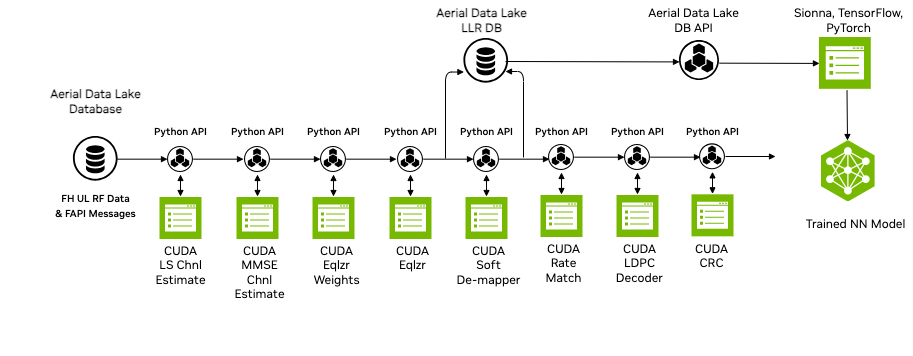
pyAerial can also be used in conjunction with Data Lake. A pyAerial pipeline can access samples from Data Lake database using the Data Lake Python APIs, and transform that data into training data for any function in the pipeline. Figure 2 illustrates data ingress from a Data Lake database into a pyAerial pipeline and using standard Python file I/O to generate training data for a soft de-mapper.
Key Features#
pyAerial has the following key features:
Feature 1: Productive Python for rapid prototyping of layer-1 pipelines
pyAerial library components are CUDA kernels with Python bindings. The productive environment of Python permits the rapid assembly of signal processing pipelines in Python. All of the analytic and visualization aspects of Python can be used for performance characterization, signal visualization and debugging.
Feature 2: Simulate machine learning in the physical layer before over-the-air operation
With the goal of going from model training and simulation in TensorFlow or PyTorch to real-time over-the-air operation, pyAerial provides a convenient way to verify, evaluate and benchmark your physical layer prior to deployment in an OTA testbed.
Feature 3: Fast simulation with CUDA optimized kernels
pyAerial library components are CUDA under the hood. Simulation is fast on a GPU. When you are simulating the coding chain, including for example an LDPC decoder, optimized CUDA code is implementing these computationally heavy functions.
Feature 4: Generate data sets for any node in layer-1 uplink or downlink pipeline
pyAerial is designed to be used in conjunction with the NVIDIA data collection platform Data Lake. pyAerial can access RF samples in a Data Lake database and transform those samples into training data for all of the signal processing functions in and uplink or downlink pipeline. Refer to the Example: Training Data Generation Using pyAerial section for more details.
Feature 5: Bit accurate simulation
Because pyAerial is Python running on CUDA, the performance you observe in BLER and other characterization metrics is what is identical to the performance of the real-time over-the-air system.
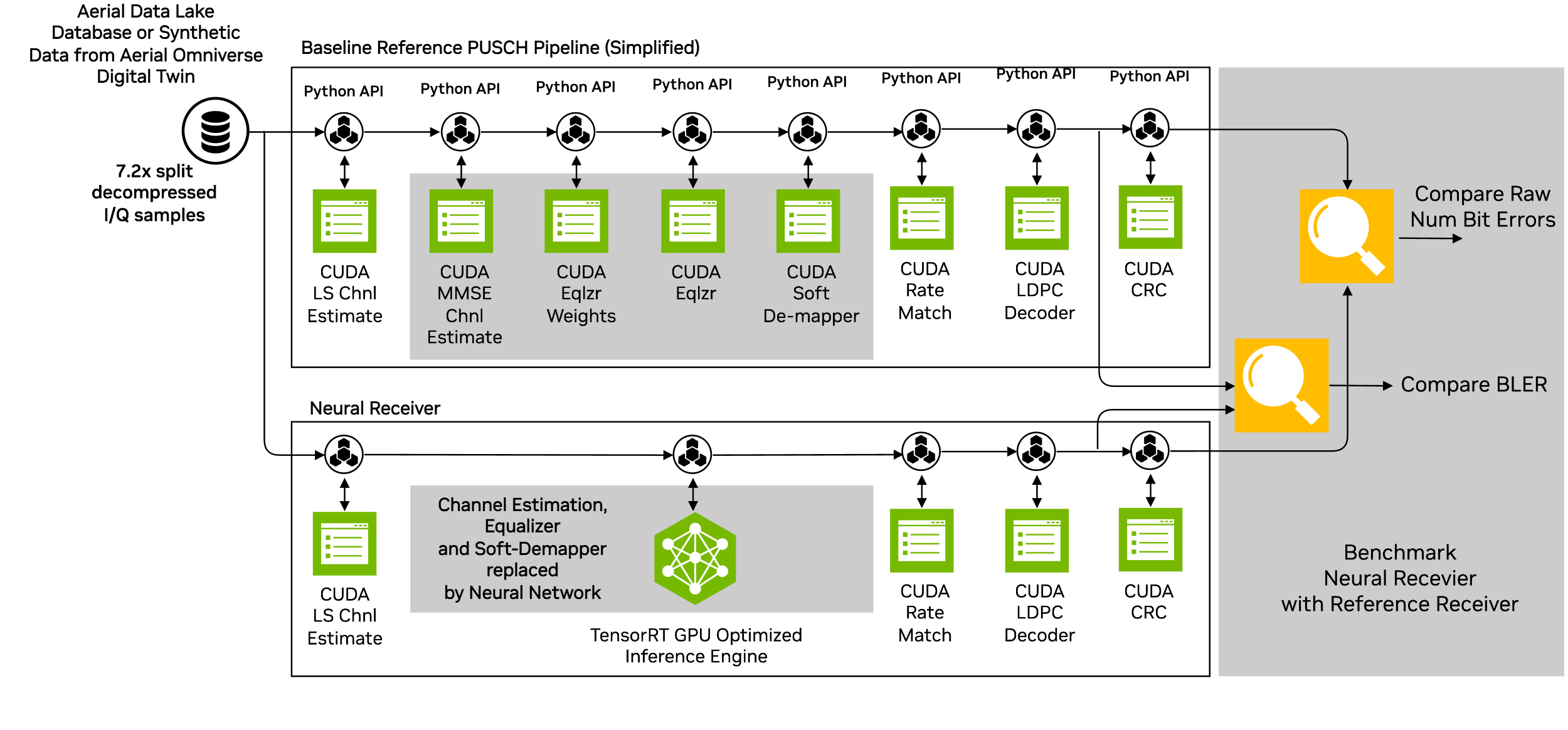
Figure 1: Using pyAerial to verify a neural pipeline context of a full uplink pipeline. This is one of the verification steps to moving to real-time operation over-the-air on a GPU base station.#
Release Notes#
Release version: 26-2
Installation simplified: pyAerial now runs inside the standard Aerial container (
run_aerial.sh) instead of a separately built container. CMake presets (pyaerial-x86/pyaerial-arm) replace manual toolchain flags, and thepyaerial_setuptarget creates and manages the Python virtual environment.
Release version: 26-1
Maintenance release: Bug fixes and small improvements