


1.3. The CUDA platform#
The NVIDIA CUDA platform consists of many pieces of software and hardware and many important technologies developed to enable computing on heterogeneous systems. This chapter serves to introduce some of the fundamental concepts and components of the CUDA platform that are important for application developers to understand. This chapter, like Programming Model, is not specific to any programming language, but applies to everything that uses the CUDA platform.
1.3.1. Compute Capability and Streaming Multiprocessor Versions#
Every NVIDIA GPU has a Compute Capability (CC) number, which indicates what features are supported by that GPU and specifies some hardware parameters for that GPU. These specifications are documented in the Section 5.1 appendix. A list of all NVIDIA GPUs and their compute capabilities is maintained on the CUDA GPU Compute Capability page.
Compute capability is denoted as a major and minor version number in the format X.Y where X is the major version number and Y is the minor version number. For example, CC 12.0 has a major version of 12 and a minor version of 0. The compute capability directly corresponds to the version number of the SM. For example, the SMs within a GPU of CC 12.0 have SM version sm_120. This version is used to label binaries.
Section 5.1.1 shows how to query and determine the compute capability of the GPU(s) in a system.
1.3.2. CUDA Toolkit and NVIDIA Driver#
The NVIDIA Driver can be thought of as the operating system of the GPU. The NVIDIA Driver is a software component which must be installed on the host system’s operating system and is necessary for all GPU uses, including display and graphical functionality. The NVIDIA Driver is foundational to the CUDA platform. In addition to CUDA, the NVIDIA Driver provides all other methods of using the GPU, for example Vulkan and Direct3D. The NVIDIA Driver has version numbers such as r580.
The CUDA Toolkit is a set of libraries, headers, and tools for writing, building, and analyzing software which utilizes GPU computing. The CUDA Toolkit is a separate software product from the NVIDIA driver
The CUDA runtime is a special case of one of the libraries provided by the CUDA Toolkit. The CUDA runtime provides both an API and some language extensions to handle common tasks such as allocating memory, copying data between GPUs and other GPUs or CPUs, and launching kernels. The API components of the CUDA runtime are referred to as the CUDA runtime API.
The CUDA Compatibility document provides full details of compatibility between different GPUs, NVIDIA Drivers, and CUDA Toolkit versions.
1.3.2.1. CUDA Runtime API and CUDA Driver API#
The CUDA runtime API is implemented on top of a lower-level API called the CUDA driver API, which is an API exposed by the NVIDIA Driver. This guide focuses on the APIs exposed by the CUDA runtime API. All the same functionality can be achieved using only the driver API if desired. Some features are only available using the driver API. Applications may use either API or both interoperably. Section The CUDA Driver API covers interoperation between the runtime and driver APIs.
The full API reference for the CUDA runtime API functions can be found in the CUDA Runtime API Documentation .
The full API reference for the CUDA driver API can be found in the CUDA Driver API Documentation .
1.3.3. Parallel Thread Execution (PTX)#
A fundamental but sometimes invisible layer of the CUDA platform is the Parallel Thread Execution (PTX) virtual instruction set architecture (ISA). PTX is a high-level assembly language for NVIDIA GPUs. PTX provides an abstraction layer over the physical ISA of real GPU hardware. Like other platforms, applications can be written directly in this assembly language, though doing so can add unnecessary complexity and difficulty to software development.
Domain-specific languages and compilers for high-level languages can generate PTX code as an intermediate representation (IR) and then use NVIDIA’s offline or just-in-time (JIT) compilation tools to produce executable binary GPU code. This enables the CUDA platform to be programmable from languages other than just those supported by NVIDIA-provided tools such as NVCC: The NVIDIA CUDA Compiler.
Since GPU capabilities change and grow over time, the PTX virtual ISA specification is versioned. PTX versions, like SM versions, correspond to a compute capability. For example, PTX which supports all the features of compute capability 8.0 is called compute_80.
Full documentation on PTX can be found in the PTX ISA .
1.3.4. Cubins and Fatbins#
CUDA applications and libraries are usually written in a higher-level language like C++. That higher-level language is compiled to PTX, and then the PTX is compiled into real binary for a physical GPU, called a CUDA binary, or cubin for short. A cubin has a specific binary format for a specific SM version, such as sm_120.
Executables and library binaries that use GPU computing contain both CPU and GPU code. The GPU code is stored within a container called a fatbin. Fatbins can contain cubins and PTX for multiple different targets. For example, an application could be built with binaries for multiple different GPU architectures, that is, different SM versions. When an application is run, its GPU code is loaded onto a specific GPU and the best binary for that GPU from the fatbin is used.
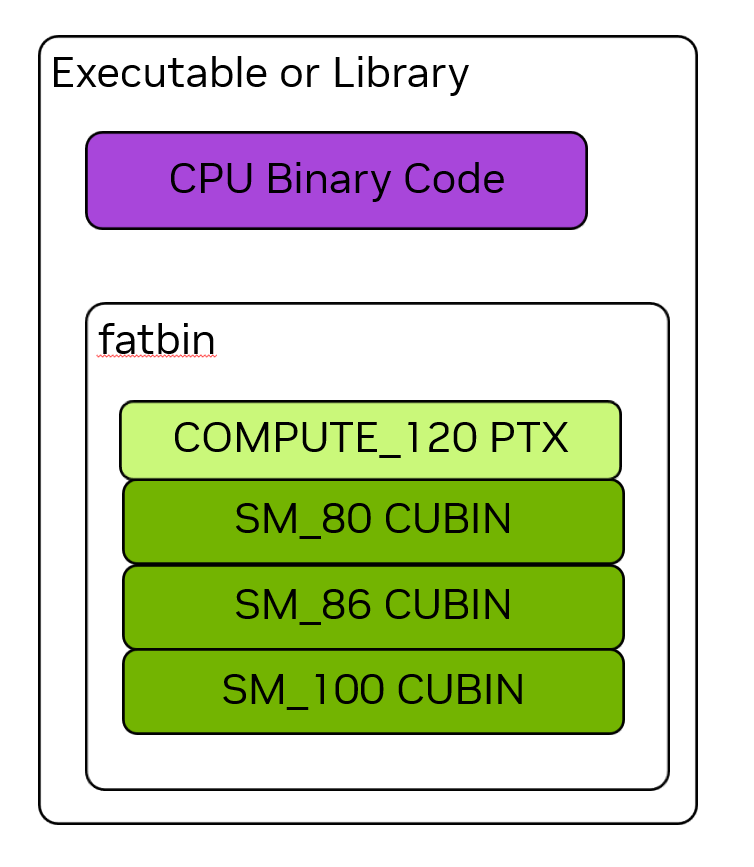
Figure 10 The binary for an executable or library contains both CPU binary code and a fatbin container for GPU code. A fatbin can contain both cubin GPU binary code and PTX virtual ISA code. PTX code can be JIT compiled for future targets.#
Fatbins can also contain one or more PTX versions of GPU code, the use for which is described in PTX Compatibility. Figure 10 shows an example of an application or library binary which contains multiple cubin versions of GPU code as well as one version of PTX code.
1.3.4.1. Binary Compatibility#
NVIDIA GPUs guarantee binary compatibility in certain circumstances. Specifically, within a major version of compute capability, GPUs with minor compute capability greater than or equal to the targeted version of cubin can load and execute that cubin. For example, if an application contains a cubin with code compiled for compute capability 8.6, that cubin can be loaded and executed on GPUs with compute capability 8.6 or 8.9. It cannot, however, be loaded on GPUs with compute capability 8.0, because the GPU’s CC minor version, 0, is lower than the code’s minor version, 6.
NVIDIA GPUs are not binary compatible between major compute capability versions. That is, cubin code compiled for compute capability 8.6 will not load on GPUs of compute capability 9.0.
When discussing binary code, the binary code is often referred to as having a version such as sm_86 in the above example. This is the same as saying the binary was built for compute capability 8.6. This shorthand is often used because it is how a developer specifies this binary build target to the NVIDIA CUDA compiler, nvcc.
Note
Binary compatibility is promised only for binaries created by NVIDIA tools such as nvcc. Manual editing or generating binary code for NVIDIA GPUs is not supported. Compatibility promises are invalidated if binaries are modified in any way.
1.3.4.2. PTX Compatibility#
GPU code can be stored in executables in binary or PTX form, which is covered in Cubins and Fatbins. When an application stores the PTX version of GPU code, that PTX can be JIT compiled at application runtime for any compute capability equal or higher to the compute capability of the PTX code. For example, if an application contains PTX for compute_80, that PTX code can be JIT compiled to later SM versions, such as sm_120 at application runtime. This enables forward compatibility with future GPUs without the need to rebuild applications or libraries.
1.3.4.3. Just-in-Time Compilation#
PTX code loaded by an application at runtime is compiled to binary code by the device driver. This is called just-in-time (JIT) compilation. Just-in-time compilation increases application load time, but allows the application to benefit from any new compiler improvements coming with each new device driver. It also enables applications to run on devices that did not exist at the time the application was compiled.
When the device driver just-in-time compiles PTX code for an application, it automatically caches a copy of the generated binary code in order to avoid repeating the compilation in subsequent invocations of the application. The cache - called the compute cache - is automatically invalidated when the device driver is upgraded, so that applications can benefit from the improvements in the new just-in-time compiler built into the device driver.
How and when PTX is JIT compiled at runtime has been relaxed since the earliest versions of CUDA, allowing more flexibility for when and if to JIT compile some or all kernels. The section Lazy Loading describes the available options and how to control JIT behavior. There are also a few environment variables which control just-in-time compilation behavior, as described in CUDA Environment Variables.
As an alternative to using nvcc to compile CUDA C++ device code, NVRTC can be used to compile CUDA C++ device code to PTX at runtime. NVRTC is a runtime compilation library for CUDA C++; more information can be found in the NVRTC User guide.
1.3.4.4. Binary Finalization#
Beginning with compute capability 10.0, intra-family binary compatibility is software-managed by the NVIDIA driver. Cubins for CC 10.0 and later architectures use a format which extends the binary representation to provide intra-family binary compatibility. A binary generated (finalized) for a specific target architecture may execute directly on the target architecture or may be re-finalized at runtime to any GPU which is guaranteed to have binary compatibility. Cubins for compute capability 9.x and earlier are not eligible for runtime re-finalization.
When a cubin for CC 10.0 or later which was generated for one target architecture is loaded on a different but compatible architecture in the same GPU family, the driver performs just-in-time finalization to bind the cubin to the architecture of the target GPU. This process is called off-target finalization.
Off-target finalization enables off-target execution, where a cubin finalized for one architecture runs on another compatible architecture in the same GPU family. Execution is considered on-target when the cubin is loaded on the architecture for which it was generated. No further finalization is required for on-target execution.
Just-in-time finalization for off-target execution should not be confused with PTX just-in-time compilation. PTX JIT compilation compiles PTX code to GPU binary code that is already finalized for the target architecture. Off-target finalization of a cubin re-finalizes an existing cubin for another compatible architecture. Off-target finalization is significantly less expensive than PTX JIT compilation, but it can still increase module load time relative to on-target execution.
The cost of off-target finalization depends on the amount of code being finalized, the host CPU resources available during module load, and the relationship between the source and target architectures. Applications that load large modules, or many modules, may observe increased startup time when cubins are finalized off-target.
As with PTX JIT compilation, the NVIDIA driver may cache the results of off-target finalization of cubins to avoid repeating finalization work in subsequent invocations of the application. The cache is controlled by the same CUDA cache environment variables described in Section 5.2.2.