

Safety Decision Maker (SDM)
A Safety Decision Maker (SDM) receives DecisionRequests from the
NvPSD Gateway and turns them into commands for the machine it
protects. It sends each command as a 64-byte UDP packet to a command endpoint: a PLC, a
controller, or one of the reference command receivers. When it detects a fault in the safety
path, it latches a safe state that only an operator can release.
SDM logic depends on the use case. Safety Core ships reference SDMs for two use cases. To write your own, follow Writing a decision maker. The latch causes and the release handshake are described in Safe-state model.
The diagram shows the structure of a reference SDM on the CCPLEX. The forklift safety function
(atl_sdm) is shown; the other reference SDMs share the structure.
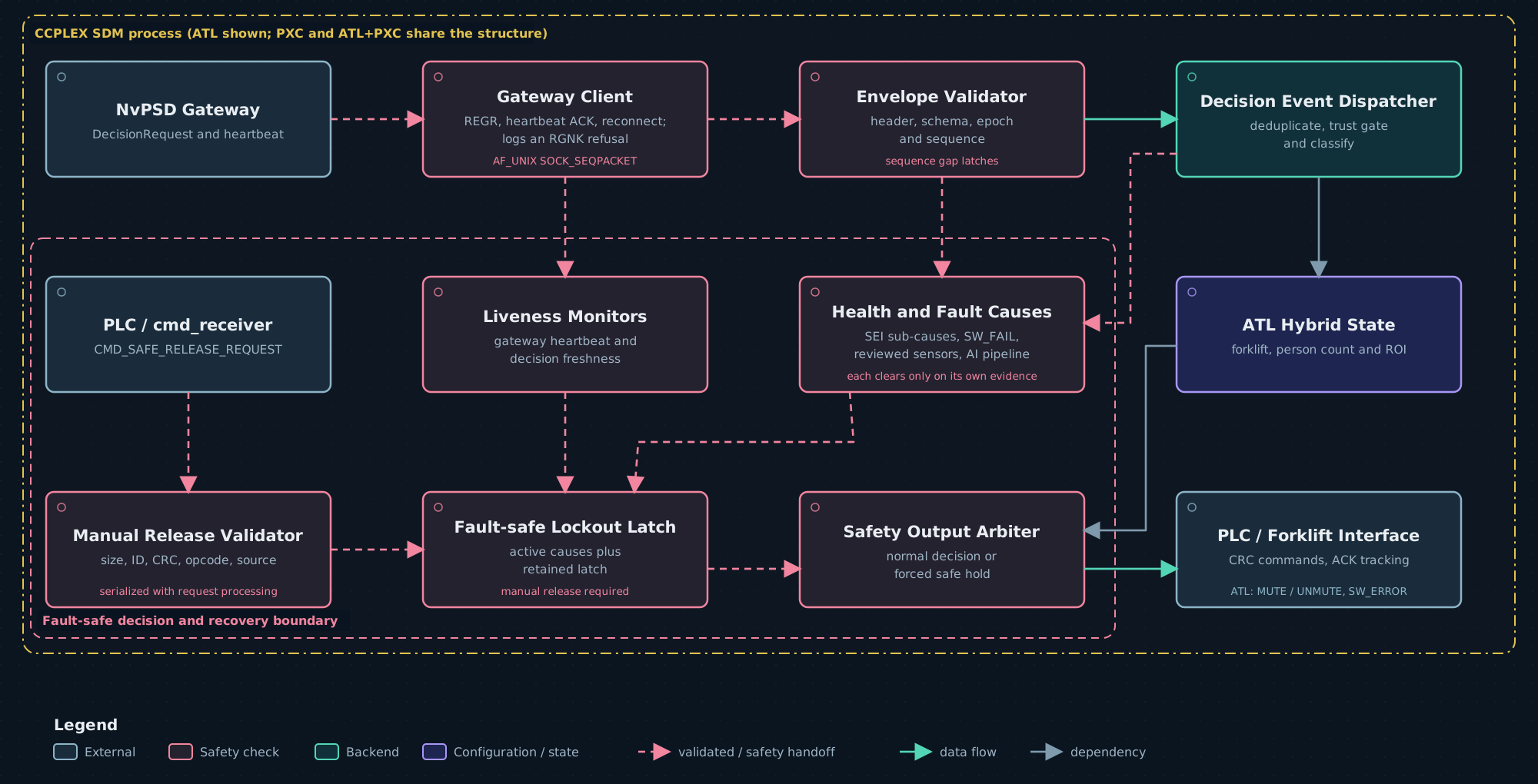
Reference decision makers
The Debian package installs each SDM with its command receiver under /opt/nvidia/psf/apps/atl/,
/opt/nvidia/psf/apps/proximity/ and /opt/nvidia/psf/apps/atl_proximity/. The configuration
templates are /opt/nvidia/psf/bin/atl_sdm_zone1.conf.sample, atl_sdm_zone2.conf.sample,
pxc_sdm_forklift.conf.sample and pxc_sdm_robots.conf.sample. The source of the SDMs and the
receivers is in the development package; see Install.
Running several SDMs
Up to 10 SDMs can register with one gateway. Each has its own subscription, command port, configuration and log, and each latches and is released on its own.
- Give one configuration (
--sdm-config) and one command port (--cmd-rx-port) per SDM, in--apporder. Two SDMs need different ports, and their configurations must not bind the same event.atl_dualruns twoatl_sdms for two zones. launch_hoisa.shstarts the SDMs on the host. The container entrypoint starts them inside the container, unless it is given--sdm-external. Both pass--decision_interval_ms 0,--hb_stale_ms 5000and--hb_period_ms 5500, and write each SDM’s log to/var/log/psf/(atl_sdm.log,pxc_sdm.log, or per-zone names for two SDMs of one type).- Multiple SDMs,
atl_dualandatl_proximityrun on the CCPLEX only.
All launcher options are in Launcher. The runner steps are in Custom deployment.
Behaviour common to the CCPLEX SDMs
Command line
atl_sdm and proximity_sdm take the same options, plus the Proximity Monitoring halo
options. Each option takes its value as a separate argument.
A missing --config prints error: --config is required and exits 1. Other bad values print
an error and exit with a non-zero status. atl_sdm treats the retired gateway options
(--gateway_ip, --gateway_port, --gateway_transport) as unknown and exits 1;
proximity_sdm accepts --gateway_ip and --gateway_port and ignores them.
Command packet
Every command and every acknowledgement is a packed 64-byte UDP packet. Multi-byte fields are in the host’s byte order.
An object record holds object_id (uint32), x, y, z (float) and metadata
(uint32, the object type). The CRC is CRC-32 with the reflected polynomial 0xEDB88320,
initial value 0xFFFFFFFF and final XOR 0xFFFFFFFF. The headers atl_cmd_pkt.h and
proximity_cmd_pkt.h in the development package define the packet and the CRC.
The reference receivers answer each command except CMD_HEARTBEAT with an acknowledgement:
the same sequence number and opcode, their own timestamp, the same object records and a new CRC.
The SDM logs a warning for a command that is not acknowledged within 3 s.
Forklift safety function (atl_sdm)
A forklift loads and unloads pallets in a trailer. Its safety function may be turned off (muted) only while the forklift is inside the trailer, nobody is in the trailer, and nobody is in the restricted ROI at the trailer gate. In every other case the safety function stays on. The scenario is described in Applications.
State. atl_sdm keeps three values, set by six bound events:
The mapping rules are in the shipped event_mapping_atl.pb.txt; see
Event mapping configuration. The second zone template,
atl_sdm_zone2.conf, binds EVENT_6 to EVENT_11.
Decision. On every change of state, atl_sdm sends:
CMD_MUTEwhen the forklift is in the trailer, the person count is 0 and there is no restricted-area violation;CMD_UNMUTEotherwise.
A person count that would exceed 10000, or a person exit while the count is 0, latches the safe
state. The safe hold is CMD_UNMUTE followed by CMD_SW_ERROR. It is sent when the latch is
entered and in place of every later decision while the latch is held. An accepted release resets
the forklift, person and ROI state.
Configuration file. The file has exactly the six keys above, each set once, as
key = value. # starts a comment, also after a value. Each value is an event from EVENT_0 to
EVENT_23, and the six must differ. SW_FAIL cannot be bound; it is always subscribed and
handled as a fault. The reviewed sensor set is not in this file; a safety_pipelines line is
rejected. Any error stops atl_sdm with error: --config <path>: <reason>.
Opcodes
Object record 0 carries the last forklift seen; object record 1 is zero.
Proximity Monitoring (proximity_sdm)
proximity_sdm slows or stops a machine when a person comes too close to it. The distance
thresholds are applied by the MDX client’s event mapping, which reports one of three events per
machine–person pair: no violation, warning or critical. proximity_sdm maps them to commands
and sends the worst one in each request:
In the shipped proximity_event_mapping.pb.txt, a pair at 1 m or closer is critical, a pair at
2 m or closer is a warning, and other pairs report no violation.
Configuration file. The file binds the three events of each pair group:
pair_groups = <group>[,<group>…]selects the groups. Every key of a selected group is required, and a key of an unselected group is an error.- Without
pair_groups, thehumanoid_person,forklift_personandtransporter_personkeys are required. - Values are
EVENT_0toEVENT_23and must all differ.
Opcodes
Object record 0 carries the machine and object record 1 the person.
Forklift–person proximity (atl_proximity_sdm)
atl_proximity_sdm runs beside atl_sdm when the container entrypoint is started with
--app atl_proximity; launch_hoisa.sh does not offer it. It subscribes to EVENT_8
(no violation), EVENT_9 (warning) and EVENT_10 (critical) from
event_mapping_atl_proximity.pb.txt, and uses the Proximity Monitoring packet and opcodes.
- It keeps up to 128 forklift–person pairs. Within a pair the newest report wins; across pairs
the worst tier wins. A pair expires after
--pair_ttl_ms(default 2000, range 200–60000). - It has no
--configand no--log_file; its log isatl_proximity_sdm.log. Its default--cmd_rx_portis12346, which must differ fromatl_sdm’s port. - Its receiver is
atl_proximity_sdm_cmd_receiver. The receiver’s default port is 12345, so start it with-pset to the SDM’s port.
Command receivers
atl_sdm_cmd_receiver and proximity_sdm_cmd_receiver are reference command endpoints. They
stand in for the machine’s controller: they check and acknowledge each command, show the
safe-state on the console, and let an operator release a latched safe state. The launchers do
not start them; run them on the controller side.
Packet handling. The receiver drops a packet that is not exactly 64 bytes, comes from
another sender, carries another identifier or fails its CRC. It does not check sequence numbers
or timestamps. It acknowledges every accepted command except CMD_HEARTBEAT.
Heartbeat watchdog. The SDM sends CMD_HEARTBEAT every 5 s. The receiver counts the first
miss 5 s after the last heartbeat and each further miss after another 5.5 s. At
--max_hb_failures misses, about 54.5 s with the default of 10, it prints
cmd_rx: upstream CMD_HEARTBEAT fault latched (tier 3) — local fail-safe, no PSS — stopping and
exits with status 0. The watchdog starts when the receiver starts, so a receiver whose SDM
never sends a heartbeat also exits after about 54.5 s. Restart the receiver after a restart of
its SDM.
Release. Writing release to the receiver’s standard input sends
CMD_SAFE_RELEASE_REQUEST. r, safe-release, y and yes work too. Input is ignored until
the SDM has sent CMD_SW_ERROR or a denial. Automated runs can echo release into the
receiver’s standard input or a FIFO.
Automatic release on first contact. 500 ms after the first valid packet from its SDM, the
receiver sends one release request on its own and prints
Startup: peer connected — sending safe-release to clear any pre-existing latch. The SDM checks
it like any other request: it is denied while a latch cause is active. With no latch held,
atl_sdm still answers and resets its forklift, person and ROI state, and atl_proximity_sdm
clears its pair table.
Console and log. The console shows the latch (*** FSI SAFE-STATE LATCHED ***, also for an
SDM on the CCPLEX), denials and the clear (>>> safe-state CLEARED <<<), and the release prompt.
Per-packet lines go to the log file.
Proximity Monitoring evaluation. proximity_sdm_cmd_receiver evaluates the commands it
received every 100 ms and applies the most conservative:
It prints each result as an [EVAL] Action: line on the console.
Known behaviour.
- The receivers acknowledge
SAFE_RELEASE_ACKandSAFE_RELEASE_DENIED. The SDMs do not accept those opcodes, so each release response addsSDM: dropping PLC packet with unsupported commandto the SDM log. It does not affect the safe state. - When the receiver cannot bind its port, it prints
Error binding socket: <error>, stops, and exits with status 0.
SDM on the FSI
On IGX Thor, the forklift safety function and Proximity Monitoring SDMs can run on the
Functional Safety Island (FSI) instead of the CCPLEX. The SEI daemon, the gateway and the MDX
client stay on the CCPLEX. fsicom-agent replaces the CCPLEX SDM binary: it registers with the
gateway, checks each request’s envelope and sequence, and forwards the request to the FSI over
NvFsiCom channel 6. It relays the FSI SDM’s command packets to the command receiver over UDP and
forwards release requests back. Its options are in
Launcher.
Packages and firmware. The psf-tegra-fsi package holds:
Setting up the FSI.
- Flash the IGX Thor BSP and the Safety Extension Package (SEP) on the target. Refer to the IGX Safety Extension Package documentation.
- On the host the target is connected to, extract the package:
dpkg -x psf-tegra-fsi.deb <extraction_path>. - Reflash the target’s FSI with the firmware for your application, from
<extraction_path>/opt/nvidia/psf/etc/fsi-fw/atl/or…/fsi-fw/proximity/. This replaces the default SEP firmware. - Reset or reboot the board, so the FSI boots the new firmware. Do this before starting the
platform’s
nvFsiComdaemon orfsicom-agent. - Start the platform’s
nvFsiComdaemon beforefsicom-agent. Without it,fsicom-agentstops after[INIT] Initializing FSI communication...and printsEnsure nvfsicom daemon is running.
With the launcher, select the FSI with launch_hoisa.sh --sdm-target fsi; it starts
fsicom-agent on the host. Under --runtime docker it starts the agent with the container user’s
group; see Host processes and the container’s group.
The steps for starting the Safety Core container directly are in
Custom deployment.
Differences from the CCPLEX SDMs.
Opcodes, sequence numbers, acknowledgements and the release handshake are the same as on the CCPLEX. The firmware checks the request schema version, so the firmware and the CCPLEX packages must come from the same release.