

NvPSD Gateway
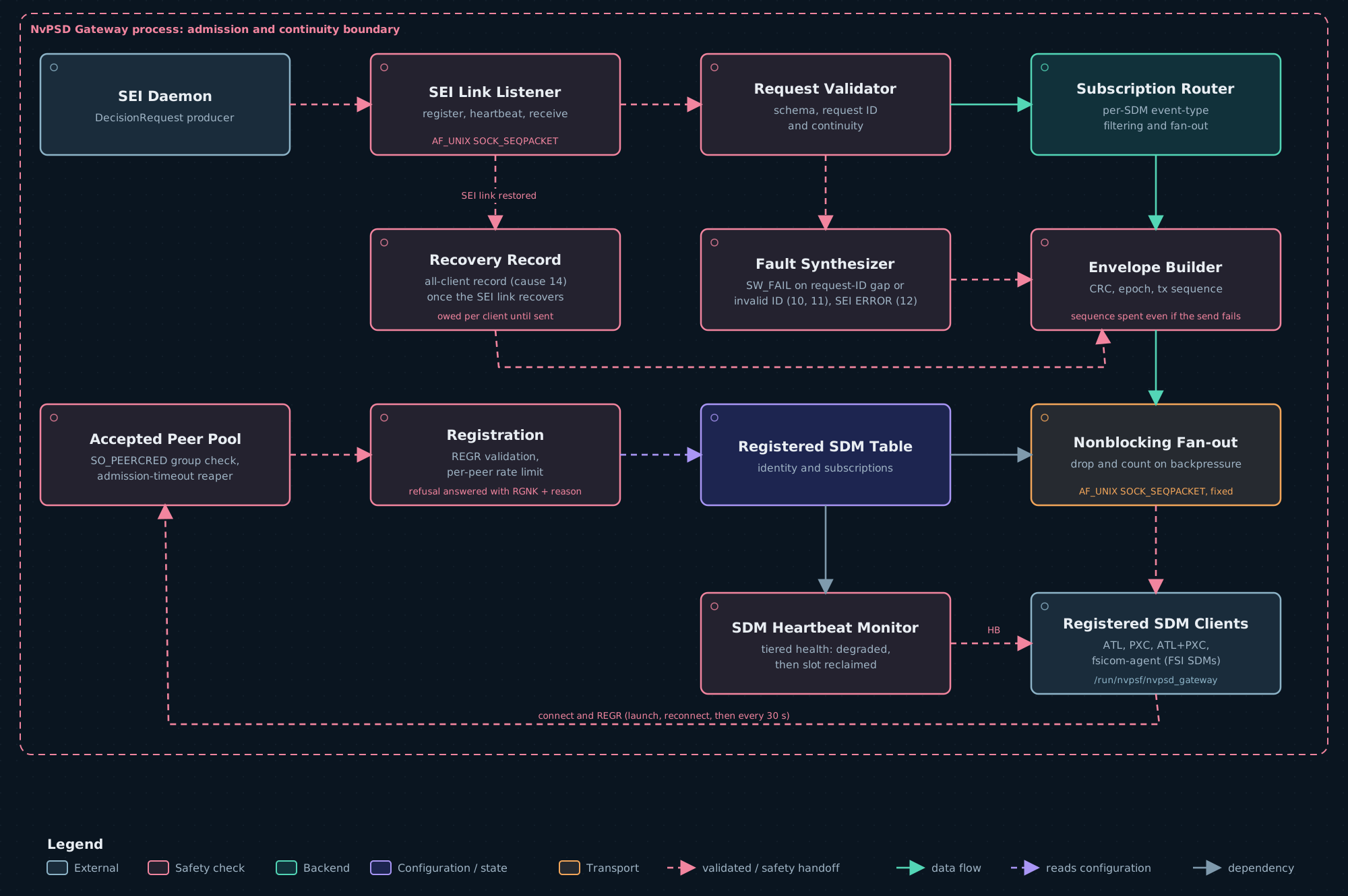
The NvPSD Gateway (nvpsd_gateway) sits between the SEI daemon and the decision makers. It
receives every DecisionRequest that SEI produces, checks that the requests arrive in sequence,
and forwards to each registered decision maker (SDM) the events that SDM subscribed to. It adds
fault records of its own when the SEI link misbehaves, and it supervises every SDM with a
heartbeat.
The gateway runs on the CCPLEX. Under the Docker runtime it runs inside the Safety Core
container; under --runtime host it runs on the host. Both launchers start it with no
arguments, so the defaults below always apply to a launcher deployment.
Links
Every gateway link is an AF_UNIX SOCK_SEQPACKET socket under /run/nvpsf. The paths are
compiled in and cannot be changed. The gateway opens no TCP or UDP port.
Both ends of every link check the other’s credentials with SO_PEERCRED. A connection is
accepted only when the peer’s primary GID equals the gateway’s own primary GID. A process
that holds the group only as a supplementary group is refused. Every Safety Core process must
therefore run with the same primary group; see
Shared process group.
The SDM link needs large kernel socket buffers. The gateway refuses to start when
net.core.rmem_max or net.core.wmem_max is too small; see
Kernel socket buffers.
Command line
All options are optional. Each takes its value as a separate argument (--num_clients 5);
the --num_clients=5 form is rejected as an unknown option.
A missing value prints error: <flag> requires a value. An out-of-range value prints an error
that names the accepted range. Any other option, including the retired --transport,
--sdm_socket, --sdm_ip, --sdm_port and --sdm_allow, prints
error: unknown option (see --help). In each case the gateway prints its usage and exits 1.
Startup
The gateway starts in this order:
- It connects to the SEI decision link. It tries 60 times, 500 ms apart (about 30 s). If every
attempt fails it logs
Failed to connect to nvpss_daemon on the PSS->PSD socketand exits 1. - It registers for every event type on the decision link. A failure exits 1.
- It registers with SEI as a client, again up to 60 times, 500 ms apart. If this fails the
gateway keeps running but sends SEI no heartbeats, and logs
NvPSSRegisterPSSClient failed after 60 attempt(s) — gateway will not send heartbeats to PSS. - It opens the SDM socket. This is the last step, so
/run/nvpsf/nvpsd_gatewaycan be absent for up to about a minute after the gateway starts. SDMs retry until it appears.
Opening the SDM socket fails, and the gateway exits 1, when:
/run/nvpsfdoes not exist (bind(<path>) failed). The gateway does not create the directory.- Another gateway is already listening on the path
(
bind(<path>) refused -- a LIVE server is already listening on this path). A stale socket file left by a stopped gateway is removed and the bind is retried. - The kernel socket buffers are too small (
SO_RCVBUF granted … raise net.core.rmem_max).
After the decision link is up, a lost link is retried every 500 ms without limit. The log shows
PSS->PSD link lost; reconnecting and then PSS->PSD link re-established.
Requests from SEI
The gateway validates the CRC and fields of every DecisionRequest it receives. A request that
fails validation is dropped without a response, so SEI’s retry budget applies.
It then checks the request ID against the previous one:
When a request reports SEI in ERROR mode, the gateway sends every SDM a SW_FAIL with cause
12 and then forwards the request, filtered by subscription. A gap in an ERROR request
produces the cause-12 record only.
The synthetic SW_FAIL records carry sensorIdentifier PSD_GATEWAY, severity CRITICAL
and status PASSTHROUGH. They go to every registered SDM whatever it subscribed to, except an
SDM in the degraded heartbeat tier. The cause values and their meaning are listed in
Causes and records.
Recovery record
A synthetic fault leaves every SDM that was registered at the time owed a recovery record. An
SDM that registers while any record is owed is owed one too. On the next request that is in
sequence and not in ERROR mode, the gateway sends each owed SDM a PSS_STATUS_NOOP with cause
14, mode NORMAL, severity OPERATIONAL, before forwarding the request.
- A record is paid only when the transport accepted it for that SDM. An SDM in the degraded heartbeat tier, or one whose send failed, stays owed until a later request.
- The record clears only the SDM’s gateway-communication sub-cause. A latched safe state still needs a manual release; see Safe-state model.
- When every owed SDM got its record, the log shows
PSS link recovered; recovery record delivered to every client that was owed one. Otherwise a warning says that some SDMs are still owed one.
Loss of SEI
The gateway sends SEI a heartbeat every 2 s. After each failed heartbeat it tries to register
with SEI again; a successful re-registration resets the count and logs
PSS re-registered after daemon restart. After --max_hb_failures consecutive failures it logs
PSS heartbeat ACK failure limit reached — PSS presumed dead and sends every SDM outside the
degraded tier a request with ID 4294967295, mode ERROR and no events. Its SEI heartbeat
then stops until the gateway restarts.
When the decision link itself drops, the gateway sends the SDMs nothing. The SDMs detect the silence through their decision-freshness timeout.
SDM admission and registration
An SDM connects to /run/nvpsf/nvpsd_gateway and then registers. Admission has two stages.
Stage one: connect. The transport refuses a connection when:
- the peer’s primary GID does not match (
peer credential is not in the allowed group); - all peer slots are taken. There are twice
--num_clientsslots, 20 by default (all <N> peer slots are occupied); - more than four connections per slot arrive in one second, 80 by default
(
endpoint connect rate exceeded).
A connected peer gets no client slot until it registers. A peer that has not sent a valid
registration within 5 s is disconnected (dropped a connection that never registered).
Stage two: register. The SDM sends a REGR message: the four bytes REGR, a one-byte
count, then that many event types as 32-bit integers in network byte order.
A refusal is answered with a 5-byte RGNK message: the four bytes RGNK and the reason byte.
The gateway logs registration refused with the reason. A successful registration gets no
reply; the first heartbeat is the confirmation, because heartbeats go only to registered SDMs.
The gateway logs registered client <slot> (<n> event types).
Subscriptions
- Requested types from
EVENT_0up toSW_FAILare kept. Of the types above that range, onlySENSOR_INVALID,SENSOR_VALID,AI_PIPELINE_INVALIDandAI_PIPELINE_VALIDare kept. Other values are dropped without an error. - Once at least one requested type is kept, the gateway adds six mandatory types:
SW_FAIL,PSS_STATUS_NOOP,SENSOR_INVALID,SENSOR_VALID,AI_PIPELINE_INVALIDandAI_PIPELINE_VALID. Every SDM therefore receives the status no-ops, the sensor and AI-pipeline trust reports and everySW_FAIL. - A new registration from an already registered SDM replaces its subscription set and resets its missed-heartbeat count. It keeps the SDM’s epoch and sequence, so no gap appears.
- The reference SDMs send their registration again every 30 s.
Fan-out and envelope
For each request, the gateway builds one copy per registered SDM. The copy holds only the events that SDM subscribed to, in their original order. A copy with no events is not sent. The only request ever sent with no events is the one that reports the loss of SEI.
Each copy is wrapped in an envelope:
The header fields are in host byte order. requestId inside the request keeps SEI’s ID.
- The sequence number is allocated before the send. A send that fails has still spent its number, so the SDM sees a gap and latches. The gap is the SDM’s evidence that a request did not arrive.
- Sends never block. When an SDM’s socket buffer is full, the request is dropped and counted,
and the gateway logs
DecisionRequest dropped, consumer not keeping up seq=…, drops=…. There is no retry. - An SDM in the degraded heartbeat tier is skipped before a sequence number is allocated, so the requests it misses leave no gap.
How an SDM must check the envelope and sequence is described in Writing a decision maker.
SDM heartbeat supervision
The gateway sends each registered SDM HBPG followed by a 32-bit sequence number in network
byte order (8 bytes). The SDM must reply HBPC with the same sequence number. Only a reply with
a newer sequence number resets the SDM’s missed count.
Each heartbeat cycle waits 2 s, sends, then waits 1.3 s before it checks for replies, so one
cycle takes about 3.3 s. With M = --max_hb_failures and W = M / 2 rounded down:
With the default M of 10, the warn tier covers misses 1–5, the degraded tier 6–9, and the slot
is reclaimed at the tenth miss, about 33 s after the last reply. With M = 1 the first miss
reclaims the slot; with M = 2 there is no degraded tier. An SDM that disconnects is reclaimed
the same way (reclaimed (peer disconnected)).
Logs
The gateway writes to syslog with the tag nvpsd_gateway or NVPSB_PSD_CLIENT. Transport
diagnostics, such as a GID mismatch or a socket-buffer shortfall, go to standard error. Where
both land is described on Safety Black Box (SBB).