

Prove the Physical Rehearsal#
Mission connection: Static validation establishes that the selected assets satisfy their declared contracts. The scene is not ready for deployment until runtime evidence also shows that those assets interact correctly when composed into the full rehearsal. Your animation and FX dailies instincts transfer directly: hold inputs constant, compare runs, inspect motion, contact, and settling, and require telemetry and a persistent report alongside the rendered frame.
Second Drop Test: Give the World Its Rules#
You repaired the missing SimReady requirements. The corrected asset outputs now contribute prims with rigid-body and collider schemas:
A rigid body identifies a prim that can participate in simulated motion.
A collider defines the surface the solver can contact.
A
PhysicsScenedefines the shared physical environment those bodies inhabit.
The last piece is still missing. The attic does not yet contain an explicitly authored PhysicsScene.
A PhysicsScene is an OpenUSD prim that records scene-wide simulation rules, including the direction and strength of gravity. Without it, the individual assets may be valid, but the composed rehearsal has no explicit, reviewable contract for the world they are expected to behave within. Relying on unstated runtime defaults would make the result difficult to reproduce or trust.
In this mission, you’ll compose the corrected assets into a new, nondestructive physics stage and author its PhysicsScene in a deployment-owned layer. You’ll then repeat the drop test while preserving the same starting pose, pod placement, timestep, and duration. By changing only the missing scene-level physics contract, you can connect any new behavior to that authored change.
When you press Play, ovphysx advances the simulation using the PhysicsScene and the physical properties authored on the prims. ovrtx renders each resulting scene state, while ovstream returns the video and authoritative telemetry to the browser.
A convincing fall is not enough. The evidence must show that the Memory Cube:
moves under the authored gravity;
passes through C-9’s open top;
contacts its physical floor and walls;
settles inside the acceptance region;
produces advancing time, step, and pose telemetry; and
can repeat the result from the same inputs.
This is where your 3D expertise matters. Stage scale, up axis, coordinate frames, collision boundaries, object placement, and layer ownership determine whether the simulation represents the intended physical world. The agent can author the requested PhysicsScene, but you define what a coherent and trustworthy world should mean.
Decide Before You Build#
Your call — what makes the composed world trustworthy? A convincing fall is not evidence. Before you build the physics stage, decide the scene-level contract that makes the rehearsal reproducible (gravity, up axis, scale) and the runtime evidence beyond the visual you require.
Author your brief. This is the last guided brief before your open build, so you own the most here: sanity-check the Skills route and author both Context and Done when. A worked example you can adapt:
Skills (your check):      confirm the brief points the agent at the ovphysx basic-workflow
                          and prim-transform-safety references before it authors the scene.
Context (your addition):  Z-up, centimeter metrics, one enabled PhysicsScene with gravity;
                          the pod stays open-top with at least 32 units of opening radius.
Done when (your addition): on my Play click the cube passes through the open top, contacts
                          the floor and walls, settles in the acceptance region, and the run
                          is reproducible with a persistent OVD report.
Carry those decisions into the Prompt Builder below, then judge the runtime evidence against them.
Runtime Evidence#
The Physics Rehearsal section reports:
nonzero rigid-body count;
simulation time and step count;
finite cube pose;
contact state or count;
containment result;
PASSorERRORstatus; anda path or link to the OVD report.
The OVD report is the persistent proof that lives beside the rendered frame. A convincing picture is not evidence; the telemetry and report are what a robotics team can review and reproduce.
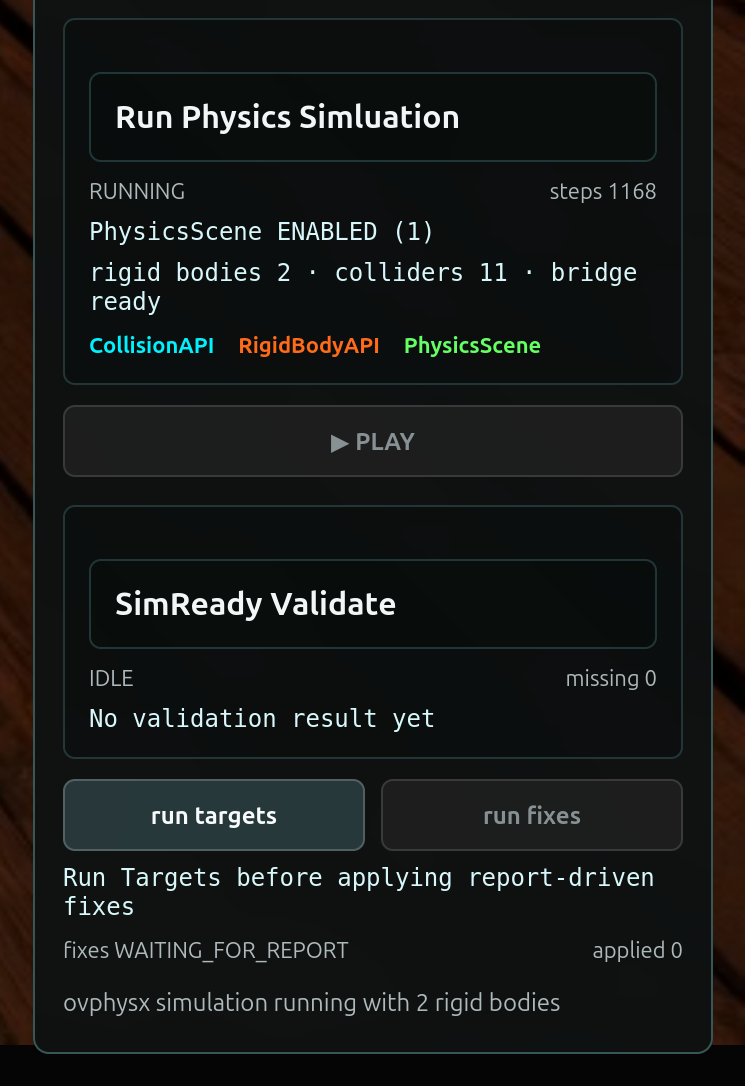
Validate: Runtime Proof Captured#
Before you move on, confirm you can answer:
Does the scene report one
PhysicsScene, two rigid bodies, and the expected collider count with the pod open at the top?When you press Play, does the cube fall under gravity, pass through the open top, contact the floor and walls, and settle inside the acceptance region?
Does the panel produce advancing time, step, and pose telemetry plus a linked OVD report?
Can you repeat the result from the same inputs?
When a Run Doesn’t Match#
If a check fails, find the first boundary to inspect:
Symptom |
First boundary |
|---|---|
The cube falls during the build or automated verification |
physics ran too early - the cube must fall only on your Play click |
Play is disabled or |
no |
The cube falls but never contacts the pod floor |
scale, up-axis, or collider mismatch - confirm Z-up, centimeter metrics, and the open-top colliders |
With runtime proof captured, we’ll interact with the live world and package the workflow in Pick Up the Physical World.