

Multi-Token Prediction (MTP)#
Overview#
Multi-Token Prediction (MTP) is an advanced training technique introduced in the DeepSeek-V3 Technical Report that enables models to predict multiple future tokens simultaneously during pre-training. Instead of learning to predict only the next token at each position, MTP adds auxiliary prediction heads that predict tokens 2, 3, or more positions ahead.
Key Benefits#
Densified Training Signals: Multiple learning signals per training iteration improve data efficiency
Pre-Planning Representations: Models learn internal representations that encode information about future tokens
Speculative Decoding Foundation: MTP-trained models can serve as foundation for faster inference via speculative decoding
When to Use MTP#
MTP is most beneficial for:
Large-scale pre-training (models > 10B parameters)
Data-constrained scenarios where maximizing learning from limited data is critical
Training foundation models intended for downstream fine-tuning or speculative decoding
MTP is primarily used for pre-training.
Additional Resources#
DeepSeek-V3 Technical Report - Original paper introducing MTP
DeepSeek-V3 GitHub - Official implementation
Megatron Core MTP Guide - Low-level implementation details
Configuration Parameters#
MTP is controlled by two primary parameters:
Parameter |
Type |
Default |
Description |
Typical Range |
|---|---|---|---|---|
|
int |
|
Number of auxiliary prediction depths. Each layer predicts tokens N positions ahead (N=1,2,…,mtp_num_layers). |
1-2 |
|
float |
|
Weight applied to MTP losses relative to main next-token loss. Controls the contribution of auxiliary predictions to the total loss. |
0.05-0.2 |
Loss Calculation#
The total training loss combines the main next-token prediction loss with averaged MTP losses:
total_loss = main_loss + (avg_mtp_loss * mtp_loss_scaling_factor)

where:
  avg_mtp_loss = mean([mtp_1_loss, mtp_2_loss, ..., mtp_N_loss])
Parameter Tuning Guidelines#
mtp_num_layers:
Start with
1for most models (predicts 1 token ahead)Use
2for models > 100B parameters if memory allowsHigher values increase memory usage and training time proportionally
mtp_loss_scaling_factor:
Default
0.1works well for most modelsIncrease to
0.15-0.2if MTP losses aren’t decreasingDecrease to
0.05-0.08if main loss is being overshadowedScale factor should be proportional to
mtp_num_layers(more layers → lower factor)
Basic Usage: Training from Scratch#
Minimal Configuration Example#
Here’s a minimal example using the Qwen3 30B-A3B recipe with MTP enabled:
from megatron.bridge.recipes.qwen.qwen3_moe import qwen3_30b_a3b_pretrain_config
from megatron.bridge.training.pretrain import pretrain
from megatron.bridge.training.gpt_step import forward_step
from megatron.bridge.training.config import ConfigContainer

log_dir = "/path/to/log/dir"
cfg: ConfigContainer = qwen3_30b_a3b_pretrain_config()
cfg.logger.tensorboard_dir = log_dir + "/tb_logs"
cfg.checkpoint.save = log_dir + "/checkpoints"
cfg.checkpoint.load = log_dir + "/checkpoints"
# Set up training dataset
cfg.dataset.blend=[[
    f"/path/to/dclm/preprocessed/dclm_{i:02d}_text_document"
    for i in range(1, 11)
], None]
cfg.dataset.split="9999,8,2"
cfg.dataset.path_to_cache = "/path/to/cache"
# cfg.model.num_layers = 8  # train a smaller model if OOM
# MTP Configuration
cfg.model.mtp_num_layers = 1
cfg.model.mtp_loss_scaling_factor = 0.1
pretrain(cfg, forward_step)
Follow the DCLM Tutorial to prepare the training data
MTP with Pipeline Parallelism#
By default, Bridge recipes place MTP layers in the last pipeline stage alongside the loss computation layer. Recent Megatron Core versions also support placing all MTP layers in a standalone stage before the final loss stage by setting pipeline_model_parallel_layout with m entries.
Pipeline Layout Guidelines#
MTP layers take approximately the same training time as a regular transformer layer. When configuring your pipeline layout:
Use
minpipeline_model_parallel_layoutfor MTP layers.Keep all MTP layers in the same PP/VPP stage.
Place MTP after decoder layers and before the final loss stage.
For standalone MTP, place an
mstage on a non-final pipeline rank and putLin the final stage, for example"E|t*3|(t|)*3tt|m|L".For colocated MTP, keep
mwithLin the last stage, for example"E|t*3|(t|)*5mL".
DeepSeek-V3 recipes include a helper for the common layouts:
from megatron.bridge.recipes.deepseek import (
    deepseek_v3_pretrain_config,
    set_deepseek_v3_pipeline_model_parallel_layout,
)

cfg = deepseek_v3_pretrain_config()
set_deepseek_v3_pipeline_model_parallel_layout(cfg.model, mtp_standalone=True)
Parallelism Support#
MTP is compatible with all major parallelism strategies in Megatron-Bridge:
Parallelism Type |
Support Status |
Notes |
|---|---|---|
Tensor Parallelism (TP) |
✅ Fully Supported |
MTP layers are automatically sharded across TP ranks |
Pipeline Parallelism (PP) |
✅ Supported with Layout Constraint |
MTP is colocated with loss by default, or can use a standalone |
Expert Parallelism (EP) |
✅ Fully Supported |
Works with MoE models (DeepSeek-V3, Mixtral, etc.) |
Context Parallelism (CP) |
✅ Fully Supported |
MTP supports long-context training via CP |
Data Parallelism (DP) |
✅ Fully Supported |
Standard data parallelism works transparently |
Monitoring MTP Training#
Per-Layer Loss Logging#
During training, you’ll see losses for each MTP depth logged separately:
iteration 100/ 300000 | consumed samples: 3200 | elapsed time per iteration (ms): 3738.6 | learning rate: 6.000000E-05 | global batch size: 32 | lm loss: 7.968678E+00 | load_balancing_loss: 1.329517E+00 | mtp_1 loss: 7.925096E+00 | loss scale: 1.0 | grad norm: 1.040 | number of skipped iterations: 0 | number of nan iterations: 0 |
Interpreting Loss Values#
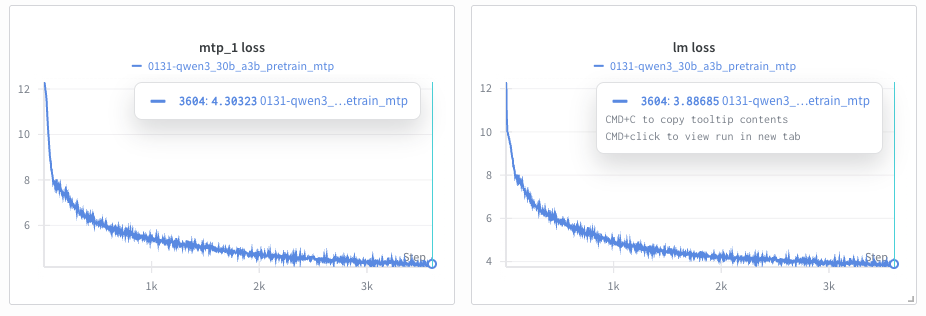
The figure above shows typical training curves for MTP-enabled training:
Left: MTP auxiliary loss (
mtp_1 loss) tracking the first additional token predictionRight: Main language model loss (
lm loss) for standard next-token prediction
Expected Patterns:
MTP losses are higher than main loss: Predicting tokens further in the future is inherently harder. In the example above,
mtp_1 loss(~4.3) is higher thanlm loss(~3.9) at 3500 iterations.All losses decrease over training: Both main and MTP losses should trend downward, as shown in the curves above.
Loss gap remains relatively stable: The difference between main and MTP losses should not grow significantly over training.
Red Flags:
NaN values: Indicates training instability (see Troubleshooting section)
Diverging losses: If MTP losses increase while main loss decreases, reduce
mtp_loss_scaling_factorWidening gap: If MTP losses fall behind by > 1.0, increase
mtp_loss_scaling_factor
MTP vs Non-MTP Comparison:
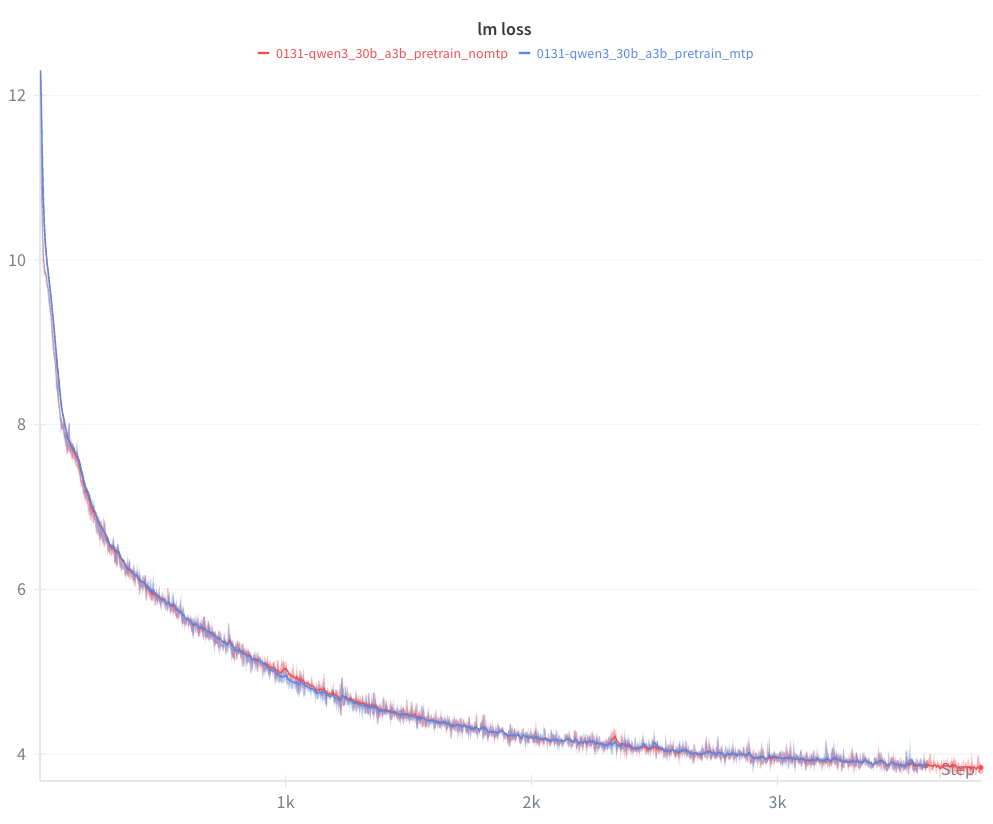
The figure above compares lm loss between MTP-enabled (blue) and non-MTP (red) training runs on Qwen3-30B-A3B. The curves do not differ significantly in the first few thousand iterations. Notably, the MTP-enabled run shows smoother behavior around iterations 1000 and 2300, where the non-MTP run exhibits more pronounced spikes.
TensorBoard/WandB Visualization#
MTP losses are automatically logged to TensorBoard and/or WandB. Look for:
lm loss- Main next-token prediction lossmtp_1 loss- First auxiliary prediction lossmtp_2 loss- Second auxiliary prediction loss (ifmtp_num_layers=2)
Training Characteristics#
MTP adds computational overhead due to additional forward passes
Memory usage increases proportionally to
mtp_num_layersMTP is designed to improve data efficiency during pre-training
Model Performance:
MTP provides additional training signals at each token position
Can potentially improve downstream task performance
MTP-trained models can be used for speculative decoding during inference
Current Limitations#
The following features are not yet supported with MTP:
Feature |
Status |
Workaround |
|---|---|---|
HuggingFace ↔ Megatron Checkpoint Conversion |
⚠️ Model-specific |
Conversion support varies by model; check model-specific documentation |
Sequence Packing (Fine-Tuning) |
❌ Not supported |
For pre-training, no issues. For fine-tuning, set |
Cross-Attention |
❌ Not supported |
MTP only works with decoder-only models (GPT, Llama, etc.) |
Learned Absolute Position Embeddings |
❌ Not supported |
Use RoPE (rotary position embeddings) or no position embeddings |
Block-Based Activation Recomputation |
❌ Not supported |
Use |
Important Notes#
Checkpoint Conversion:
HuggingFace ↔ Megatron checkpoint conversion with MTP is model-specific. Some models have conversion support planned, while others may not support MTP parameter mapping. Check the documentation for your specific model.
Sequence Packing:
MTP is incompatible with fine-tuning sequence packing (e.g., SFT with packed sequences). For pre-training, there are no sequence packing restrictions.
Troubleshooting Guide#
Error: Out of Memory (OOM)#
MTP increases memory usage proportionally to mtp_num_layers. Try:
Reduce
mtp_num_layersto 1Enable activation recomputation:
recompute_granularity="selective"Increase pipeline parallelism
Reduce micro batch size
Error: MTP Loss is NaN#
Training instability. Try:
Lower learning rate
Enable gradient clipping:
clip_grad=1.0Use BF16 instead of FP16
Reduce
mtp_loss_scaling_factorto 0.05
Expected Log: MTP layers not found on this PP rank#
This is normal. Only the rank selected by the pipeline layout builds MTP layers. With the default layout this is the last pipeline stage; with standalone MTP it is the stage containing m.
Additional Resources#
Code Examples#
DeepSeek-V3 Recipe:
src/megatron/bridge/recipes/deepseek/deepseek_v3.pyExample of MTP with large-scale MoE model
Predefined pipeline layouts for PP + MTP
Qwen3-Next Recipe:
src/megatron/bridge/recipes/qwen/qwen3_next.pyClean example of MTP configuration for dense models
Good starting point for custom recipes
MTP Core Implementation:
3rdparty/Megatron-LM/megatron/core/transformer/multi_token_prediction.pyLow-level MTP layer implementation
Loss computation and logging helpers
Documentation#
Megatron Core MTP Guide:
3rdparty/Megatron-LM/docs/user-guide/features/multi_token_prediction.mdImplementation notes and design decisions
Pipeline Parallelism Guide:
docs/parallelisms.mdUnderstanding pipeline parallelism layouts
Best practices for PP configuration
External Resources#
DeepSeek-V3 Technical Report: https://arxiv.org/abs/2412.19437
Original paper introducing MTP
Section 3.2: “Multi-Token Prediction”
Training details and ablation studies
DeepSeek-V3 GitHub: deepseek-ai/DeepSeek-V3
Official implementation and model weights
Training configurations and hyperparameters
Megatron-LM GitHub: NVIDIA/Megatron-LM
Upstream Megatron-Core implementation
Issues and discussions
Getting Help#
If you encounter issues not covered in this guide:
Check the Megatron-Bridge GitHub Issues
Review the Megatron-LM Discussions
When reporting issues, include:
Full training configuration (recipe and parameters)
Error messages and stack traces
GPU type and count
Megatron-Core version (
pip show megatron-core)