


HIL Architecture#
System architecture for the two-host Hardware-in-the-Loop (HIL) testing environment.
System diagram#
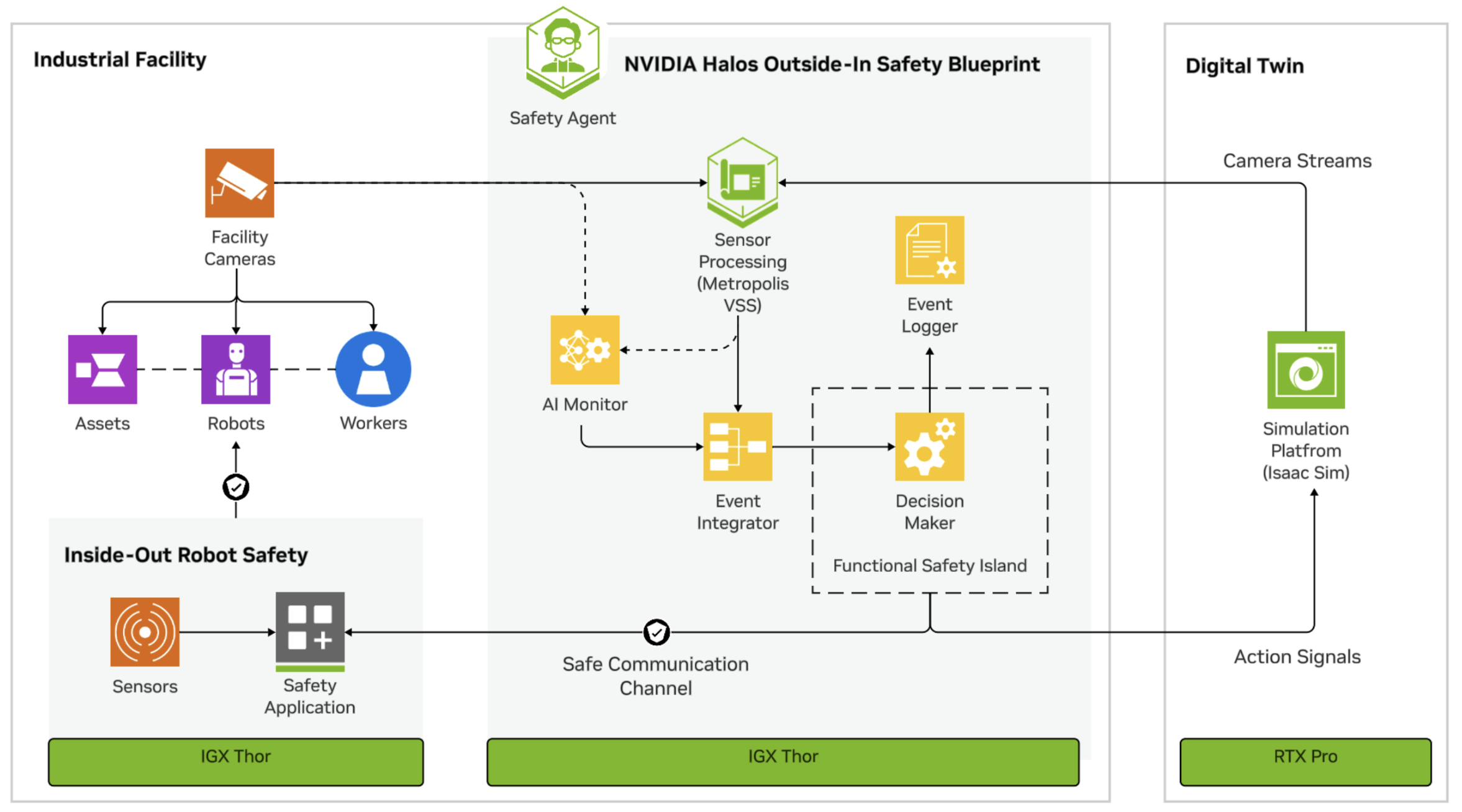
NVIDIA Halos Outside-In Safety architecture#
HIL exercises the digital-twin path on the right: Isaac Sim runs on the x86 stimulus host and supplies the camera streams, and the blueprint — perception, the monitors, and the Safety Core — runs on the IGX Thor and returns the safety decision. The facility and inside-out blocks are the production deployment the harness stands in for. The services and ports that path maps to are below.
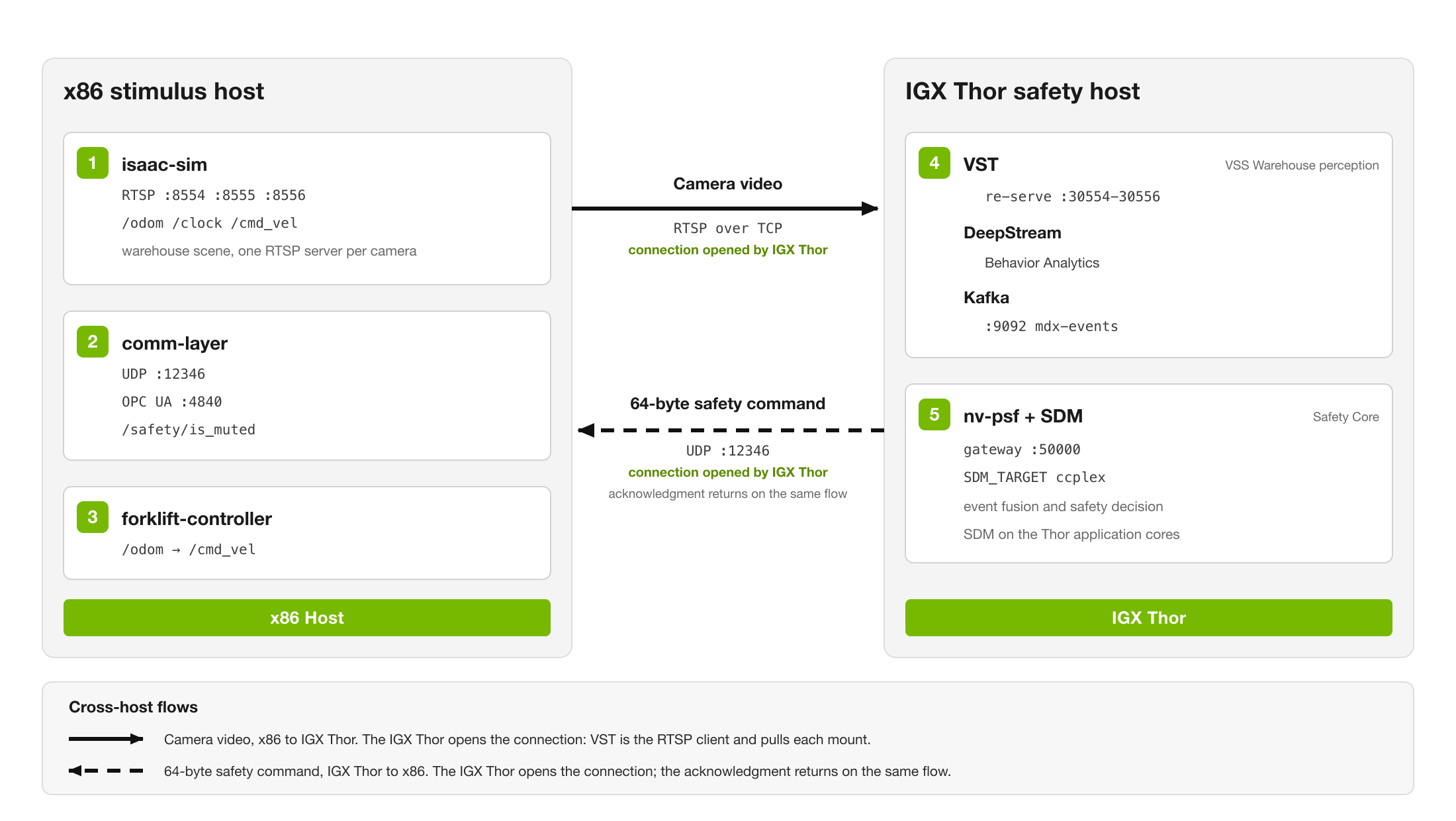
The two hosts and the two flows that cross between them. The numbers match the component sections below.#
Components#
1. Isaac Sim (x86)#
Built on nvcr.io/nvidia/isaac-sim:6.0.0 (the ISAAC_SIM_IMAGE value in hil.env) and run with network_mode: host. It renders the warehouse scene and self-hosts one in-process RTSP server per camera — :8554/camera, :8555/camera_01, and :8556/camera_02 — with no relay in front of them. It publishes /odom and /clock, consumes /cmd_vel, and its safety-indicator Action Graph subscribes to /safety/is_muted.
2. Communication layer (x86)#
Binds UDP 12346 on 0.0.0.0 with no source-address filter and acknowledges every packet to the sender’s own address, so a remote safety host needs no configuration change here. Like the OPC UA endpoint, the command port is unauthenticated: run the harness on a trusted network segment (see Known Limitations). It republishes each decision on /safety/command and /safety/is_muted, and serves OPC UA at opc.tcp://0.0.0.0:4840/safety/. That endpoint doubles as the container healthcheck, and isaac-sim waits on it through depends_on: service_healthy — an unhealthy communication layer stops Isaac Sim from starting at all.
3. Forklift controller (x86)#
A stimulus generator. It consumes /odom and publishes /cmd_vel, driving the forklift around a fixed 41-pose loop. It does not consume the safety opcodes on /safety/command: the decision is visualized by the in-scene safety indicator, not by the forklift changing its behavior.
4. VSS Warehouse perception (IGX Thor)#
VST is the RTSP client: it pulls the three x86 mounts and re-serves each one Thor-locally as /live/<UUID> on :30554, :30555, and :30556. DeepStream consumes that re-serve, never Isaac Sim directly. Behavior Analytics consumes the perception detections and publishes ROI and tripwire events to the Kafka topic mdx-events on localhost:9092, where the Safety Core reads them — the perception-to-safety hop never crosses the host boundary.
5. Safety Core (IGX Thor)#
The nv-psf container plus a host-side Safety Decision Maker (SDM) binary, started by the launch script installed by the Thor package rather than by Docker Compose. The NvPSD Gateway and the SDM exchange over UDP on 127.0.0.1:50000, with the SDM re-registering roughly every 30 seconds; see Integration Guide for the gateway protocol. The target is selected by SDM_TARGET, and the profile ships ccplex: the SDM runs as a host process (atl_sdm) on the Thor application cores. Running it on the Functional Safety Island instead needs gated-access packages and is described in SDM on FSI in the Deployment Guide.
Data flow#
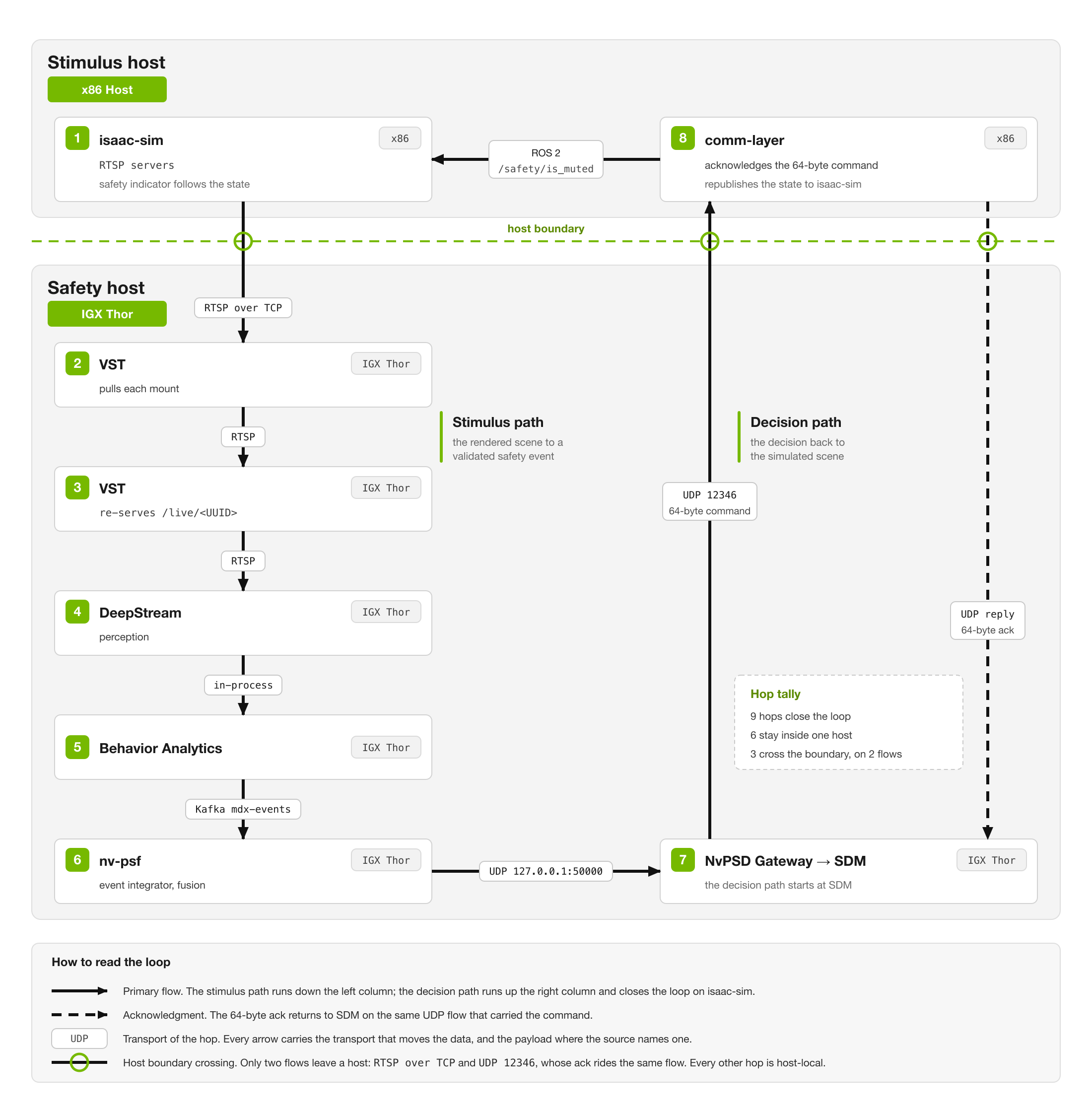
Every hop in the loop, with the transport that carries it. The stimulus path runs down the left, the decision path back up the right, and the dashed line marks the host boundary.#
Network interfaces#
Two flows carry the safety loop across the host boundary; everything else in the table below is orchestration and infrastructure.
Port |
Protocol |
Listener |
Connector |
Environment variable |
|---|---|---|---|---|
|
RTSP over TCP |
|
VST (IGX Thor) |
— (fixed in |
|
UDP |
|
SDM (IGX Thor) |
|
ephemeral |
UDP reply |
SDM source socket (IGX Thor) |
|
— |
|
OPC UA over TCP |
|
Container healthcheck, external OPC UA clients |
|
|
HTTP |
VST (IGX Thor) |
x86 host, for orchestration and preflight |
|
|
HTTP |
Perception (IGX Thor) |
x86 host, optional |
|
|
SSH over TCP |
IGX Thor |
x86 host, for the preflight check and safety-host commands |
— |
|
NTP over UDP |
External time source |
Both hosts, outbound |
— |
The safety host pulls over TCP only when rtsp_streaming_over_tcp: true is set on its VST configuration; over UDP the sensors report online and no media arrives (Deploy the HIL Closed Loop).
The acknowledgment travels back on the flow the SDM already established, so the IGX Thor needs no inbound rule for 12346. Firewall rules required: Thor to x86, TCP 8554-8556 and UDP 12346; x86 to Thor, TCP 30888, 9000 (optional), and 22; both hosts outbound to NTP on UDP 123.
UDP 12345 and the halo_safety_udp_port setting behind it belong to the base profile’s on-video overlay. In hil that overlay is not driven, the setting stays at its shipped default, and the communication layer is the sole command sink.
ROS 2 and its DDS discovery never cross the host boundary — all three ROS participants run on the x86 host — so a discovery failure is always an x86-side problem.
Safety command packet#
The command and its acknowledgment are both 64 bytes: the magic identifier 0xA2, a uint16 sequence number, the opcode, a UTC seconds and microseconds timestamp, a CRC-32 computed over bytes 0-19 and 24-63, and two 20-byte object records. For the byte-by-byte layout, see Deployment Guide.
The communication layer echoes the full packet back to the sender with a fresh timestamp and a recomputed CRC. The SDM warns when a packet has gone unacknowledged for more than three seconds, and does not retry. Occasional sequence-number gaps are benign, because the decision state is re-emitted idempotently; sustained loss is not.
A HEARTBEAT is sent every five seconds.
The opcodes the hil profile emits:
Opcode |
Value |
Meaning |
|---|---|---|
|
|
Periodic keep-alive; confirms the safety host to communication layer link is live |
|
|
Hardware fault reported by the decision maker |
|
|
Allow operation |
|
|
Software fault reported by the decision maker |
|
|
Prevent operation |
The decision maker can also latch a safe state and use three further opcodes on this channel to clear it; see 2.5 Clearing a Latched Safe State in the Deployment Guide.
Configuration surface#
Each host carries its own environment file. deployments/profiles/hil.env is a Docker Compose environment file whose COMPOSE_PROFILES=hil setting selects the three x86 services. deployments/profiles/hil-thor.env is not a Compose profile — it is sourced by the Thor launch script.
Three values must mirror each other across the two files. When they do not, the symptom is commands leaving the safety host with no acknowledgment coming back, and nothing obviously wrong on either side.
x86 ( |
IGX Thor ( |
Must satisfy |
|---|---|---|
|
|
The x86 address VST pulls the camera streams from, and the address the SDM sends decisions to |
|
|
The address the preflight probes and ssh reach the safety host on |
|
|
Identical value; both ship |
hil_preflight.sh runs on the stimulus host and checks the x86 half — that HOST_IP and PEER_HOST_IP are filled in and different, and that COMM_UDP_PORT is set — plus ssh reachability to the safety host. It cannot read hil-thor.env: the two Thor-side values are verified by hand, and the script prints them as a checklist when it is run without --thor.
ROS_AUTOMATIC_DISCOVERY_RANGE ships as SUBNET in hil.env, where sil.env ships LOCALHOST. LOCALHOST pins DDS peers to the loopback address while the selected interface stays the physical NIC, so on a multi-interface host the three containers never discover each other and the forklift never moves. SUBNET uses LAN-wide multicast instead, so ROS_DOMAIN_ID must be nonzero when other ROS hosts share the subnet, and all three containers must carry the same value. Both variables are baked in at container creation, so a change takes effect only when the containers are recreated.
PSF_LAUNCH_MODE selects whether the Safety Core starts the Safety AI Monitor. The profile ships skip, which does not; active does, and reads the sensor configuration file, so its stream URLs and identifiers must be filled in from the live VST sensor list first. See
Sensor configuration file for the format.
VST_BASE_URL and PERCEPTION_BASE_URL are derived from PEER_HOST_IP and need no edit. The preflight check reads them from the x86 host, and the alternative Isaac-side sensor-registration path uses them; the documented bring-up registers sensors on the safety host, so nothing else on the x86 host calls them.
Logs#
On the x86 host, under ${MDX_DATA_DIR}/comm-layer:
opc_server.log— commands and heartbeats as received, with the decoded opcode.ros_bridge.log— the ROS 2 republish of each decision.
On the IGX Thor, under /var/log/psf:
psf.log— fusion, and theDecisionRequestlines that show perception is feeding events.atl_sdm.log— decisions sent and acknowledgments received, paired by sequence number.
For the full safety-host log set, see Logs in the Deployment Guide.
With the SDM on the safety island, its internal state and logs are not reachable from the host and its packets carry an epoch-zero timestamp. The communication layer log is then the only postmortem record of the decision stream, and latency must be computed receive-side.
Timing across the host boundary#
The distance between the two hosts dominates the loop, not the safety stack. Decision transport is almost entirely propagation delay, so it is set by where the hosts sit: negligible on a shared LAN, and half the round trip on a link that spans sites. Place the two hosts on the same network segment unless the test requires otherwise.
Bandwidth is not the constraint. Three 1080p H264 streams on separate connections are modest next to what any link carrying the round trip already sustains.
Delivered frame rate tracks the Isaac Sim render rate, not the rate the streams advertise. A perception frame rate below the nominal camera rate is the simulation, not the network.
Both hosts must be NTP-synced. The preflight check warns when the skew between them exceeds two seconds.
Differences from SIL and from the base profile#
Aspect |
SIL (single host) |
HIL (two hosts) |
|
|---|---|---|---|
Hosts |
One x86 host |
An x86 stimulus host and an IGX Thor safety host |
One IGX Thor |
Simulation |
Isaac Sim, on the same host as everything else |
Isaac Sim on the x86 host only |
None — an existing camera feed |
Perception and Safety Core |
x86, alongside Isaac Sim |
IGX Thor |
IGX Thor |
Command sink |
Local |
Remote |
Local VST overlay on |
Decision rendering |
In-scene safety indicator over ROS 2 |
In-scene safety indicator over ROS 2, on the x86 host |
VST |
ROS discovery range |
|
|
Not applicable — no ROS participants |
Shared across all three: the Safety Core image and its decision logic, the event contract on Kafka, and the 64-byte command format. The profile changes where those run and where the decision is delivered, not what they do.
What HIL does not exercise#
A HIL run exercises the decision path end to end on the target platform. It does not exercise the following, and a result should not be quoted as though it did.
Element |
In HIL |
In production |
|---|---|---|
Camera input |
Rendered by Isaac Sim on the x86 host and delivered over RTSP |
Physical cameras on the facility network |
Scene content |
A fixed warehouse scene with one forklift on a fixed path |
Live facility traffic |
Forklift response |
The forklift controller ignores the safety opcodes; the decision is shown by the in-scene indicator |
The decision gates the machine |
Load |
One forklift on one fixed path, plus the digital humans the scene renders |
Many vehicles and people moving concurrently on unconstrained paths |
The Safety Core is wall-clock only in HIL and in production alike. A simulated clock must never be fed into the pipeline: events carrying simulation timestamps are dropped as stale.
Next Steps#
Deploy the HIL Closed Loop — Bring the two-host closed loop up
SIL Architecture — The single-host architecture this one splits
Deployment Guide — Safety Core installation, options, and troubleshooting in full