

Submit Supported Workload Types via YAML
This guide describes how to run supported workload types using the NVIDIA Run:ai UI by submitting a YAML manifest directly.
To learn more about workload types in NVIDIA Run:ai and determine what is the most suitable workload type for your goals, see Workload types and features.
Note
Workloads can be submitted using YAML outside of NVIDIA Run:ai (for example, with kubectl). For details, see Supported features.
Before You Start
Make sure you have created a project or have one created for you.
Note
Via YAML submission is enabled by default. If you do not see it in the menu, contact your administrator to enable it under General settings → Workloads → Submit supported workload types via YAML.
Supported Workload Types
Supported workload types include a broad range of workloads from the ML and Kubernetes ecosystem that are already registered as workload types in the platform and ready to use. See Supported workload types for more details.
- Your administrator can also register additional workload types for your organization. See Registering new workload types for more details.
- By default, workload types are grouped into Build, Train and Deploy categories. These categories determine how the workload is scheduled and prioritized within a project and how they are grouped for monitoring and reporting.
Note
Some supported workload types require additional installation or cluster preparation before they can be used. Refer to the documentation for each workload type for specific prerequisites.
Workload Priority and Preemption
By default, supported workload types are assigned a priority and preemptibility based on their workload type. These defaults determine how workloads are scheduled relative to others within the same project, whether they can use over-quota resources, and whether they may be interrupted once running. You can override the defaults by configuring priority and preemptibility. For more details on the default values per workload type, see Workload types default.
Setting GPU Fractions
To enable GPU fractions for workloads submitted via YAML, use the following annotations to define the GPU fraction configuration. You can configure gpu-fraction, gpu-memory, or the NVIDIA-native nvidia.com/container.<container-name>.gpu-memory.request alternative. For concept details, deployment considerations, and a full example, see GPU Fractions.
GPU fractions can be assigned to only one container in the pod. By default, GPU fraction allocation is applied to the first container (index 0) in the pod. Set the gpu-fraction-container-name annotation to specify which container should consume the fractional GPU resources. The specified container can be the main container, a sidecar, or an init container, any container other than the default first container.
Setting DRA Resource Claims
To request hardware managed via Kubernetes Dynamic Resource Allocation (DRA), reference a ResourceClaim or ResourceClaimTemplate in the pod spec. For the field reference and a full example, see the Kubernetes documentation on scheduling DRA resources.
Setting Stale Gang Eviction Timeout
For gang-scheduled workloads (for example, distributed training or distributed inference), set the kai.scheduler/staleness-grace-period annotation to override the cluster-wide default grace period before the Scheduler evicts a stale pod group. For concept details, see Stale Gang Eviction.
The value is a duration string, a number followed by a unit (s, m, or h), for example 30s, 5m, or 1h. An invalid value is ignored, and the cluster-wide default applies. A negative value disables stale gang eviction for that pod group entirely.
Creating a New Workload
-
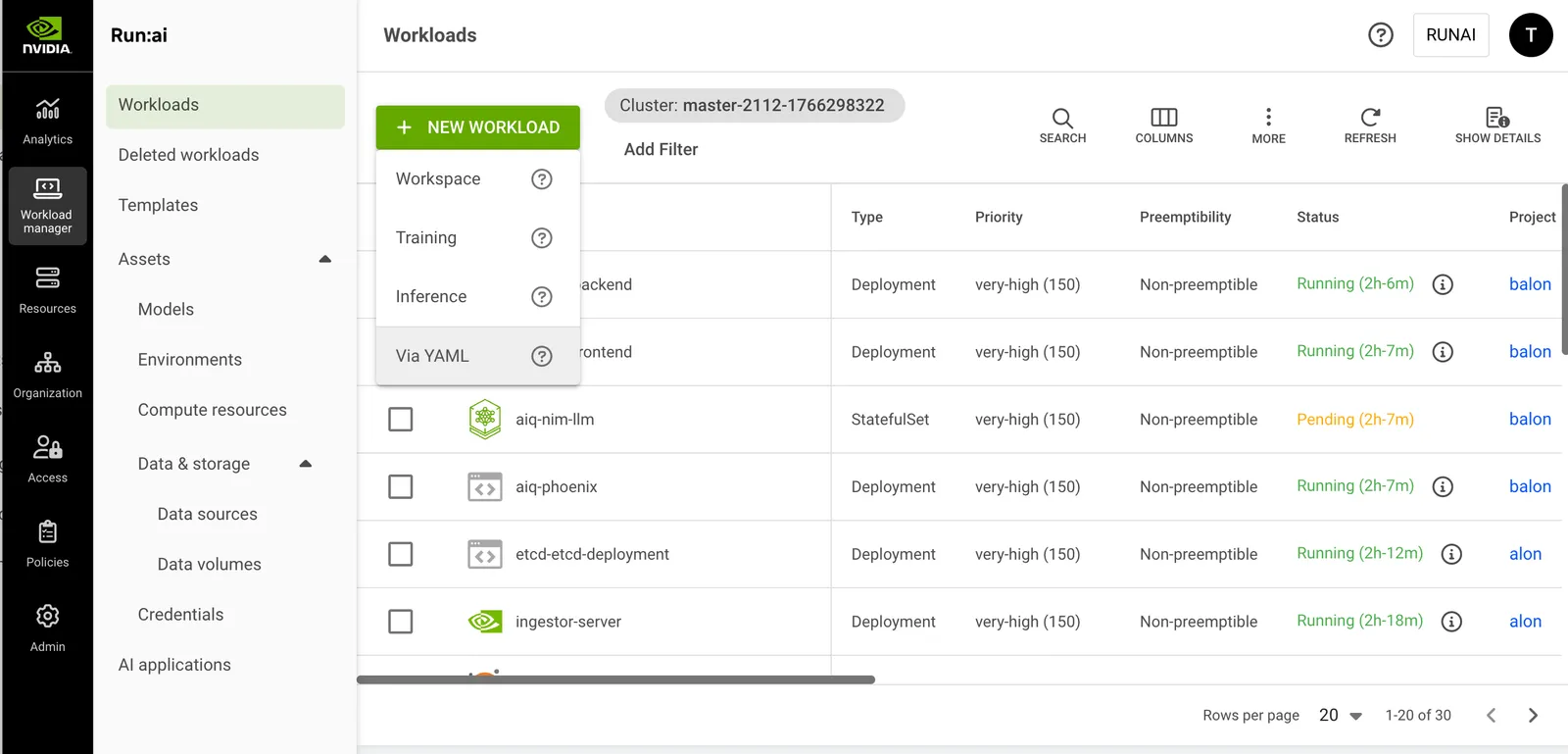
To create a workload, go to Workload manager → Workloads.
-
Click + NEW WORKLOAD and select Via YAML from the dropdown.
-
In the YAML submission form, select the cluster where the workload will run.
-
Upload or paste your YAML manifest. Hover over Supported workload types to view a full list of available workloads:
- To upload a file, click UPLOAD YAML FILE and choose your YAML.
- To paste the YAML, insert it directly into the editor.
-
Select a project:
-
If the
namespaceis not defined in the YAML, select a project from the submission form. To create a new project, click +NEW PROJECT and refer to Projects for a step-by-step guide. -
If a project is selected in the form, it overrides the
namespacedefined in the YAML. -
Alternatively, set the project directly in the YAML using the
metadata.namespacefield.
-
-
Set whether the workload may be interrupted. Change this setting only if you want to override the default preemptibility defined for the workload type. Non-preemptible workloads use the project’s available GPU quota and will not be interrupted once they start running. Preemptible workloads may be interrupted if resources are needed for higher priority workloads. Semi-preemptible workloads guarantee their minimum required replicas run without interruption, while any replicas beyond that minimum behave as preemptible replicas:
-
In the UI, select Preemptible, Semi-preemptible, or Non-preemptible from the dropdown.
-
In the YAML, set the following label under
metadata.labels:
-
-
Set the workload priority. Change this setting only if you want to override the default priority defined for the workload type. Higher priority workloads are scheduled before lower-priority ones:
-
In the UI, select a priority from the dropdown.
-
In the YAML, set
priorityClassNameundermetadata.labelsusing one of the supported values:very-low,low,medium-low,medium,medium-high,high,very-high:
-
-
If the project’s node pools support MNNVL, set whether Multi-Node NVLink (MNNVL) acceleration is required for this workload. MNNVL provides high-bandwidth, low-latency communication between GPUs on supported nodes, improving performance for multi-GPU workloads:
- Not required - The workload will not use MNNVL acceleration, even if MNNVL-capable nodes are available.
- Required - The workload will require MNNVL-capable nodes. Scheduling may be restricted to compatible nodes, and if none are available, the workload may remain pending.
For more information, see Using GB200 NVL72 and Multi-Node NVLink Domains.
-
Click CREATE WORKLOAD
Managing and Monitoring
After the workload is created, it is added to the Workloads table, where it can be managed and monitored.
Accessing Workload Endpoints
NVIDIA Run:ai automatically discovers and displays network endpoints for workloads that include Kubernetes networking resources. For more information, see Kubernetes Services, Load Balancing, and Networking.
To expose endpoints, include the relevant networking configuration in your YAML. For example, the following Dynamo workload defines an Ingress that NVIDIA Run:ai will automatically discover:
Once the workload is running, the Connections column shows the endpoint URL directly if there is one, or the number of endpoints if there are multiple. See Connections associated with the workload for more details.
Using an endpoint:
- Click Copy to copy the URL to your clipboard.
No endpoints displayed:
If no endpoints appear, the workload may not yet be in a running state, or the networking configuration in your YAML manifest may not be set up correctly. Check the following:
- Verify the workload status is Running.
- Confirm that your YAML manifest includes the required networking configuration.
- Check that the networking configuration is correctly defined and applied.
Using CLI
To view the available actions, see the CLI v2 reference.
Using API
To view the available actions, see the Workloads V2 API reference.
Troubleshooting
Generic or unknown errors
Generic or unknown errors
Description: Not specific enough to diagnose from the message alone.
Authentication and permissions
Authentication and permissions
Description: You may not be authorized to submit/manage workloads in the selected scope, or your token issuer is not recognized.
Cluster or API compatibility
Cluster or API compatibility
Description: The API endpoint you used is not compatible with the target cluster version.
Priority or category not available
Priority or category not available
Description: The selected priority or category isn’t supported in the target cluster.
Workload name validation
Workload name validation
Description: The workload name is missing, invalid, too long, or already exists.
Project or cluster selection errors
Project or cluster selection errors
Description: The request context is missing or ambiguous.
Workload type (GVK) not found or not ready in the cluster
Workload type (GVK) not found or not ready in the cluster
Description: NVIDIA Run:ai can’t map your manifest’s GVK (group/version/kind) to a workload type that is registered and ready in the selected cluster. See Supported workload types.
Batch job workload stuck in Resuming state
Batch job workload stuck in Resuming state
Description: After using the Run action on a batch job workload type (such as Job, PyTorchJob, or RayJob), the workload gets stuck in the Resuming state indefinitely. This is a known Kubernetes issue.
Affected versions: Kubernetes versions prior to v1.32.9, v1.33.6, v1.34.2, or v1.35.0 (depending on your minor version).
Resolution: Upgrade your cluster to a fixed Kubernetes release: v1.32.9 or later, v1.33.6 or later, v1.34.2 or later, or v1.35.0 or later.
Manifest structure and parsing errors
Manifest structure and parsing errors
Description: The submitted YAML is not a valid Kubernetes-style manifest, or it can’t be parsed.