

Introduction#
Physical Environment Challenges and the Warehouse Blueprint Solution#
Organizations operating warehouses, factories, and logistics hubs confront escalating complexity. These environments demand efficiency, safety, and real-time adaptability. Many organizations struggle with:
Limited Real-Time Visibility: Manual methods and siloed data systems prevent real-time tracking of assets, personnel, and processes.
Suboptimal Resource Utilization: Poor space and equipment usage increases operational costs.
Safety Concerns: Dynamic and hazardous environments challenge personnel safety and compliance efforts.
Scalability Limitations: Organizations cannot adapt to fluctuating demands or scale operations effectively.
To address these challenges, organizations must transform raw video and sensor data from physical spaces into actionable insights. Warehouse Blueprint delivers the foundational capabilities to accomplish this transformation. This comprehensive platform leverages advanced AI and computer vision to enable machines to perceive, understand, and interact with the physical world.
Warehouse Blueprint implements a layered architecture that comprises Foundational Microservices, Blueprints, and AI Agents. Developers use this architecture to build and deploy sophisticated warehouse blueprint applications. Solutions range from applications that utilize pre-built AI Agents for specific tasks to custom integrations that leverage core Foundational Blueprints, supporting both warehouse blueprint 2D and 3D applications with tailored calibration approaches.
Key Concepts#
Layered Architecture#
Warehouse Blueprint implements a layered architecture that includes Foundational Microservices, Blueprints, and AI Agents. We refer to the complete end-to-end reference architecture, which incorporates all core components, as the Warehouse Blueprint Agentic Blueprint. The ‘Safety Inspector’ blueprint serves as an example that we discuss in subsequent sections.
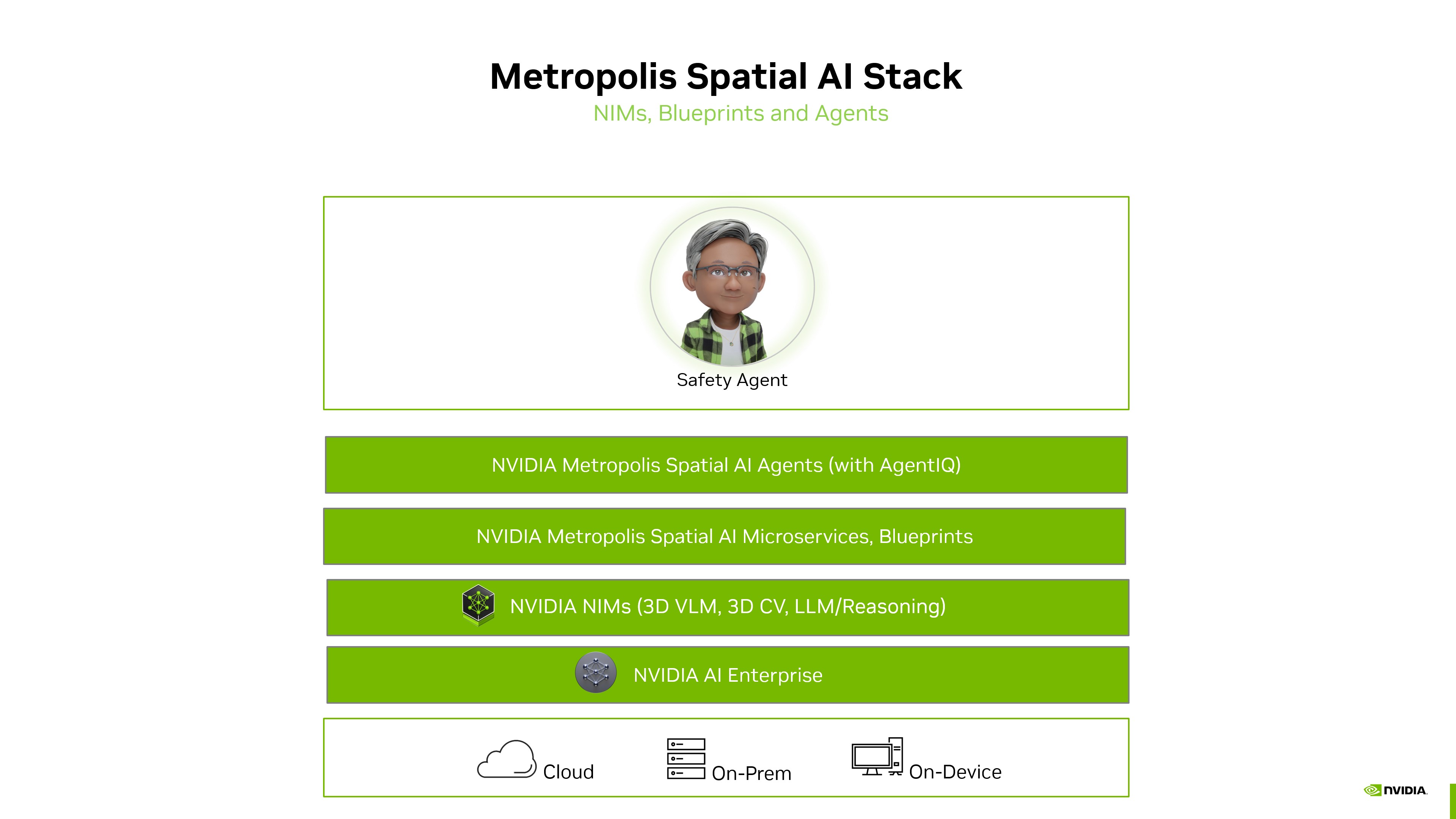
Foundational Microservices and Blueprints#
Core, deployable Microservices and Blueprints deliver fundamental capabilities (e.g., Warehouse Blueprint 3D, Warehouse Blueprint 2D with Agents, VIOS MicroService). Developers integrate these directly or AI Agents consume them.
AI Agents#
Customizable packages contain core Agent logic and use “Tools” to interact with Foundational Microservices and Blueprints (e.g., Agents).
Agentic Application Blueprint#
End-to-end examples combine AI Agents with Foundation Microservices and Blueprints (e.g., Warehouse Blueprint). These examples serve as starting points or demonstrations and often map to a Deployment Profile.
Tool#
AI Agents use this interface or abstraction to invoke functionality from VSS Reference User Interface.
Deployment Profile#
Pre-defined combinations of Microservices, Blueprints, and Agents deploy specific capability sets.
Simulation / Digital Twin#
Development requires simulation and digital twin capabilities (SDG, 3D Calibration data, testing).
Relationship with Outside-In Safety (OIS)#
Warehouse Blueprint provides foundational Blueprints such as the 2D Warehouse Blueprint, which OIS consumes and documents within its specific context.
Developer Journeys#
Developers can integrate with Warehouse Blueprint 2D & 3D Blueprints using two modes:
Deploy Warehouse Blueprint 2D Blueprint with Agents
Interact with the system using natural language (via API or UI)
Access analytics APIs and event streams directly in this mode
Deploy only Warehouse Blueprint 2D & 3D Blueprints
Integrate via APIs and event streams (e.g., Kafka)
Core Use Cases#
Warehouse Blueprint enables applications that transform physical operations. These applications deliver value through:
Real-time Alerts: Systems send immediate notifications for critical events (e.g., safety violations, security breaches) to enable prompt responses.
On-Demand Insights: Users perform ad-hoc queries and analytics on operational data (e.g., space utilization, asset movement, process bottlenecks) for informed decision-making.
Continuous Data Integration: Systems maintain seamless data flow to and from enterprise systems (e.g., WMS, ERP) for comprehensive monitoring, trend analysis, and strategic planning.
Warehouse Blueprint enables these key use cases:
Use Case |
Core Goal |
|---|---|
Space Management & Asset Tracking |
Detect, track, and count assets (e.g., pallets, equipment, personnel), optimize floor space utilization, and enable end-to-end cargo traceability to enhance operational efficiency. |
Workspace Safety & Proximity Monitoring |
Monitor environments for potential hazards, detect proximity breaches between personnel and machinery, and enforce safety protocols through real-time alerts to improve worker safety. |
Production Line & Process Optimization |
Detect and track personnel, equipment (e.g., AMRs), and materials along production lines, identify bottlenecks, and analyze operational hotspots to increase throughput and efficiency. |