

Real-Time Embedding Microservice#
Overview#
The Real-Time Embedding microservice (RTVI-Embed, container image vss-rt-embed) is a FastAPI-based REST API service
that provides video and text embedding generation capabilities. It supports video/image files,
live RTSP streams, and text inputs, enabling real-time analysis and batch processing of visual media content.
All REST endpoints use the /v1 prefix. The service listens on port 8000 inside the
container; map it to the host with BACKEND_PORT (default 8000).
Key Features#
Video Embeddings: Generate embeddings from video files with configurable chunk duration and overlap
Image Embeddings: Process single or multiple images for embedding generation
Live Stream Support: Real-time embedding generation from RTSP camera streams
Text Embeddings: Generate embeddings from text inputs
Streaming Responses: Server-Sent Events (SSE) for real-time streaming output
Kafka Integration: Kafka messages containing generated embeddings for video input
Redis Integration: Error messages on Redis channel
Batch Operations: Bulk upload and deletion of live streams
Health Monitoring: Comprehensive health check endpoints (liveness, readiness, startup)
Metrics: Prometheus-format metrics for monitoring and observability
OpenTelemetry Integration: Distributed tracing and metrics collection
Architecture#
The diagram below shows the DeepStream Accelerated Pipeline architecture of the microservice.
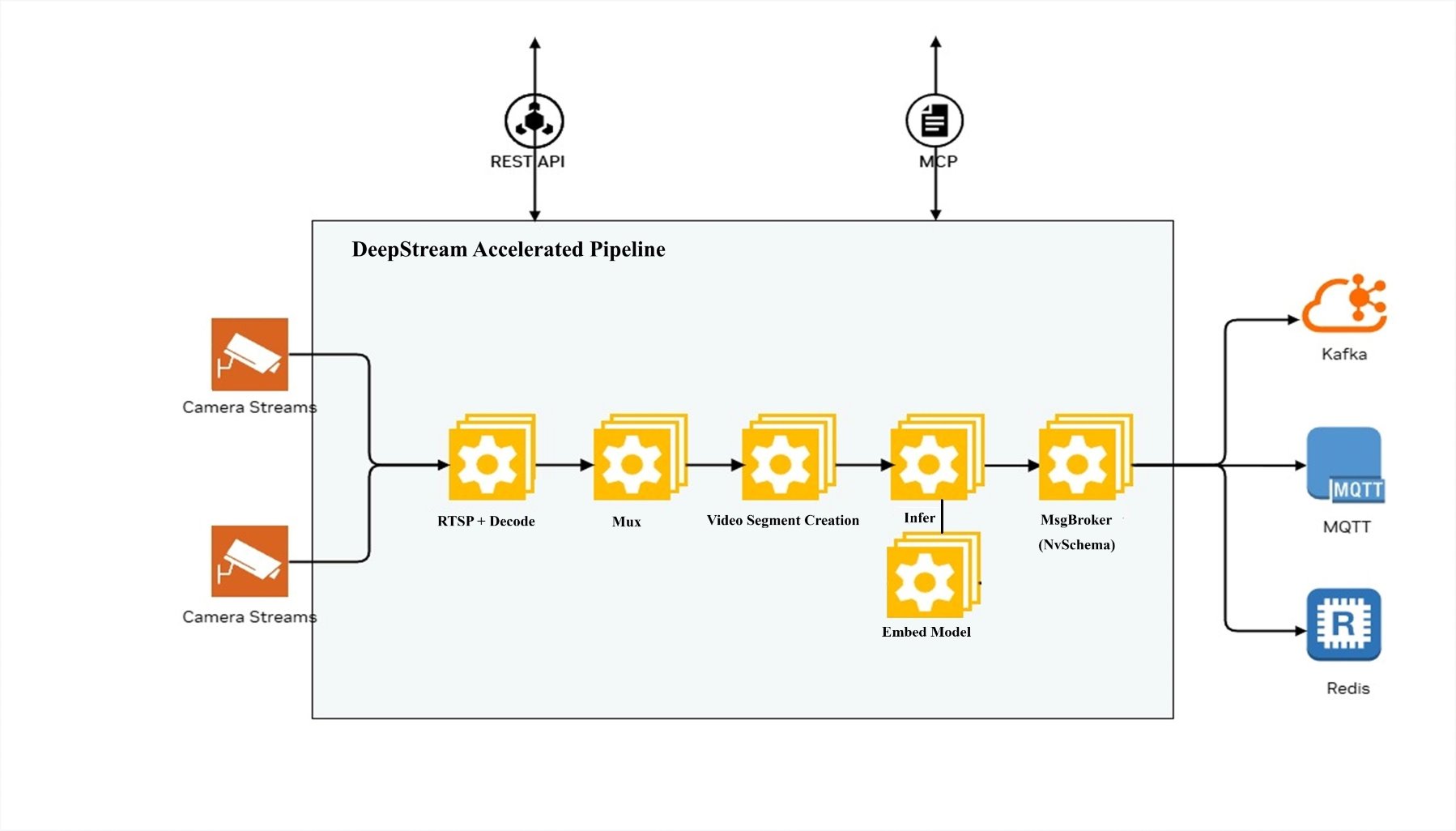
DeepStream Pipeline#
The microservice uses the DeepStream SDK to process video and image files. For video input, the video is segmented into chunks as per requested chunk duration, overlap. For each video chunk,the microservice uniformly samples frames and generates embeddings for the sampled frames. The number of frames sampled is determined by the model configuration (8 in case of Cosmos-Embed1).
For image input, the microservice generates embeddings for the list of images provided in the request. For less than 8 images, the microservice pads the images to 8 images.
For text input, the text is tokenized and embeddings are generated for the tokenized text. The model pads or truncates the input text tokens to 128 tokens.
Supported Models#
The microservice supports the Cosmos-Embed1 model, a joint video-text embedder. It supports both video and text input for embedding generation.
Model variant |
Resolution |
Repository |
Use case |
|---|---|---|---|
Cosmos-Embed1-448p |
448p |
Default model |
|
Cosmos-Embed1-336p |
336p |
Lower-resolution variant |
|
Cosmos-Embed1-224p |
224p |
Lowest-resolution variant |
|
Cosmos-Embed1-448p-anomaly-detection |
448p |
Anomaly detection; default for search workflow |
To fine-tune Cosmos-Embed1 with NVIDIA TAO and integrate custom checkpoints, see Model customization overview and Cosmos-Embed1 (video embedding).
Supported Inputs#
Category |
Supported values |
|---|---|
Video codecs |
H.264 (AVC), H.265 (HEVC), VP8, VP9 |
Image formats |
JPEG, PNG |
Container formats |
MP4, MKV, MOV, WebM |
Streaming protocols |
RTSP over TCP, RTSP over UDP |
File upload |
Video and image files via |
API Reference#
For complete API documentation including all endpoints, request/response schemas, and interactive examples, see the Real-Time Embedding API Reference.
The API is organized into the following categories:
Embeddings: Generate video, image, live-stream, and text embeddings
Files: Upload and manage video/image files
Live Stream: Add, list, and manage RTSP live streams
Stream: RTVI-CV compatible stream add, remove, and list APIs
Models: List available embedding models
Health Check: Service health and readiness probes
Metrics: Prometheus metrics endpoint
Metadata: Service metadata and version information
NIM Compatible: Version and manifest endpoints for interoperability
Endpoint |
Method |
Description |
|---|---|---|
|
|
Get Prometheus-format RTVI metrics |
|
|
Get RTVI Embed Microservice readiness status |
|
|
Get RTVI Embed Microservice liveness status |
|
|
Get RTVI Embed Microservice startup status |
|
|
Get asset storage statistics |
|
|
Get RTVI Embed Microservice metadata |
|
|
Upload a media file or register media by path |
|
|
List uploaded files |
|
|
Delete a file |
|
|
Get file information |
|
|
Get file content |
|
|
Add one or more live streams |
|
|
List live streams |
|
|
Remove a live stream |
|
|
Remove multiple live streams |
|
|
Add a stream using the RTVI-CV compatible format |
|
|
Remove a stream using the RTVI-CV compatible format |
|
|
List streams using the RTVI-CV compatible format |
|
|
List available models |
|
|
Generate embeddings for a video, image, or live stream |
|
|
Stop live stream embedding generation |
|
|
Generate embeddings for text input |
|
|
Get release and API versions |
|
|
Get service manifest information |
All endpoints are prefixed with /v1. The API is available at
http://<host>:8000.
Deployment#
Prerequisites#
Validated GPUs:
The Real-Time Embedding Microservice has been validated and tested on the following NVIDIA GPUs:
NVIDIA H100
NVIDIA RTX PRO 6000 Blackwell
NVIDIA L40S
NVIDIA DGX Spark
NVIDIA IGX Thor
NVIDIA AGX Thor
Software:
OS: Ubuntu 24.04/22.04 or compatible Linux distribution (x86); DGX OS 7.4.0 (DGX Spark); Jetson Linux BSP Rel 38.4/38.5 (Jetson Thor)
Docker: Version 28.2+ and earlier than 29.5.0
Docker Compose: Version 2.36+
NVIDIA Driver: 580+
NVIDIA Container Toolkit: Latest version
NGC container registry:
Generate an API key at https://ngc.nvidia.com (Setup → API Keys), then authenticate Docker before pulling images:
export NGC_API_KEY=<your-key>
echo "$NGC_API_KEY" | docker login nvcr.io -u '$oauthtoken' --password-stdin
Quick Start#
To deploy the RTVI-Embed microservice, clone the video-search-and-summarization repository and change into the Docker directory:
git clone https://github.com/NVIDIA-AI-Blueprints/video-search-and-summarization.git
cd video-search-and-summarization
git checkout tags/v3.2.1
cd services/rtvi/rt-embed/docker
Then follow these sections on this page:
Prerequisites (NGC container registry)
Environment Variables
Sample docker-compose.yml file
Deployment Commands
Kafka Integration
Docker Compose#
The microservice can be deployed using Docker Compose.
The deployment is defined in the docker-compose.yml file.
Environment Variables#
Create a .env file with the following variables and update the values as per your requirements.
See Environment Variables Reference for the complete list.
Use RTVI_IMAGE for compose.yaml; use the RTVI_EMBED_* lines only with legacy image compose (see sample below).
BACKEND_PORT=<port>                         # Host port on which the service will be available
RTVI_IMAGE=nvcr.io/nvidia/vss-core/vss-rt-embed:3.2.1 # Real-Time Embedding Microservice image tag
# On DGX Spark / ARM SBSA, use the SBSA tag, e.g.:
# RTVI_IMAGE=nvcr.io/nvidia/vss-core/vss-rt-embed:3.2.1-sbsa

# Legacy split-image compose:
# RTVI_EMBED_IMAGE=nvcr.io/nvidia/vss-core/vss-rt-embed
# RTVI_EMBED_TAG=3.2.1
# On DGX Spark / ARM SBSA, use the SBSA tag, e.g.:
# RTVI_EMBED_TAG=3.2.1-sbsa
# On Jetson Thor, the default tag is a multiarch image that supports ARM64.

# Storage
ASSET_STORAGE_DIR=/path/to/assets           # Host path for uploaded files (optional)
EXAMPLE_STREAMS_DIR=/path/to/sample-videos  # Host path for example streams (optional)

# GPU Configuration
NVIDIA_VISIBLE_DEVICES=0                    # Use specific GPUs (default: all)

# Logging
LOG_LEVEL=INFO                              # DEBUG, INFO, WARNING, ERROR

# Kafka server config
KAFKA_ENABLED=<true/false>                  # Enable Kafka messages containing generated embeddings
KAFKA_BOOTSTRAP_SERVERS=<ip_address:port>   # Kafka server
KAFKA_TOPIC=mdx-embed                       # Kafka message topic
ERROR_MESSAGE_TOPIC=mdx-embed-errors        # Kafka error topic (or Redis channel when Redis is enabled)
Sample docker-compose.yml file#
For the current deployment stack, use the compose file: services/rtvi/rt-embed/docker/compose.yaml (uses RTVI_IMAGE).
The sample below is a legacy compose (RTVI_EMBED_IMAGE / RTVI_EMBED_TAG); use the linked compose.yaml for deployment.
version: '3.8'
services:
  rtvi-server:
    image: ${RTVI_EMBED_IMAGE:-nvcr.io/nvidia/vss-core/vss-rt-embed}:${RTVI_EMBED_TAG:-3.2.1}
    shm_size: '16gb'
    runtime: nvidia
    user: "1001:1001"
    ports:
      - "${BACKEND_PORT?}:8000"
    volumes:
      - "${ASSET_STORAGE_DIR:-/dummy}${ASSET_STORAGE_DIR:+:/tmp/assets}"
      - "${MODEL_ROOT_DIR:-/dummy}${MODEL_ROOT_DIR:+:${MODEL_ROOT_DIR:-}}"
      - "${NGC_MODEL_CACHE:-rtvi-ngc-model-cache}:/opt/nvidia/rtvi/.rtvi/ngc_model_cache"
      - "${RTVI_LOG_DIR:-/dummy}${RTVI_LOG_DIR:+:/opt/nvidia/rtvi/log/rtvi/}"
      - rtvi-hf-cache:/tmp/huggingface
      - rtvi-triton-model-repo:/tmp/triton_model_repo

    environment:
      MODEL_PATH: "${MODEL_PATH:-git:https://huggingface.co/nvidia/Cosmos-Embed1-448p}"
      MODEL_IMPLEMENTATION_PATH: "${MODEL_IMPLEMENTATION_PATH:-/opt/nvidia/rtvi/rtvi/models/custom/samples/cosmos-embed1}"
      MODEL_REPOSITORY_SCRIPT_PATH: "${MODEL_REPOSITORY_SCRIPT_PATH:-/opt/nvidia/rtvi/rtvi/models/custom/samples/cosmos-embed1/create_triton_model_repo.py}"
      NGC_API_KEY: "${NGC_API_KEY:-}"
      HF_TOKEN: "${HF_TOKEN:-}"
      NVIDIA_VISIBLE_DEVICES: "${NVIDIA_VISIBLE_DEVICES:-all}"
      VLM_BATCH_SIZE: "${VLM_BATCH_SIZE:-}"
      NUM_VLM_PROCS: "${NUM_VLM_PROCS:-}"
      NUM_GPUS: "${NUM_GPUS:-}"
      LOG_LEVEL: "${LOG_LEVEL:-INFO}"
      INSTALL_PROPRIETARY_CODECS: "${INSTALL_PROPRIETARY_CODECS:-false}"
      FORCE_SW_AV1_DECODER: "${FORCE_SW_AV1_DECODER:-}"
      RTVI_RTSP_LATENCY: "${RTVI_RTSP_LATENCY:-2000}"
      RTVI_RTSP_TIMEOUT: "${RTVI_RTSP_TIMEOUT:-2000}"
      RTVI_RTSP_RECONNECTION_INTERVAL: "${RTVI_RTSP_RECONNECTION_INTERVAL:-5}"
      RTVI_RTSP_RECONNECTION_WINDOW: "${RTVI_RTSP_RECONNECTION_WINDOW:-60}"
      RTVI_RTSP_RECONNECTION_MAX_ATTEMPTS: "${RTVI_RTSP_RECONNECTION_MAX_ATTEMPTS:-10}"
      VSS_NUM_GPUS_PER_VLM_PROC: "${VSS_NUM_GPUS_PER_VLM_PROC:-}"
      ENABLE_OTEL_MONITORING: "${ENABLE_OTEL_MONITORING:-false}"  # Set to 'true' to enable OpenTelemetry
      OTEL_RESOURCE_ATTRIBUTES: "${OTEL_RESOURCE_ATTRIBUTES:-}"
      OTEL_TRACES_EXPORTER: "${OTEL_TRACES_EXPORTER:-otlp}"
      OTEL_EXPORTER_OTLP_ENDPOINT: "${OTEL_EXPORTER_OTLP_ENDPOINT:-http://otel-collector:4318}"
      OTEL_METRIC_EXPORT_INTERVAL: "${OTEL_METRIC_EXPORT_INTERVAL:-60000}"  # Metrics export interval in milliseconds
      KAFKA_ENABLED: "${KAFKA_ENABLED:-false}"
      KAFKA_TOPIC: "${KAFKA_TOPIC:-mdx-embed}"
      ERROR_MESSAGE_TOPIC: "${ERROR_MESSAGE_TOPIC:-mdx-embed-errors}"
      KAFKA_BOOTSTRAP_SERVERS: "${KAFKA_BOOTSTRAP_SERVERS:-kafka:9092}"
      ENABLE_REDIS_ERROR_MESSAGES: "${ENABLE_REDIS_ERROR_MESSAGES:-false}"
      REDIS_HOST: "${REDIS_HOST:-redis}"
      REDIS_PORT: "${REDIS_PORT:-6379}"
      REDIS_DB: "${REDIS_DB:-0}"
      REDIS_PASSWORD: "${REDIS_PASSWORD:-}"
      ASSET_DOWNLOAD_TOTAL_TIMEOUT: "${ASSET_DOWNLOAD_TOTAL_TIMEOUT:-300}"
      ASSET_DOWNLOAD_CONNECT_TIMEOUT: "${ASSET_DOWNLOAD_CONNECT_TIMEOUT:-10}"
      ENABLE_REQUEST_PROFILING: "${ENABLE_REQUEST_PROFILING:-false}"
    ulimits:
      memlock:
        soft: -1
        hard: -1
      stack: 67108864
      nofile:
        soft: 65535
        hard: 65535
    ipc: host
    stdin_open: true
    tty: true
    extra_hosts:
      host.docker.internal: host-gateway
    healthcheck:
      test: ["CMD", "curl", "-f", "http://localhost:8000/v1/ready"]
      interval: 30s
      timeout: 10s
      retries: 3
      start_period: 1200s

volumes:
  rtvi-hf-cache:
  rtvi-ngc-model-cache:
  rtvi-triton-model-repo:
Note
Platform-specific images:
For DGX Spark with the legacy sample below, set
RTVI_EMBED_TAGin your.envfile (compose.yamlusesRTVI_IMAGE=...-sbsainstead):RTVI_EMBED_TAG=3.2.1-sbsa
For Jetson Thor, the default image is a multiarch image that supports ARM64.
Deployment Commands#
# Start the service
docker compose up -d

# View logs
docker compose logs -f rtvi-server

# Check service health
curl http://localhost:${BACKEND_PORT:-8000}/v1/ready?detailed=false

# Stop the service
docker compose down

# Stop and remove volumes
docker compose down -v

# Remove all containers and volumes
docker compose down -v --rmi all
Standalone Helm Chart Deployment#
Use the standalone Helm chart when running only RTVI-Embed on Kubernetes. The
chart is in deploy/helm/services/rtvi/charts/rtvi-embed in the
video-search-and-summarization repository. In the standalone profile
(overrides_rtvi_embed.yaml), Kafka and Redis are not required
(kafkaEnabled: false, waitForKafka.enabled: false).
Clone the repository and change into the chart directory:
git clone https://github.com/NVIDIA-AI-Blueprints/video-search-and-summarization.git
cd video-search-and-summarization
git checkout tags/v3.2.1
cd deploy/helm/services/rtvi/charts/rtvi-embed
Create the namespace and secrets:
kubectl create namespace rtvi-embed
# nvcr.io image pull secret (referenced as ngc-image-pull-secret).
kubectl create secret docker-registry ngc-image-pull-secret \
  --docker-server=nvcr.io \
  --docker-username='$oauthtoken' \
  --docker-password="$NGC_API_KEY" \
  -n rtvi-embed
# Hugging Face token for the gated Cosmos-Embed1 checkpoint.
kubectl create secret generic hf-token-secret \
  --from-literal=HF_TOKEN="$HF_TOKEN" \
  -n rtvi-embed
Install the chart with the standalone override:
helm upgrade --install vss-rtvi-embed . \
  -n rtvi-embed \
  -f overrides_rtvi_embed.yaml \
  --wait --timeout 45m
The override wires
hfTokenSecret.name=hf-token-secretandhfTokenSecret.key=HF_TOKEN; adjust these if you use different secret names. First startup can take several minutes while the Cosmos-Embed1 model downloads and the Triton model repository is built.Expose the API for local testing:
kubectl port-forward -n rtvi-embed svc/vss-rtvi-embed 8000:8000
The API is available at http://localhost:8000/docs.
Configuration#
Environment Variables Reference#
Core Configuration#
Variable |
Description |
Default |
Required |
|---|---|---|---|
|
Port for REST API server |
|
Yes |
|
Logging verbosity |
|
No |
Hugging Face Token Configuration#
Variable |
Description |
Default |
Required |
|---|---|---|---|
|
Hugging Face access token with READ permissions |
No |
Model Configuration#
Variable |
Description |
Default |
Required |
|---|---|---|---|
|
Inference batch size |
Auto-calculated |
No |
|
Number of inference processes |
|
No |
|
Number of GPUs to use |
Auto-detected |
No |
|
GPU device IDs |
|
No |
|
Model source: |
|
No |
|
Implementation code path for the model |
|
No |
|
NGC API key for downloading models via the |
No |
|
|
trtexec network precision for Cosmos-Embed1 video/text TRT engines ( |
|
No |
|
Extra trtexec args (shell-quoted string) appended verbatim to both video and text engine builds, e.g. |
No |
Storage and Caching#
Variable |
Description |
Default |
Required |
|---|---|---|---|
|
Host path for uploaded files. When set, Docker bind-mounts this path over the default tmpfs at |
No |
|
|
Numeric max asset storage in GB; enables automatic age-out eviction. When |
|
No |
|
Sample streams directory |
No |
|
|
Log output directory |
No |
|
|
Path for NGC/git model cache directory |
No |
|
|
TTL-based asset eviction in hours. |
|
No |
|
Maximum file size for HTTP/data URI asset ingestion (GB). Direct multipart uploads are instead constrained by |
|
No |
|
Maximum redirect hops for URL downloads ( |
|
No |
|
Server-level authentication for URL downloads. Format: |
No |
|
|
Comma-separated list of absolute directory paths allowed for |
No |
Feature Toggles#
Variable |
Description |
Default |
Required |
|---|---|---|---|
|
Enable NSYS profiling |
|
No |
|
Install additional codecs |
|
No |
|
Force software AV1 decode |
|
No |
|
Attach GOP-aware decode probe on |
|
No |
RTSP Streaming#
Variable |
Description |
Default |
Required |
|---|---|---|---|
|
RTSP latency (ms) |
|
No |
|
RTSP timeout (ms) |
|
No |
|
Time to detect stream interruption and wait for reconnection (seconds) |
|
No |
|
Duration to attempt reconnection after interruption before terminating the session (seconds) |
|
No |
|
Max attempts for reconnection after interruption before terminating the session (no.) |
|
No |
|
Per-delete upper bound (seconds) shared by the pre-delete setup wait and the pipeline drain of in-flight chunks. On timeout each stage logs a warning and proceeds. |
|
No |
OpenTelemetry / Monitoring#
When ENABLE_OTEL_MONITORING is true, RTVI-Embed exports Prometheus-format
metrics and OpenTelemetry traces (request latencies, embedding throughput, GPU
utilization, and error rates).
Variable |
Description |
Default |
Required |
|---|---|---|---|
|
Enable OpenTelemetry monitoring |
|
No |
|
Service name for traces |
|
No |
|
OTLP endpoint |
|
No |
|
Traces exporter type |
|
No |
|
Metrics export interval in milliseconds |
|
No |
|
Enable per-request profiling and traces dump |
|
No |
Kafka Configuration#
Variable |
Description |
Default |
Required |
|---|---|---|---|
|
Enable Kafka integration |
|
No |
|
Host port to expose Kafka (Docker Compose only) |
|
No |
|
Kafka broker addresses |
|
No |
|
Kafka topic name for embedding messages |
|
No |
|
Kafka topic name for error messages (or Redis channel when Redis is enabled) |
|
No |
|
Enable streaming text embeddings results to Kafka |
|
No |
|
Max queued Kafka producer send jobs before dropping during broker metadata stalls |
|
No |
Redis Error Messages Configuration#
Variable |
Description |
Default |
Required |
|---|---|---|---|
|
Enable Redis for error messages instead of Kafka |
|
No |
|
Redis channel name for error messages |
|
No |
|
Redis server hostname |
|
No |
|
Redis container/service port for application connections |
|
No |
|
Host machine port to expose Redis (Docker Compose only) |
|
No |
|
Redis database number |
|
No |
|
Redis authentication password |
No |
Advanced Performance#
Variable |
Description |
Default |
Required |
|---|---|---|---|
|
GPUs per Embedding process |
No |
|
|
Disable decoder reuse |
Auto |
No |
Kafka Integration#
When you deploy with the compose file (services/rtvi/rt-embed/docker/compose.yaml), Kafka and Redis containers are started automatically and rtvi-server depends on them. The compose defaults are KAFKA_ENABLED=true and KAFKA_BOOTSTRAP_SERVERS=kafka:9092. Set KAFKA_ENABLED=false and ENABLE_REDIS_ERROR_MESSAGES=false in .env only when you intentionally run without those dependencies.
RTVI-Embed sends Kafka messages containing generated embeddings for video input.
The messages are sent to the mdx-embed topic.
The microservice sends the Kafka messages as Protobuf messages with the nv.VisionLLM message type.
Please refer to the Protobuf Schema documentation for more details on the Kafka message schema.
Note: Kafka messages are not sent for the text embeddings.
Kafka Topics#
The microservice publishes to the following Kafka topic:
VisionLLM Messages (default:
mdx-embed): Contains VisionLLM protobuf messages with embedding results for video input
Configuration:
Kafka integration is controlled by the following environment variables:
KAFKA_ENABLED: Enable/disable Kafka integration (
true/false). Default:falseKAFKA_BOOTSTRAP_SERVERS: Comma-separated list of Kafka broker addresses (e.g.,
localhost:9092orkafka:9092for Docker)KAFKA_TOPIC: Topic for VisionLLM messages. Default:
mdx-embedERROR_MESSAGE_TOPIC: Topic for error messages (or Redis channel when Redis is enabled). Default:
mdx-embed-errors
Message Format#
VisionLLM Embedding Messages#
VisionLLM embedding messages contain video embedding results and are serialized as
Protocol Buffer messages using the VisionLLM message type.
Message Header:
message_type:
"vision_llm"key:
{request_id}:{chunk_idx}- Used for Kafka partitioning and ordering
Message Structure:
See the protobuf schema documentation for complete VisionLLM message
structure. Key fields include:
version: Model version identifier
timestamp: Start timestamp (protobuf Timestamp)
end: End timestamp (protobuf Timestamp)
startFrameId: Start frame identifier
endFrameId: End frame identifier
sensor: Sensor information including:
id: Sensor/stream identifiertype: “Camera” for live streams, “Video” for filesdescription: Asset descriptioninfo: Additional metadata (path, assetDir, url, videoFps)
frames: Array of Frame messages with frame-level information:
id: Frame identifiertimestamp: Frame timestampinfo: Frame metadata
llm: LLM information containing:
info: Model metadata (modelId, modelApiType, modelOwnedBy)queries: Array of query objects with:id: Query identifierparams: Query parameters (chunkIdx, streamId, requestId, startNtp, endNtp)prompts: Input prompts (if provided)response: Empty string for embedding-only requests
visionEmbeddings: Array of Embedding messages with:vector: Float array containing the embedding vector
info: Additional metadata map including:
requestId: Request IDchunkIdx: Chunk indexstreamId: Stream/asset identifierframeCount: Number of frames processedinputTokens: Number of input tokens (if available)outputTokens: Number of output tokens (if available)decodeLatencyMs: Video decode latency in millisecondsvlmLatencyMs: Inference latency in millisecondschunkLatencyMs: Total chunk processing latency in millisecondsqueueTimeS: Time spent in queue in secondsprocessingLatencyS: Total processing latency in seconds
Example Message Flow:
1. Video chunk is processed through the pipeline
2. Embeddings are generated by the Cosmos-Embed1 model
3. VisionLLM protobuf message is constructed with:
   - Chunk timing information (timestamp, end)
   - Frame metadata (frames, startFrameId, endFrameId)
   - Sensor information
   - Embedding vectors (in llm.visionEmbeddings)
   - Performance metrics (latencies, token counts)
4. Message is serialized to protobuf binary format
5. Message is sent to Kafka with:
   - Topic: mdx-embed
   - Key: {request_id}:{chunk_idx}
   - Header: message_type=vision_llm
   - Value: Serialized protobuf bytes
Redis Error Messages#
Error messages can be sent to Redis instead of Kafka. To use Redis for error
messages, set the following environment variables in your .env file:
ENABLE_REDIS_ERROR_MESSAGES=true         # Enable Redis for error messages instead of Kafka
REDIS_HOST=redis.example.com             # Redis server hostname
REDIS_PORT=6379                          # Redis server port
REDIS_DB=0                               # Redis database number
REDIS_PASSWORD=your_password             # Optional, only if Redis requires authentication
ERROR_MESSAGE_TOPIC=mdx-embed-errors     # Redis channel name for error messages
Note: If Redis authentication is required, set the REDIS_PASSWORD environment variable.
Redis Error Message Format Details:
Each error message published to the Redis channel is a JSON object containing:
streamId: The unique identifier of the stream where the error occurred (string)timestamp: ISO 8601 formatted timestamp with milliseconds indicating when the error occurred (format:YYYY-MM-DDTHH:MM:SS.sssZ)type: The error severity level. Common values:"functional": Default error type for operational errors (default)"critical": Critical errors that prevent service initialization or operation
source: The hostname or service name of the pod/container that generated the error (e.g., the pod’s hostname or"rtvi-embed"if hostname is unavailable)event: A detailed description of the error event, including any relevant error messages or context (string)
Example Redis Error Messages:
Critical error during service initialization:
{
  "streamId": "",
  "timestamp": "2026-02-05T10:30:45.123Z",
  "type": "critical",
  "source": "rtvi-embed-pod-7f9c8b",
  "event": "Failed to initialize Inference pipeline: CUDA device not available"
}
Functional error during stream processing:
{
  "streamId": "stream-abc-12345",
  "timestamp": "2026-02-05T10:35:22.456Z",
  "type": "functional",
  "source": "rtvi-embed-pod-7f9c8b",
  "event": "Failed to decode frame: Invalid video format"
}
Subscribers to the Redis channel can consume these error messages in real-time for monitoring, logging, or alerting purposes.
Usage Examples#
Required Packages for Usage Examples#
The Python examples require the following packages. Install with:
pip install requests sseclient-py
requests – HTTP client for all examples
sseclient-py – Server-Sent Events client (required only for streaming examples)
List available models#
import requests
import json

BACKEND_PORT = 8000
BASE_URL = f"http://localhost:{BACKEND_PORT}/v1"

response = requests.get(f"{BASE_URL}/models")
models = response.json()
print(f"Available models: {models['data']}")
model_id = models["data"][0]["id"]   # use in embedding requests below
Video File Embeddings Example#
import requests
import json

BACKEND_PORT = 8000
BASE_URL = f"http://localhost:{BACKEND_PORT}/v1"
model_id = requests.get(f"{BASE_URL}/models").json()["data"][0]["id"]

# Step 1: Upload a video file
with open("video.mp4", "rb") as f:
    response = requests.post(
        f"{BASE_URL}/files",
        files={"file": f},
        data={
            "purpose": "vision",
            "media_type": "video",
            "creation_time": "2024-06-09T18:32:11.123Z"
        }
    )
file_info = response.json()
file_id = file_info["id"]
print(f"Uploaded file: {file_id}")

# Step 2: Generate video embeddings
embedding_request = {
    "id": [file_id],
    "model": model_id,   # from GET /v1/models, e.g. cosmos-embed1-448p
    "chunk_duration": 10,
    "chunk_overlap_duration": 0
}
response = requests.post(
    f"{BASE_URL}/generate_video_embeddings",
    json=embedding_request
)
embeddings = response.json()
print(f"Generated embeddings for {len(embeddings['chunk_responses'])} chunks")

# Step 3: Process results
for chunk in embeddings["chunk_responses"]:
    print(f"[{chunk['start_time']} - {chunk['end_time']}]: Embedding size: {len(chunk['embeddings'])}")

# Step 4: Clean up
requests.delete(f"{BASE_URL}/files/{file_id}")
print("File deleted")
Live Stream Example#
The following example demonstrates generating embeddings from a live RTSP stream:
import requests
import json
import sseclient

BACKEND_PORT = 8000
BASE_URL = f"http://localhost:{BACKEND_PORT}/v1"
model_id = "cosmos-embed1-448p"   # or from GET /v1/models

# Step 1: Add live stream
stream_request = {
    "streams": [{
        "liveStreamUrl": "rtsp://example.com/stream",
        "description": "Main warehouse camera"
    }]
}
response = requests.post(
    f"{BASE_URL}/streams/add",
    json=stream_request
)
stream_info = response.json()
stream_id = stream_info["results"][0]["id"]
print(f"Added stream: {stream_id}")

# Step 2: Start embedding generation with streaming
embedding_request = {
    "id": [stream_id],
    "model": model_id,
    "stream": True,
    "chunk_duration": 10,
    "chunk_overlap_duration": 0
}
response = requests.post(
    f"{BASE_URL}/generate_video_embeddings",
    json=embedding_request,
    stream=True
)

# Step 3: Process streaming responses
client = sseclient.SSEClient(response)
for event in client.events():
    if event.data == "[DONE]":
        break
    data = json.loads(event.data)
    if "chunk_responses" in data:
        for chunk in data["chunk_responses"]:
            print(f"[{chunk['start_time']}]: Embedding size: {len(chunk['embeddings'])}")

# Step 4: Stop processing and remove stream
requests.delete(f"{BASE_URL}/generate_video_embeddings/{stream_id}")
requests.delete(f"{BASE_URL}/streams/delete/{stream_id}")
print("Stream removed")
RTVI-CV Compatible Stream API#
In addition to the /v1/streams/* endpoints, the RTVI Embed service exposes
an RTVI-CV schema-compatible stream API for cross-service interoperability with
RTVI-CV pipelines: POST /v1/stream/add, POST /v1/stream/remove, and
GET /v1/stream/get-stream-info. The request payloads follow the RTVI-CV
key/value schema, where value carries camera_id,
camera_url, and change.
import requests

BACKEND_PORT = 8000
BASE_URL = f"http://localhost:{BACKEND_PORT}/v1"

# Register a stream using the RTVI-CV compatible format
add_payload = {
    "key": "sensor",
    "value": {
        "camera_id": "camera-entrance-east-01",
        "camera_url": "rtsp://example.com/stream",
        "change": "camera_add"
    }
}
response = requests.post(f"{BASE_URL}/stream/add", json=add_payload)
response.raise_for_status()

# List registered streams (RTVI-CV compatible format)
streams = requests.get(f"{BASE_URL}/stream/get-stream-info").json()
print(streams)

# Remove the stream
remove_payload = {
    "key": "sensor",
    "value": {
        "camera_id": "camera-entrance-east-01",
        "change": "camera_remove"
    }
}
requests.post(f"{BASE_URL}/stream/remove", json=remove_payload)
Text Embeddings Example#
The following example demonstrates generating embeddings from text input:
import requests
import json

BACKEND_PORT = 8000
BASE_URL = f"http://localhost:{BACKEND_PORT}/v1"
model_id = "cosmos-embed1-448p"   # or from GET /v1/models

# Generate text embeddings
text_request = {
    "text_input": [
        "A person walking in a warehouse",
        "A forklift moving pallets"
    ],
    "model": model_id
}
response = requests.post(
    f"{BASE_URL}/generate_text_embeddings",
    json=text_request
)
result = response.json()

# Process results
print(f"Model: {result['model']}")
for item in result["data"]:
    print(f"Text: {item['text_input']}")
    print(f"Embedding size: {len(item['embeddings'])}")
    print(f"First 5 values: {item['embeddings'][:5]}")
Customization#
Customizing the Model#
The Real-Time Embedding Microservice can be configured to run with different variants of the Cosmos-Embed1 model or custom models.
Model Variant Selection#
The microservice can be configured to run with variants of the Cosmos-Embed1 model by setting the MODEL_PATH environment variable. Three source schemes are supported:
HuggingFace (``git:`` scheme) — downloads from HuggingFace Hub on first startup:
MODEL_PATH=git:https://huggingface.co/nvidia/Cosmos-Embed1-448p
Supported Cosmos-Embed1 variants include:
git:https://huggingface.co/nvidia/Cosmos-Embed1-448p(default)git:https://huggingface.co/nvidia/Cosmos-Embed1-448p-anomaly-detection(default for search workflow)git:https://huggingface.co/nvidia/Cosmos-Embed1-336pgit:https://huggingface.co/nvidia/Cosmos-Embed1-224p
For private HuggingFace repositories, set the HF_TOKEN environment variable to a token with READ permissions.
NGC (``ngc:`` scheme) — downloads from the NGC model registry on first startup:
NGC_API_KEY=<your-ngc-api-key>
# Format: ngc:<org/team/model:ver>
MODEL_PATH=ngc:nvidia/tao/cosmos-embed1:v1.0
Generate an NGC API key at https://ngc.nvidia.com under Org → API Keys. The model is downloaded once and cached in NGC_MODEL_CACHE (default: /opt/nvidia/rtvi/.rtvi/ngc_model_cache/).
Local path — points directly to a pre-downloaded model directory:
MODEL_PATH=/path/to/cosmos-embed1
Use the /v1/models API to get the name of the model once the server is up.
Batch Size Configuration#
The inference batch size can be tuned for optimal performance using the VLM_BATCH_SIZE environment variable.
Example:
VLM_BATCH_SIZE=32
If not specified, the microservice automatically calculates an appropriate batch size based on available GPU memory.
Custom Model Implementation#
To run a custom model, set the MODEL_PATH, MODEL_IMPLEMENTATION_PATH, and MODEL_REPOSITORY_SCRIPT_PATH environment variables
to point to your custom model code directory, model implementation code directory, and model repository script respectively.
MODEL_PATH is the local model path shared with the container or a Hugging Face/NGC model repository URL.
MODEL_IMPLEMENTATION_PATH is the path to the custom model implementation code directory that contains the custom model inference code and is shared with the container.
MODEL_REPOSITORY_SCRIPT_PATH is the path to the custom model repository script that contains the custom model repository creation code.
If the model is a variant of the Cosmos-Embed1 model, set the MODEL_PATH environment variable to appropriate custom model repository.
The MODEL_IMPLEMENTATION_PATH and MODEL_REPOSITORY_SCRIPT_PATH are set to the default values.
Using a model other than Cosmos-Embed1#
To run a model that is not a Cosmos-Embed1 variant, provide your own model
implementation and point MODEL_IMPLEMENTATION_PATH at it. Use the
Cosmos-Embed1 reference implementation as a template for your own model. The
source is available in the
video-search-and-summarization
repository at
services/rtvi/rt-embed/src/models/custom/samples/cosmos-embed1 (the base
class it subclasses is at
services/rtvi/rt-embed/src/models/base_vlm_model.py). The same files are
also bundled in the container at the default MODEL_IMPLEMENTATION_PATH
(/opt/nvidia/rtvi/rtvi/models/custom/samples/cosmos-embed1).
Review the reference implementation, in particular
inference.pyand theBaseVlmModelbase class. Either read them in the repository or inspect the copies on a running container:docker compose exec rtvi-server \ ls /opt/nvidia/rtvi/rtvi/models/custom/samples/cosmos-embed1 docker compose exec rtvi-server \ cat /opt/nvidia/rtvi/rtvi/models/custom/samples/cosmos-embed1/inference.py
Copy the sample directory to a host location, then update the inference code in
inference.py(model loading, preprocessing, and the inference calls) to run your model. Keep the interface the same — your model class must still subclassBaseVlmModel(frommodels.base_vlm_model) and implement the same methods that the referenceCosmosEmbedModelprovides, so the microservice can load and call it without changes:_initialize_model(self, **kwargs)— load the model and processor._shutdown_model(self)— release GPU memory and stop any server.model_name(property) — the model name surfaced by/v1/models.generate(self, query, chunks, video_frames=None, video_frames_times=None, generation_config=None, **kwargs)— run inference over the video/text chunks and return a list ofVlmModelOutputobjects, one per chunk, with theembeddingsfield populated.can_enqueue_requests(self)— whether the model accepts concurrent requests.get_model_info(model_path, vlm_model_type="")andget_input_config(model_path, vlm_model_type="")(static methods) — return the model identity tuple and theInputConfig(frame count, resolution) for your model.
Only the body of these methods (how your model is loaded and how inference is run) should change; the method names, signatures, and return types must match the base class. The reference implementation supports both an optimized Triton path and a PyTorch fallback (selected by the
DISABLE_OPTIMIZATIONenvironment variable) — implement whichever your model needs.If your model needs a different Triton model repository layout, update the repository creation script (
create_triton_model_repo.pyin the same sample directory) accordingly and pointMODEL_REPOSITORY_SCRIPT_PATHat it. If you only use the PyTorch path (DISABLE_OPTIMIZATION=true), the Triton repository script is not required.Mount your implementation (and the model weights) into the container and set the environment variables to point at them:
MODEL_PATH=/path/to/your/model
MODEL_IMPLEMENTATION_PATH=/path/to/your/model_implementation
MODEL_REPOSITORY_SCRIPT_PATH=/path/to/your/create_triton_model_repo.py
After the service starts, use the /v1/models API to confirm your model is
loaded and to retrieve its model name for embedding requests.
Troubleshooting#
Common Issues#
- File Upload Fails
Check file size limits
Verify media type matches content
Ensure filename uses valid characters
- Embeddings Generation Timeout
Increase timeout settings
Reduce chunk duration
Check GPU availability
- Live Stream Connection Fails
Verify RTSP URL is accessible
Check authentication credentials
Confirm network connectivity
- Service Not Ready
Wait for startup completion
Check GPU availability
Review service logs
- Error: Hugging Face API rate limit exceeded
Check Hugging Face token configuration
Ensure token has READ permissions and is added to the environment variable
HF_TOKEN
- Internal Server Error
Check model configuration
Ensure model is available
Check GPU availability
Check network connectivity
Check service logs
Delete the triton model repository and restart the service to avoid engine build issues
Duplicate live-stream / camera IDs rejected with HTTP 409
In 3.2.0, adding a stream with a camera_id (RTVI-CV API) or streamId
that is already registered returns HTTP 409 (DuplicateCameraId /
DuplicateStreamId). In 3.1.0 the existing registration was silently
overwritten. Handle the 409 error by removing the prior stream first
or surface the 409 to the caller.
Error Response Format#
All errors return a consistent JSON format:
{
    "code": "ErrorCode",
    "message": "Human-readable error description"
}
Common Error Codes#
- 400 - Bad Request
InvalidParameters: Request parameters are invalidBadParameters: Parameter values are incorrectInvalidFile: File format or content is invalid
- 401 - Unauthorized
Authentication required
- 409 - Conflict
Resource is in use or conflict exists
- 422 - Unprocessable Entity
InvalidParameters: Request validation failed
- 429 - Rate Limit Exceeded
Too many requests
- 500 - Internal Server Error
InternalServerError: Unexpected server errorTextEmbeddingsError: Text embedding generation failed
- 503 - Service Unavailable
Service is not ready or unhealthy
Glossary#
- Asset
A file or live stream managed by the AssetManager
- Chunk
A segment of video/audio processed as a single unit
- Embedding
A vector representation of visual or textual content
- NTP Timestamp
Network Time Protocol timestamp in ISO8601 format
- PTS
Presentation Timestamp — time offset in nanoseconds from file start
- RTSP
Real-Time Streaming Protocol for live video streams
- SSE
Server-Sent Events — HTTP protocol for streaming data to clients
- UUID
Universally Unique Identifier (36 characters with hyphens)
API Reference