

Motivation and Definition#
Imagine two robot arms: one places parts into a box and the other assembles gears whose teeth must mesh together.
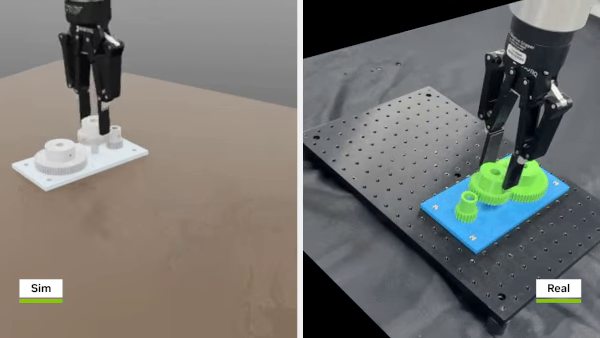
The incoming gear must mesh with its neighbors as it seats on the shaft; aligning the center hole alone is not enough. Frame from Isaac Lab’s gear-insertion tutorial. Watch the assembly in motion#
The first robot is programmed to pick rigid parts and place them into a roomy box. A perception system can estimate the pose of the parts and the box, and a motion planner can find a collision-free path. The robot can execute that motion and release each part, with room for small placement errors.
The second robot must install the final gear so its teeth mesh with the gears already in place. Reaching the right position is not enough: the teeth can collide and prevent the gear from seating. Small differences in alignment and friction change which adjustments succeed, making a reliable controller harder to design and tune. With robot learning, the robot can acquire these corrective motions through repeated attempts in simulation.
Robot learning is the use of machine learning methods to improve robot behavior from data, demonstrations, or interaction with its environment. Robot learning is a subfield of physical AI, which is the study of artificial intelligence (AI) in systems that operate physically in our world. Examples of physical AI include autonomous vehicles, robotic arms, and smart spaces.
Robot learning is different from:
Classical robotics. Robot learning emphasizes learning from data and experience. Classical approaches rely more on explicitly designed models, planning algorithms, and explicit feedback control.
AI outside physical systems. A robot must act through a physical body, in a world that changes around it: objects move, people enter the workspace, and contacts change. It must also handle uncertain sensing and hardware limits. An AI system that works only with digital inputs and outputs does not face those same physical constraints.
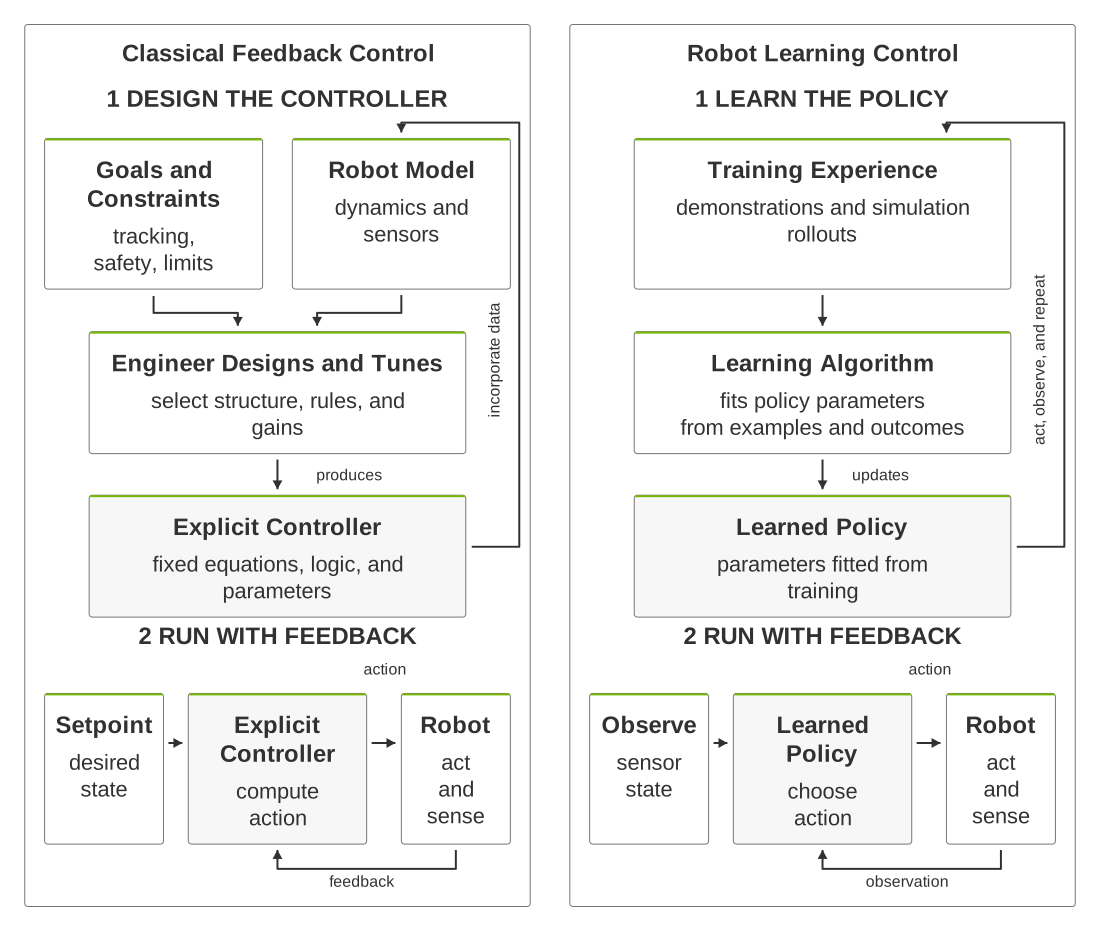
Both approaches use feedback at runtime; learning changes how the controller is created.#
In robotics, an action (such as gripping an object) changes the next observation (the object has moved and is now partially occluded by the gripper). A slightly misplaced grasp can move an object, hide it from the camera, or cause a drop. Errors can compound across subsequent decisions. In classical robotics, engineers design controllers to handle these feedback loops.
Robot learning does not require every part of the system to be learned. A practical robot might use a learned model to recognize objects, a classical motion planner to calculate a collision-free path, and a conventional controller to execute the movement. Engineers decide which components benefit from learning and which should use explicit models or safety rules.
This brings us to the two main reasons for robot learning: adaptation and generalization. Robot learning enables a system to handle variation that would be difficult to cover with fixed instructions. The central challenge is that the learned behavior must work reliably in the physical world, where mistakes have real consequences.
Review#
Check Your Understanding#
What distinguishes a learned robot policy from a programmed controller?
Answer
A learned policy uses parameters fitted from data or experience. A programmed controller uses explicitly designed rules or models. Both can respond to sensor feedback, so feedback alone does not establish learning.
Apply What You Learned#
For a robot behavior you know, how would a programmed approach and a learned approach differ? Describe the sensors and actions, the rules you would program, and the data a learned version would need. Identify which component would change through training.
Agent Tutor Prompt
Copy this prompt and include your answer:
Review my answer to this question: For a robot behavior you know, how would a programmed approach and a learned approach differ? Describe the sensors and actions, the rules you would program, and the data a learned version would need. Identify which component would change through training.
My answer: [paste your answer here].
Check whether I distinguish programmed rules from parameters fitted through training, connect the training data to the learned component, and explain how sensors and actions support the behavior. Ask for missing context rather than assuming it. Identify what I explained well, point out one gap or misconception, and ask a follow-up question that helps me improve my answer. Let me revise it before supplying a complete answer.
Key Takeaways#
Learned parameters distinguish robot learning from programmed feedback control.
Physical interaction changes future observations and creates practical constraints.
Isaac Lab lets you collect repeated simulated experience before evaluating a learned policy.