

Robot Learning Workflows#
Let’s bring these ideas together. A robot learning workflow begins with a task specification: what the policy observes, which actions it controls, how episodes begin and end, and what counts as a success or failure.
The learning method determines how experience changes the policy. In reinforcement learning, rewards guide that update, while a separate evaluation checks whether the resulting behavior meets the task’s goal.
In Isaac Lab, these ideas become environment and learning configurations. The environment determines what happens at each step, and the learning configuration determines how experience updates the policy. The diagram below connects the concepts in this module to the workflow you will explore in Isaac Lab Basics.
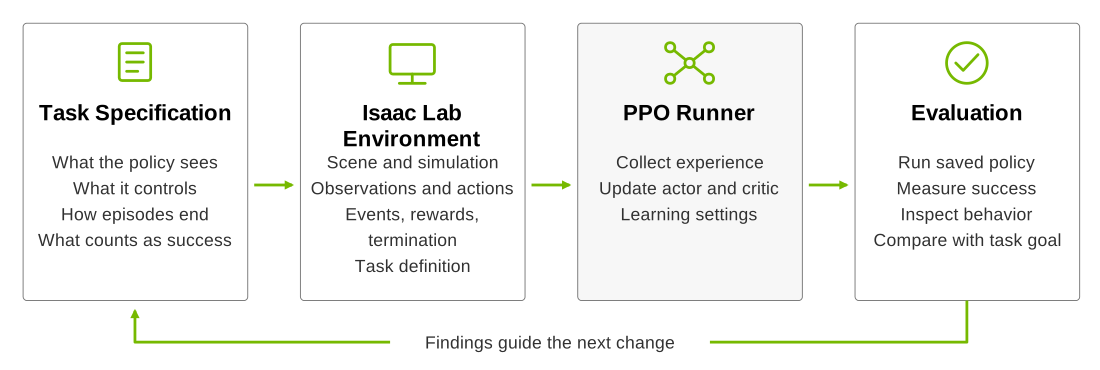
The task configuration defines experience, the PPO runner learns from it, and evaluation checks the resulting behavior against the original goal.#
Connect the Concepts to the Coming Lessons#
Isaac Lab Basics introduces the tools and workflow for building a simulated task, checking its behavior, and training a policy. Train a Robot Arm then applies that workflow to an SO-101 arm placing a vial in a rack.
Use the concepts from the preceding lessons to understand what each stage is trying to accomplish:
Task specification becomes a simulated environment. The observations, actions, resets, and ending conditions from Problem Specification describe what a policy can sense and control. Upcoming lessons explore how Isaac Lab represents those choices and how to check them before training.
Interaction becomes training experience. The transitions and rollouts from Reinforcement Learning connect simulation steps to the actor and critic updates introduced in Proximal Policy Optimization. You will follow that loop when training a cartpole policy and a robot teacher policy.
Rewards guide learning; evaluation checks the goal. As discussed in Reward Design and Policy Evaluation, a rising reward curve needs to be checked against observed behavior and task success. Later lessons compare simple-agent baselines, trained policies, recordings, and evaluation results.
Policy inputs constrain deployment. Policy Distillation distinguishes a teacher with privileged simulation observations from a student using available sensor observations. The robot lessons explore that distinction with a state-based teacher and a camera-based student.
Simulation success is evidence with limits. The mismatches discussed in Simulation to Reality explain why success in a simulated task does not establish success on hardware. Keep that boundary in mind when interpreting the policies you will train.
Review#
Check Your Understanding#
Where do the task specification and learning configuration appear in the Isaac Lab workflow? How do they relate to each other?
Answer
The task specification appears in Isaac Lab’s environment configuration: it defines the scene, observations, actions, reset events, rewards, and termination conditions. These choices determine what the policy can sense and control, and what experience the environment produces.
The learning configuration appears in the PPO runner configuration. It determines how rollouts collected from the environment are used to update the policy through actor and critic learning.
The two work together: the environment defines the experience, and the runner learns from that experience. Evaluation then checks whether the trained policy achieves the original task goal, rather than relying on reward alone.
Apply What You Learned#
Consider any robot system you find interesting. How would you sketch a workflow from task definition through training to evaluation? Identify the task inputs and actions, training experience, policy updates, and evidence of task success.
Agent Tutor Prompt
Copy this prompt and include your answer:
Review my answer to this question: Consider any robot system you find interesting. How would you sketch a workflow from task definition through training to evaluation? Identify the task inputs and actions, training experience, policy updates, and evidence of task success.
My answer: [paste your answer here].
Check my reasoning about observations, actions, rewards, collected experience, updates, and evidence of task success. Ask for missing context rather than assuming it. Identify what I explained well, point out one gap or misconception, and ask a follow-up question that helps me improve my answer. Let me revise it before supplying a complete answer.
Key Takeaways#
The environment configuration implements the task specification.
The PPO runner configuration determines how collected experience updates the policy.
The coming lessons explore these connections first with cartpole, then with the SO-101 vial-placement task.