

Overall Architecture

Dynamo is a distributed inference runtime for generative AI systems that must operate at high throughput, low latency, and high reliability under changing traffic conditions. It is backend-agnostic (SGLang, TRT-LLM, vLLM, and others) and is built around three cooperating concerns:
- A fast request path for token generation
- A responsive control path for scaling and placement
- A resilient state path for KV reuse and failure recovery
This document presents Dynamo as an architecture, not a feature list: what each plane owns, how requests move, how the system adapts, and how it remains correct under failure.
Design Goals
Dynamo is designed to satisfy the following goals simultaneously:
- Latency stability: keep TTFT and ITL predictable under bursty and mixed-length traffic.
- GPU efficiency: disaggregate prefill and decode so each can scale independently.
- Compute reuse: minimize KV recomputation through KV-aware routing and cache lifecycle management.
- Operational resilience: treat worker crashes, restarts, and overload as normal operating events.
- Deployment portability: support Kubernetes-native control paths and non-Kubernetes runtime modes.
Why This Architecture Exists
Modern LLM serving hits recurring bottlenecks:
- Prefill/decode imbalance leaves GPUs underutilized when traffic mix shifts (DistServe).
- KV recomputation increases TTFT and wastes compute when routing ignores cache overlap (DeepSeek).
- Memory pressure from long contexts and concurrency exceeds HBM capacity without multi-tier cache management (KVBM, Mooncake, AIBrix, FlexKV, LMCache).
- Dynamic demand breaks static provisioning assumptions (AzureTrace).
- Real-world failures (pod restart, partition, hot-spot overload) require first-class recovery behavior.
Dynamo addresses these constraints by separating serving, control, and state propagation into explicit planes and control loops.
Architecture Overview
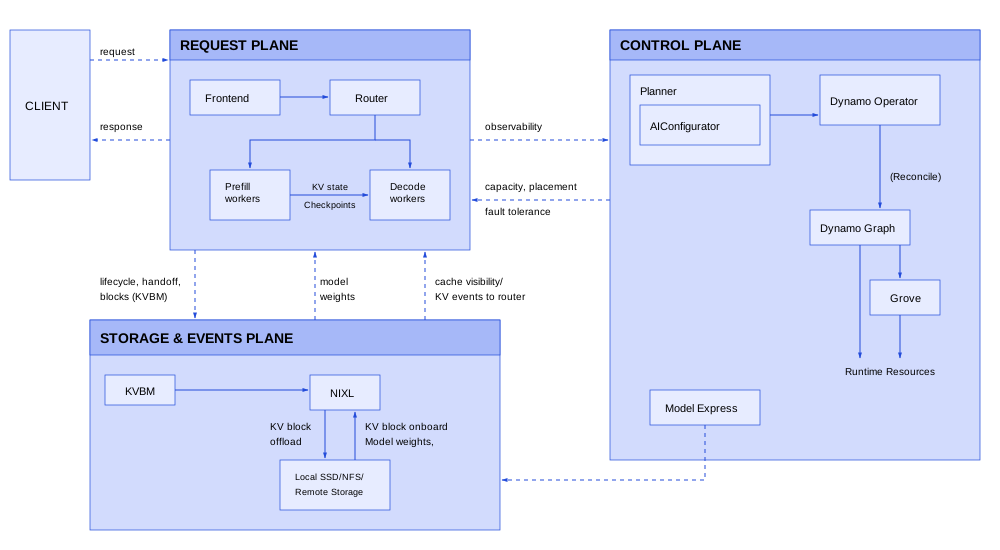
System Model
Request Plane (critical data path)
The request plane is responsible for request/response execution:
- Frontend accepts and normalizes requests.
- Router selects workers based on load and KV overlap.
- Prefill workers compute prompt KV state.
- Decode workers generate output tokens.
This path is optimized for low overhead and continuous token streaming.
Control Plane (adaptation and orchestration path)
The control plane is responsible for desired-state management:
- Planner computes scaling targets from live metrics.
- Dynamo Operator reconciles Kubernetes resources from Dynamo CRDs.
- Discovery + Endpoints/CRD establish liveness and discoverability.
- Grove/KAI Scheduler path provides topology-aware placement and grouped scaling in multinode Kubernetes deployments.
- Model Express is an optional model-management endpoint when configured.
This path is optimized for correctness and convergence to target capacity.
Storage & Events Plane (state propagation path)
The storage/events plane is responsible for cache state visibility and movement:
- KV Events publish cache lifecycle transitions.
- KVBM manages block reuse, eviction, and offload/recall across memory tiers.
- NIXL performs high-speed KV/data transfer across workers and memory domains.
This path is optimized for cache reuse and cross-worker handoff efficiency.
End-to-End Request Narrative (Disaggregated Mode)
- Client sends request to Frontend.
- Frontend validates/preprocesses and forwards to Router.
- Router chooses a Prefill worker.
- Prefill computes KV and returns transfer metadata.
- Router chooses a Decode worker.
- Decode receives KV state (typically via NIXL transfer path).
- Decode streams tokens back through Frontend.
- KV Events update cache visibility for future routing decisions.
- KVBM may offload or recall KV blocks based on pressure and reuse potential.
For flow-level detail, see Architecture Flow. For request transport options, see Request Plane.
Control Loops
Serving Loop
Maintains low-latency request execution across frontend, router, prefill, and decode workers.
Planning Loop
Maintains capacity alignment with demand:
- Planner consumes runtime metrics.
- Planner computes prefill/decode targets.
- Connector layer applies targets to runtime resources.
Planner supports throughput-based and load-based strategies. See Planner Design.
Resilience Loop
Maintains system continuity under failure:
- Health checks detect unhealthy workers.
- Discovery liveness removes stale endpoints.
- Graceful shutdown drains in-flight work.
- Request migration/cancellation controls in-flight behavior.
- Load shedding prevents cascading collapse under overload.
See Fault Tolerance.
Kubernetes-Native Realization (CRD + Grove)
In Kubernetes deployments, the same architecture maps to declarative resources:
- Dynamo Operator reconciles
DynamoGraphDeployment. - Discoverability is derived from
DynamoWorkerMetadata+ EndpointSlices. - Grove-backed multinode deployments model worker groups as
PodCliqueSetandPodClique. - Independent prefill/decode elasticity is represented via
PodCliqueScalingGroupwith separatereplicasandmintargets.
The diagram labels such as PodClique A/B, ScalingGroup "Prefill", ScalingGroup "Decode", and (replicas, min) represent this grouped scaling model.
Deployment Modes
The request plane can be exposed in two ways:
- Standalone mode (default) — the Dynamo Frontend is the request entry point and the integrated Dynamo Router selects workers using KV-aware scoring. Used by all local installs and the default Kubernetes deployment.
- Gateway mode (GAIE) — Dynamo runs behind a Kubernetes Gateway API Inference Extension gateway. KV-aware routing is performed at the gateway layer by the Dynamo Endpoint Picker Plugin (EPP); the Frontend runs as a sidecar in
--router-mode directand respects the EPP’s per-request worker selection passed via request headers.
Both modes share the same control plane, storage/events plane, and backend integrations — only the request entry point and the location of the routing decision differ. See the Inference Gateway (GAIE) guide for the gateway-mode setup and configuration reference.
Fault Tolerance Architecture
Fault tolerance is embedded across layers:
This model assumes failures are routine, not exceptional.
Performance Rationale
Disaggregated Serving
Separating prefill and decode improves utilization and enables phase-specific scaling.
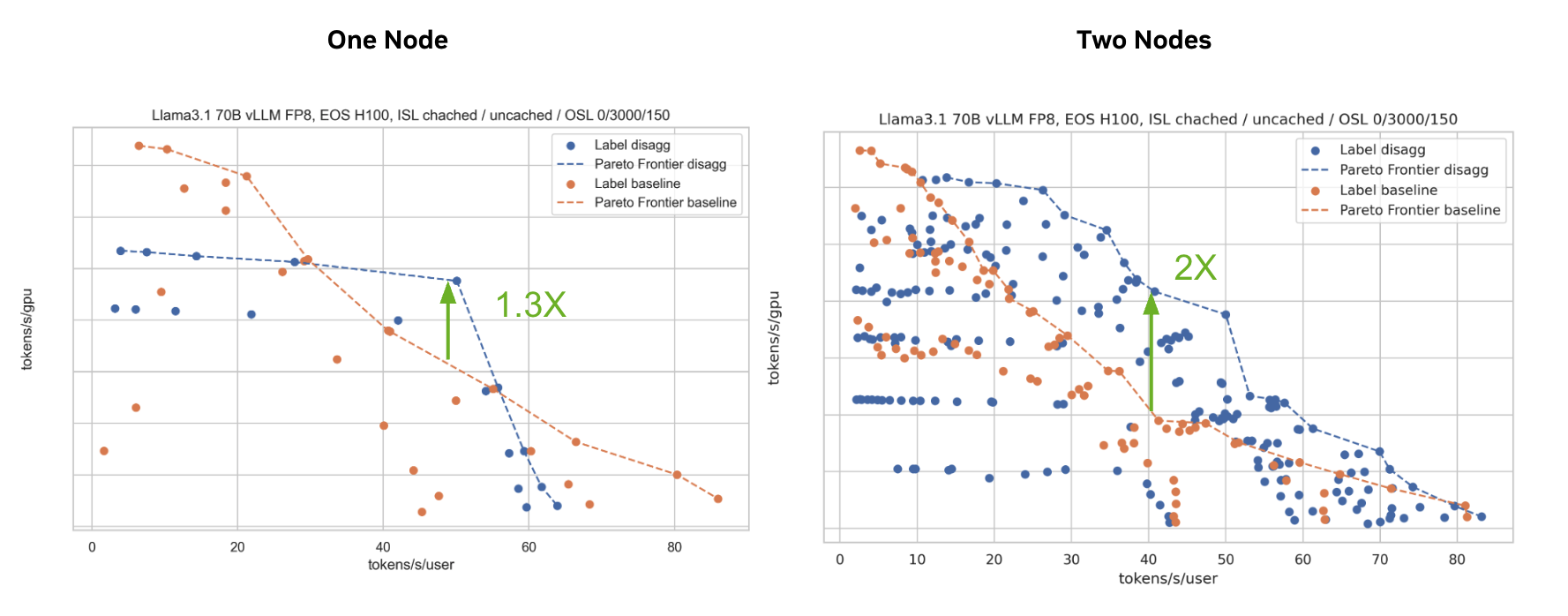
Tested on H100 with R1 Distilled Llama 70B FP8 on vLLM. 3K ISL / 150 OSL.
KV-Aware Routing
Routing with cache overlap + load signals reduces prefill recomputation and improves latency. For an external production case study, see How Baseten achieved 2x faster inference with NVIDIA Dynamo.
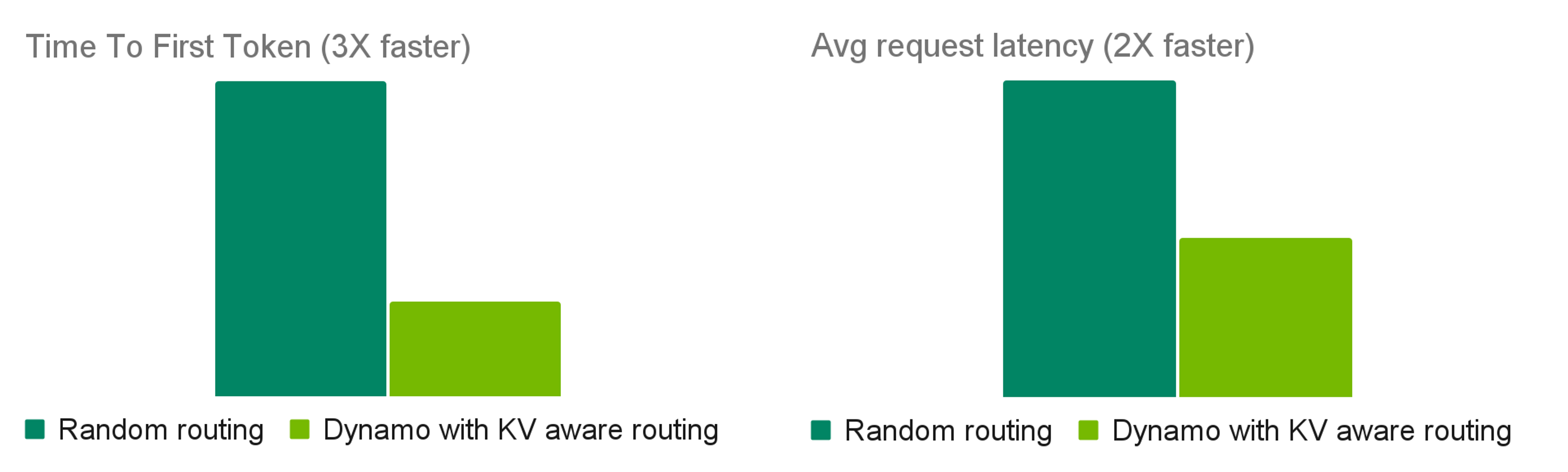
Tested with 100K requests to R1 using R1 Distilled Llama 70B FP8 on 2 H100 nodes. Avg 4K ISL / 800 OSL.
KV Block Manager (KVBM)
KVBM extends effective cache capacity using multi-tier memory offload/recall.
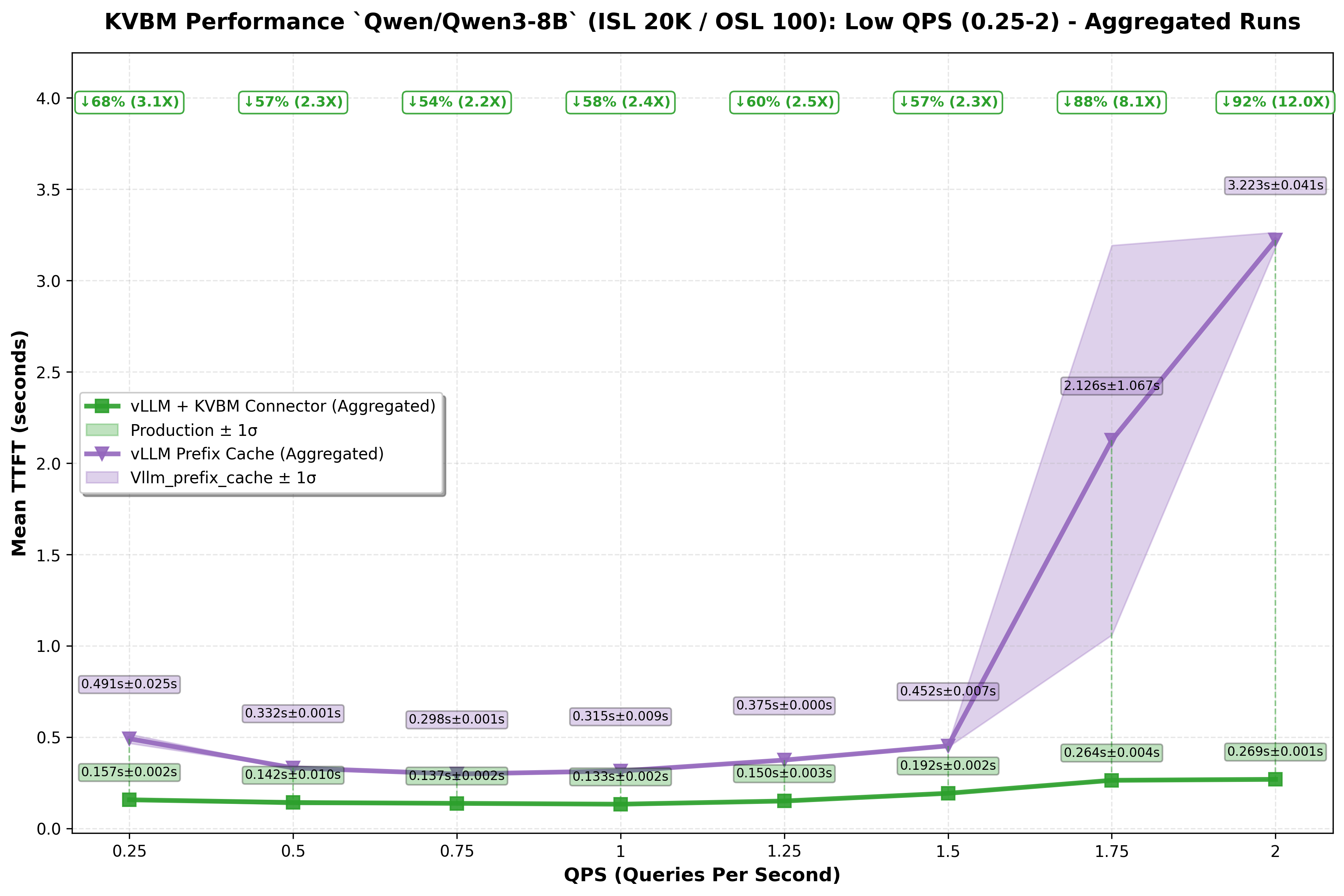
Tested across QPS values using Qwen3-8B on H100. Avg 20K ISL / 100 OSL.
NIXL Data Transfer
NIXL reduces KV handoff cost in distributed serving by optimizing cross-worker transfer behavior across heterogeneous memory.
Implementation Model
- Rust for performance-sensitive runtime components.
- Python for backend integration and extensibility.
- Modular subsystem boundaries so routing, planning, memory, and transport can evolve independently.
Related Documentation
- Architecture Flow
- Router Design
- Planner Design
- Discovery Plane
- Event Plane
- Request Plane
- Fault Tolerance
- Grove
Acknowledgements
Dynamo is informed by prior open-source work from:
- vLLM
- SGLang
- DistServe
- Mooncake
- AIBrix
- BentoML