

Quantization (PTQ + QAD)#
The released Nemotron 3.5 Super NVFP4 checkpoint (nvidia/NVIDIA-Nemotron-3.5-Super-VL-120B-A12B-NVFP4) is produced with NVIDIA Model Optimizer: post-training quantization (PTQ) with the predefined aggressive recipe, followed by 200 iterations of SFT-based Quantization-Aware Distillation (QAD). It reaches 99.52% median accuracy recovery relative to BF16 across 35 benchmarks, with a mean per-benchmark verbosity increase of 0.49%.
This page summarizes §4–5 of the tech report. Quantization is not a nemotron super35 stage: to quantize your own Super 3.5 checkpoint (for example your own fine-tune), see Recipe Execution, which runs the released precision recipe through PTQ → QAD → export with Megatron-Bridge, using Model Optimizer’s NemotronH Omni VL W4A4 tutorial.
Precision Recipes#
The released checkpoint uses the Aggressive column (Table 12 of the report). Bits per element (BPE) counts stored payload including scales over all original parameters, including vision, MTP, and unquantized modules: 74.987 GB over 124.453B parameters gives 4.82 BPE.
Layer |
BF16 |
FP8 |
Conservative |
Aggressive (released) |
Very aggressive (not released) |
|---|---|---|---|---|---|
C-RADIO encoder |
BF16 |
BF16 |
BF16 |
BF16 |
BF16 |
VL connector |
BF16 |
BF16 |
BF16 |
BF16 |
BF16 |
MoE + shared-expert GEMMs |
BF16 |
FP8 |
NVFP4 |
NVFP4 |
NVFP4 |
Latent down/up projection |
BF16 |
FP8 |
BF16 |
BF16 |
NVFP4 |
Router / gate (compute) |
FP32 |
FP32 |
FP32 |
FP32 |
FP32 |
Attention QKV / out projection |
BF16 |
FP8 |
BF16 |
FP8 |
NVFP4 |
KV cache |
BF16 |
FP8 |
FP8 |
FP8 |
FP4 |
BMM1 (QKᵀ) |
BF16 |
FP8 |
FP8 |
FP8 |
FP4 |
BMM2 (PV) |
BF16 |
FP8 |
FP8 |
FP8 |
FP8 |
Mamba linear |
BF16 |
FP8 |
BF16 |
FP8 |
NVFP4 |
Mamba SSM cache |
FP32 |
FP32 |
FP32 |
FP16 + stochastic rounding |
FP16 + stochastic rounding |
Mamba convolution |
BF16 |
BF16 |
BF16 |
BF16 |
BF16 |
Embedding |
BF16 |
BF16 |
BF16 |
BF16 |
BF16 |
lm_head |
BF16 |
FP8 |
BF16 |
FP8 |
W4A16 |
Avg. BPE |
16.00 |
8.10 |
5.15 |
4.82 |
4.64 |
The released checkpoint also contains the quantized, boosted MTP head. It was evaluated with an FP8 KV cache; ablations showed comparable accuracy with an NVFP4 KV cache (99.36% vs. 99.52% median recovery).
Acceptance Criteria#
Recipes are developed between conservative and aggressive bookends and must meet:
Median accuracy recovery ≥ 99% — the median over benchmarks of the NVFP4 / BF16 score ratio, averaged over repeats.
Verbosity increase ≤ 5% relative to BF16.
PTQ#
Aspect |
Choice |
|---|---|
Calibration data |
1,024 image–text samples from the post-training SFT data; images go through the vision encoder so the language model sees projected visual tokens |
Calibration parallelism |
Data parallel × expert parallel across 4 ranks (256 samples each), routed and MTP experts split evenly; vision, attention, and Mamba layers replicated |
Weight-scale selection |
MSE (per-block scale search over FP8 values) — better recovery than max-based or MSE 4-over-6 scales |
ModelOpt AutoQuantize was also explored as a sensitivity-driven alternative: it assigns NVFP4, FP8, or BF16 per module to minimize total sensitivity under a target bitwidth. The sensitivity profile is highly non-uniform — the lm_head accounts for nearly half the NVFP4 sensitivity, attention and Mamba projections come next, and MoE experts are comparatively robust.
QAD#
QAD starts from the calibrated PTQ student and distills the BF16 model into it with a KL-divergence objective.
Parameter |
Value |
|---|---|
Trainable |
Weights of language-model GEMMs with enabled quantizers only (embeddings, norms, vision encoder, projector, MTP, router bias frozen) |
Quantizer state |
Restored from PTQ, not recalibrated |
Losses |
KL only (no hard-target CE, MTP CE, load-balancing, or feature distillation) |
Optimizer |
Distributed AdamW, β₁ = 0.9, β₂ = 0.95, ε = 1e-8, weight decay 0.1, clip 1.0 |
Learning rate |
Linear warm-up to 5e-6 over ~9,100 source records, then constant |
Data |
100% SFT blend (a 75/25 SFT/RL-rollout mix gave only modest benefits) |
Scale |
128 nodes × 4 GB200 (512 GPUs); about 2 hours per 100 iterations |
Selected |
4.82-BPE aggressive recipe at 200 iterations |
Additional QAD iterations were not uniformly helpful: the best iteration count depended on the recipe, and gains largely saturated by 300 iterations.
Results#
Selected rows from the BF16 vs. released NVFP4 comparison (Table 22 of the report):
Benchmark |
BF16 |
NVFP4 |
Recovery |
|---|---|---|---|
SWE-bench Verified |
71.10 |
71.07 |
99.95% |
SWE-bench Pro |
51.78 |
51.30 |
99.08% |
Terminal-Bench 2.1 |
60.67 |
62.78 |
103.47% |
LiveCodeBench v6 |
88.22 |
87.41 |
99.08% |
GPQA-Diamond (no tools) |
89.52 |
89.90 |
100.42% |
HLE (no tools, text) |
31.79 |
31.44 |
98.91% |
CharXiv (RQ) |
80.82 |
79.88 |
98.85% |
MathVision |
78.16 |
77.79 |
99.52% |
Video-MME-v2 |
32.85 |
32.54 |
99.05% |
MMLongBench-Doc |
62.82 |
62.82 |
100.00% |
AA-LCR |
68.62¹ |
67.69 |
98.63% |
IFBench |
70.86 |
71.50 |
100.90% |
MMLU-ProX |
76.91 |
73.76 |
95.90% |
Median recovery (35 benchmarks) |
99.52% |
||
Verbosity change (ratio of totals) |
+0.49% |
¹ Table 22 lists the BF16 AA-LCR score as 68.62; Table 10 lists 68.63.
Verbosity excludes non-completed Terminal-Bench rollouts: about 4.5% runaway trajectories of roughly 700K tokens each dominate that benchmark’s mean, and including them raises the ratio-of-totals change to 2.99%.
MTP Drafter Precision#
The MTP module (one attention layer and one MoE layer) shares the checkpoint’s single lm_head. Profiling shows the MTP experts and the lm_head dominate drafting latency, so the released checkpoint quantizes the MTP experts to NVFP4 W4A4 (MTP attention weights stay BF16) and the shared lm_head to FP8. This barely changes acceptance length while speeding up drafting (Table 20; SPEED-Bench, temperature 1; speedup projected at draft length 5 on one GB200 relative to the NVFP4 backbone with unquantized MTP and lm_head):
Backbone / LM head |
MTP experts / MTP LM head |
Acceptance length, draft 5 |
Acceptance length, draft 7 |
Projected speedup |
|---|---|---|---|---|
BF16 / BF16 |
BF16 / BF16 |
4.115 |
4.612 |
— |
NVFP4 / BF16 |
BF16 / BF16 |
4.109 |
4.592 |
1.000 |
NVFP4 / BF16 |
NVFP4 / BF16 |
4.066 |
4.518 |
1.043 |
NVFP4 / BF16 |
NVFP4 / FP8 |
4.069 |
4.514 |
1.114 |
NVFP4 / BF16 |
NVFP4 / W4A16 |
4.031 |
4.469 |
1.136 |
NVFP4 / FP8 |
NVFP4 / FP8 (released) |
4.063 |
4.520 |
1.127 |
NVFP4 / FP8 |
NVFP4 / W4A16 |
4.025 |
4.471 |
1.150 |
The MTP KV cache must use the backbone’s precision. The released checkpoint was built by quantizing the boosted MTP separately and splicing it into the quantized backbone; the report recommends co-quantizing both in future releases.
Deployment and Serving#
The NVFP4 checkpoint runs in one of two modes, depending on the GPU:
Platform |
Mode |
Notes |
|---|---|---|
Blackwell (B200, GB200, GB300) |
W4A4 |
NVFP4 weights and activations |
Non-Blackwell (for example H100) |
W4A16 |
NVFP4 weights, 16-bit activations |
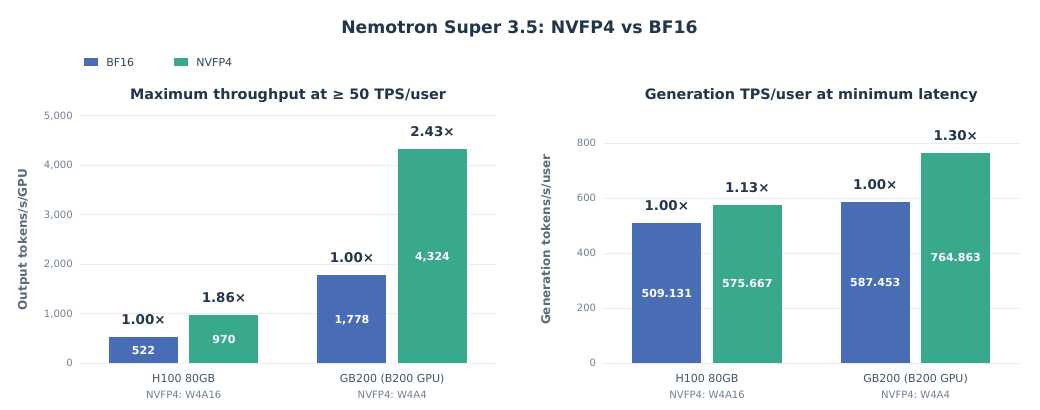
Figure 10 measures serving with vLLM on a 20-turn agentic proxy workload (2K input / 1K output tokens per turn). Peak throughput is output tokens/s/GPU at ≥ 50 tokens/s/user; speed at minimum latency is generation tokens/s/user.
Platform |
Peak throughput, BF16 → NVFP4 |
Speed at minimum latency, BF16 → NVFP4 |
|---|---|---|
H100 80GB (W4A16) |
522 → 970 (1.86×) |
509 → 576 (1.13×) |
GB200 (W4A4) |
1,778 → 4,324 (2.43×) |
587 → 765 (1.30×) |
The report’s inference work (§5) targets interactive, long-context agentic serving in vLLM:
Prefix caching + speculative decoding: an extra Mamba cache checkpoint near the speculative-decoding replay boundary avoids replaying a whole Mamba cache block to recover the drafter’s hidden state.
Per-quantization GEMM backend selection for mixed-precision checkpoints at intermediate batch sizes.
Internal prefill checkpoints write reusable Mamba states without splitting the prefill forward pass.
ReplaySSM (checkpointing replay for the Mamba state) stores a checkpointed state plus a small buffer of recent inputs instead of writing every speculative state. On one GB200 with a 16-step buffer it raises output throughput by 4.7–6.4% and per-user generation speed by 6.4–12.5% (Table 23).
Headline numbers:
Peak throughput: up to 4,632 output tokens/s/GPU on GB200 at ≥ 50 tokens/s/user (abstract and conclusion; Table 23: one GB200, concurrency 64, 5 speculative tokens, ReplaySSM off; 4,856 with ReplaySSM on).
Against Qwen3.8 Flash-Next: the abstract and conclusion quote 2.88× under the evaluated interactive agentic workload. Figure 11, at the same ≥ 50 tokens/s/user threshold, shows 4,331.88 output tokens/s/GPU on GB200 against 2,282.73 for Qwen3.8 Flash-Next (1.90×) and 1,854.35 for Qwen3.5-122B-A10B (2.34×). The report does not reconcile the two.
Disaggregated serving of the NVFP4 checkpoint with NVIDIA Dynamo and vLLM on 11 Vera Rubin (VR200) GPUs, replaying SWE-bench Pro agentic sessions (Table 24):
Deployment |
Concurrency |
Output tokens/s/GPU |
Tokens/s/user (median) |
TTFT (median) |
|---|---|---|---|---|
Aggregated (11 instances) |
616 |
2,969 |
96.6 |
0.49 s |
Disaggregated (7 prefill + 4 decode GPUs) |
528 |
3,276 (+10.3%) |
155.9 (+61%) |
1.12 s |
Recipe Execution#
Model Optimizer’s NemotronH Omni VL W4A4 PTQ + QAD tutorial quantizes this architecture (NemotronH_Omni_Reasoning_V3, which Megatron-Bridge maps to its Super-VL bridge) with Megatron-Bridge: PTQ → QAD → Hugging Face export → vLLM serving. Its PTQ recipe is the report’s released Aggressive tier; its calibration, QAD data, and QAD scale are smaller and public. The commands below are summarized from the tutorial; follow it for the full notes.
Where the Tutorial Differs from the Report#
Aspect |
Tech report (released checkpoint) |
Model Optimizer tutorial |
|---|---|---|
Precision recipe |
Aggressive tier (Table 12) |
|
Calibration |
1,024 image–text samples from the SFT data |
512 text-only samples ( |
QAD data |
SFT blend |
35,800 conversations from 11 public Nemotron chat datasets ( |
QAD scale |
512 GB200 GPUs, 200 iterations, LR 5e-6 constant after warm-up |
32 GB300 GPUs, 600 iterations, GBS 64 at 32K, LR 2e-5 → 5e-6 |
MTP head |
Boosted MTP quantized separately, then spliced in |
Quantized in PTQ, frozen during QAD ( |
Checkpoint size |
74.987 GB |
70 GB |
Setup#
The tutorial runs in the NeMo 26.08 container (nvcr.io/nvidia/nemo:26.08) on GB300 (4 GPUs per node), with Model Optimizer mounted at /opt/Model-Optimizer and Megatron-Bridge main at /opt/Megatron-Bridge. Serving NVFP4 W4A4 requires a Blackwell GPU.
Step 1 — Data#
# Set output_dir in data_blend.yaml first; writes train.jsonl (35,800) and validation.jsonl (1,000)
python -m modelopt.torch.utils.plugins.prepare_megatron_data_blend --config data_blend.yaml
Step 2 — PTQ (one 4-GPU node)#
torchrun --nproc_per_node 4 /opt/Model-Optimizer/examples/megatron_bridge/quantize.py \
    --hf_model_name_or_path nvidia/NVIDIA-Nemotron-3.5-Super-VL-120B-A12B-BF16 \
    --trust_remote_code \
    --recipe model_type/nemotron_h/ptq/nvfp4-aggressive-mse \
    --tp_size 1 --ep_size 4 --pp_size 1 \
    --calib_dataset_name cnn_nemotron_v2_mix --calib_num_samples 512 --calib_batch_size 1 \
    --export_megatron_path /path/to/super35_w4a4_megatron \
    --skip_generate
--tp_size 1 is required: static NVFP4 weight scales are not supported with tensor parallelism, so expert parallelism spreads the experts instead.
Step 3 — QAD (8 nodes × 4 GB300)#
QAD distills the frozen BF16 teacher into the PTQ student with a logit KL loss only. Launch one task per GPU (32 in all) with srun, mapping the Slurm rank variables to RANK / WORLD_SIZE / LOCAL_RANK; the tutorial has the full sbatch script. Each task runs:
python -u /opt/Model-Optimizer/examples/megatron_bridge/distill.py \
    --teacher_hf_path nvidia/NVIDIA-Nemotron-3.5-Super-VL-120B-A12B-BF16 \
    --student_hf_path nvidia/NVIDIA-Nemotron-3.5-Super-VL-120B-A12B-BF16 \
    --student_megatron_path /path/to/super35_w4a4_megatron \
    --trust_remote_code \
    --tp_size 1 --pp_size 1 --cp_size 4 --ep_size 32 \
    --sft --sft_hf_dataset /path/to/qad_blend/train.jsonl \
    --sft_hf_validation /path/to/qad_blend/validation.jsonl \
    --sft_loss_mode assistant \
    --freeze_mtp \
    --seq_length 32768 --mbs 1 --gbs 64 --train_iters 600 \
    --lr 2e-5 --min_lr 5e-6 --lr_warmup_iters 30 \
    --recompute_granularity full --recompute_method uniform --recompute_num_layers 1 \
    --no_async_save --save_interval 100 --checkpoint_keep_last -1 \
    --eval_iters 4 --eval_interval 100 --log_interval 10 \
    --output_dir /path/to/qad_output
Each saved iteration is about 1.6 TB; size --save_interval and --checkpoint_keep_last to your storage.
Step 4 — Export to Hugging Face (one 4-GPU node)#
torchrun --nproc_per_node 4 /opt/Model-Optimizer/examples/megatron_bridge/export_quantized_megatron_to_hf.py \
    --hf_model_name_or_path nvidia/NVIDIA-Nemotron-3.5-Super-VL-120B-A12B-BF16 \
    --trust_remote_code \
    --megatron_path /path/to/qad_output/checkpoints \
    --export_unified_hf_path /path/to/super35_w4a4_hf \
    --pp_size 4
The exporter writes the quantized language model (including the MTP head) and copies the vision tower and projector from the BF16 checkpoint. It exports the latest iter_* under --megatron_path.
Tutorial Results#
Served with vLLM on one 4-GPU GB300 node (TP4 with expert parallelism; FP8 KV cache for the quantized checkpoints, FP16 Mamba SSM cache with stochastic rounding, nemotron_v3 reasoning parser):
Benchmark |
BF16 |
W4A4 PTQ |
W4A4 QAD (600 iters) |
|---|---|---|---|
AA-LCR |
68.63 |
68.62 |
67.94 |
AA-Omniscience |
26.21 |
25.63 |
25.87 |
GPQA Diamond |
89.52 |
89.84 |
89.90 |
HLE (no tools) |
31.79 |
30.49 |
30.72 |
MMLU-ProX |
76.91 |
74.41 |
81.15 |
SciCode (subtask) |
47.13 |
46.48 |
46.58 |
τ³-bench banking |
18.88 |
17.40 |
20.10 |
These are the tutorial’s numbers for its own checkpoint, not the released one (see Results). Most of the MMLU-ProX gain after QAD comes from fewer responses missing the required answer phrase.
Reference#
Nemotron 3.5 tech report, §4 (Quantization), §5 (Inference)
NVIDIA Model Optimizer — PTQ, AutoQuantize, QAD
NemotronH Omni VL W4A4 PTQ + QAD tutorial — the commands in Recipe Execution
Nemotron 3.5 Lightning quantization — PTQ + QAD workflow with the same tooling
Nemotron 3 Super quantization — Mamba-MoE quantization configs and Megatron-Bridge scripts