

Baselines
Baseline Evaluation Metrics
On your training job’s evaluation page, Kumo compares your model against heuristic baselines for temporal binary classification, link prediction, and regression tasks. These baselines show how much your model improves over simple heuristic-based approaches.
Kumo computes baselines at the per-entity level:
- Regression tasks use past labels as forecasts.
- Link prediction tasks recommend past user behavior as future predictions.
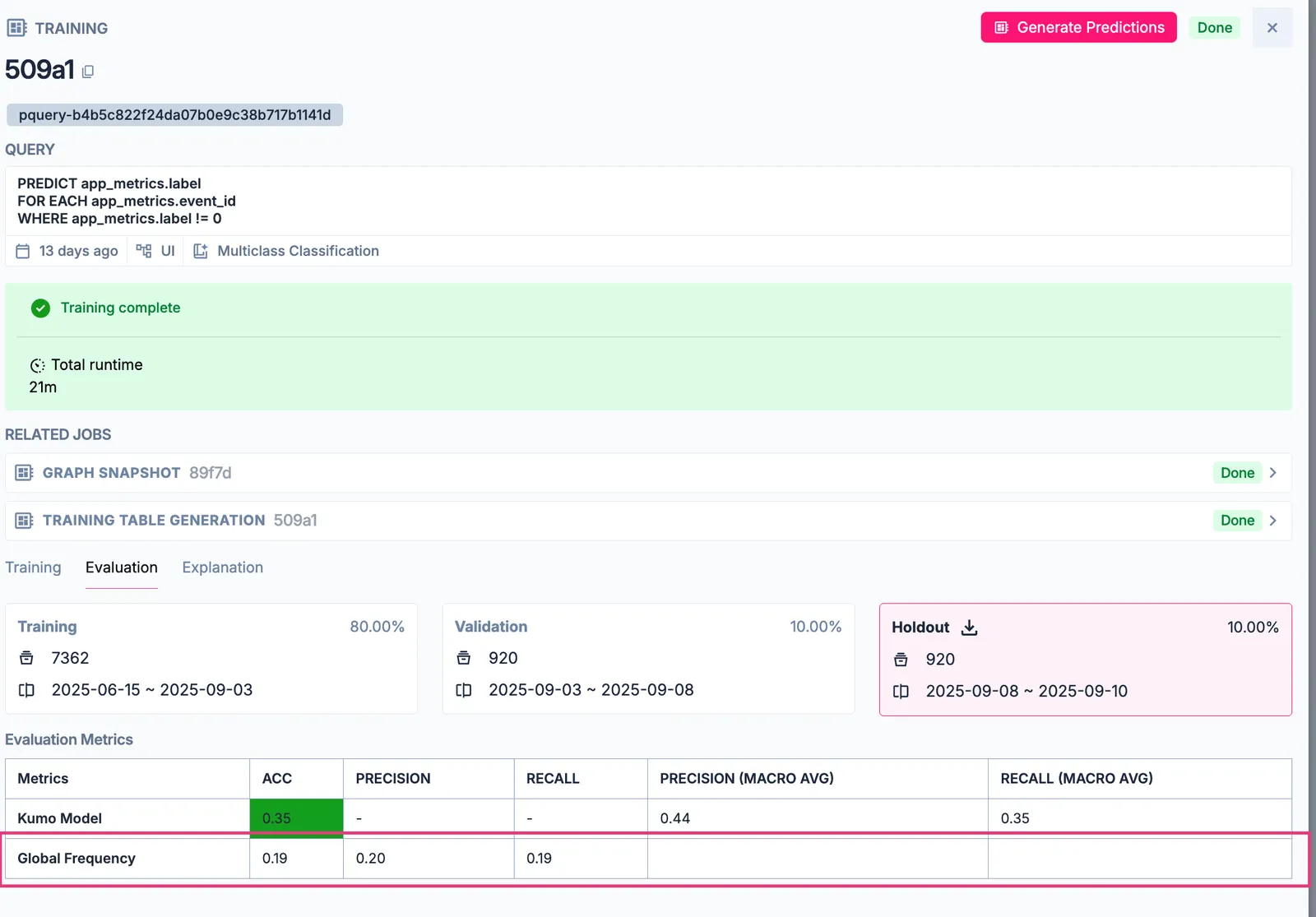
Kumo does not support baselines when timeframe_step is None.
Baselines Per Task Type
The following table describes the baselines Kumo supports, organized by prediction task type:
Why Use Baselines?
Baselines provide a reference point for measuring how much your Kumo model improves over simple heuristics. A well-performing model should outperform these baselines significantly.