

Kumo AI SaaS Security White Paper
Introduction
Kumo prioritizes the security of its services and is committed to the highest standards of protection. Technical controls are only part of the picture: the processes and people involved in keeping the platform secure and your data safe are equally important.
Our security approach uses layered controls across Kumo’s AI SaaS cloud infrastructure: access management, least privilege access, strong authentication, logging and monitoring, and vulnerability management including external penetration testing.
We proactively monitor and manage systems to identify critical security issues. When issues are identified, they are thoroughly evaluated and promptly resolved.
We follow industry-standard information security frameworks such as NIST 800-53 and the ISO 27000 series. Our goal is to make users feel confident using our service for their most sensitive workloads. This document describes the security controls available in the Kumo AI SaaS cloud infrastructure.
Kumo AI SaaS Cloud Infrastructure
The Kumo AI SaaS cloud infrastructure supports our end-to-end machine learning (ML) platform. Kumo enables enterprises to use predictive analytics to solve prediction problems: data scientists register data sources and issue SQL-like predictive queries that specify ML tasks. Kumo then automates feature preparation, label engineering, training dataset creation, model optimization, and MLOps.
Kumo is a fully managed software-as-a-service (SaaS) platform:
- There is no hardware (virtual or physical) to select, install, configure, or manage.
- There is no software to install, configure, or manage.
- Kumo handles ongoing maintenance, management, upgrades, and tuning.
Along with our AI SaaS, Kumo also offers data warehouse native deployment options, which may provide additional security benefits for your organization. Refer to our deployment options page for more information.
High-Level Architecture
The following architecture diagram describes the Kumo AI SaaS cloud infrastructure:
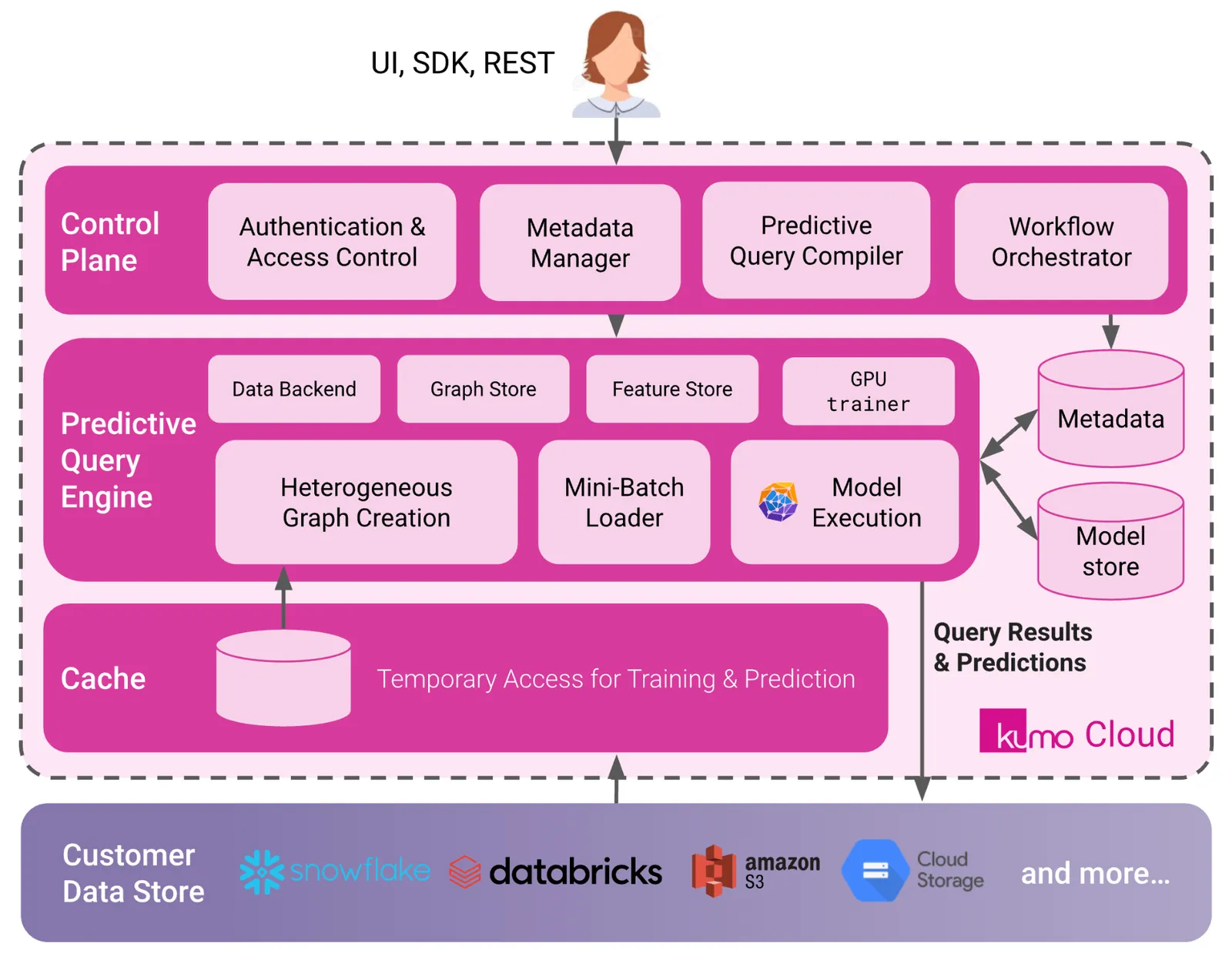
Users (that is, customers) access Kumo only through the predictive query interface. ML predictions are returned through the users’ data store. All user data remains stored in their data store. User-defined predictive queries run against the cache, which is populated from the customer’s data store. Data resident in the cache and cache retention time are user configurable. Users must provide Kumo credentials/access policies for Kumo to access a subset of the user’s data store.
All data objects created or stored by Kumo are hidden and not directly accessible by users; they are only accessible through the predictive query interface. Kumo utilizes cloud service providers as further described in the service agreement and/or documentation, and provides services using a VPC/VNET and storage hosted by the applicable cloud provider.
The Kumo AI SaaS cloud architecture consists of four key layers:
- Control Plane
- Predictive Query Engine
- Metadata DB
- Cache
Control Plane
The control plane is a collection of services that coordinate activities across Kumo. It runs on compute instances provisioned by Kumo from the cloud provider.
Predictive Query Engine
Predictive query processing is performed in the processing layer. Kumo processes queries using massively parallel processing (MPP) clusters of deep learning accelerators. After predictive query processing is complete, all data on the predictive query processing engine is purged.
Metadata DB
The Kumo metadata database holds data schema information, machine learning models, aggregate data statistics, and other metadata.
Cache
The data cache is not directly visible or accessible by users. Data cache objects are only accessible through predictive query operations run using Kumo. Kumo caches transformed and derived data for faster predictive query processing and execution, and manages all aspects of how this data is stored, including the organization, file size, structure, compression, metadata, statistics, and other aspects of data storage. The cache retention policy is defined by the user.
Internal Kumo AI Cloud Infrastructure Security
Data Centers
The Kumo AI cloud infrastructure runs on top of a public cloud provider’s services. Cloud provider data centers comply with a wide range of physical and information security standards; the Kumo AI cloud inherits the same best-in-class security controls.
For additional information, refer to the cloud service provider’s compliance page:
Encryption
Encryption in Transit
Encryption using TLS 1.2 is required for all client connections to the Kumo AI cloud.
Encryption at Rest
Cache at rest uses the default transparent AES-256 based encryption algorithm.
Kumo Employee Access Control
Kumo maintains an access management standard, updated annually at minimum, that dictates access control based on the principles of least privilege, need to know, and segregation of duties. Kumo employee access reviews occur at time of hire, termination, change of role, and periodically throughout each calendar year. Additionally, employees undergo background checks where permissible by law.
Elevated Access Permissions and Just-in-time Access
Kumo engineers with a business need for access to production resources do not have standing access to the production environment. Instead, elevated access permissions are assigned for a limited period of time through a discrete action performed by the authorized engineer (that is, just-in-time access). This elevation of privilege also requires authorization by another authorized Kumo engineer (that is, multi-party approval). Exceptions to the just-in-time access rule are granted only for the period when an engineer is actively performing on-call duties.
Audit Logs
Administrative actions are captured in Kumo’s audit log system and retained for 12 months. These logs are reviewed for anomalies by Kumo’s information security team, and maintained in a separate environment with separation of duties to prevent unauthorized modification or deletion.
Internal Kumo AI Cloud Service Security
Separation of Production and Non-Production Environments
The Kumo AI cloud maintains strict separation between production and non-production environments. Kumo enforces the principle of least privilege and separation of duties for access to all environments, and access to production environments is limited to authorized personnel only.
Deletion of Cache Data
Upon termination or expiration of their Kumo AI SaaS subscription, users can request deletion of their data as part of the account closure procedure. User data is deleted within 30 days of the request.
Available Customer Security Controls
Kumo AI Cloud Authentication and User Management
The Kumo AI cloud web UI supports username/password-based authentication and single sign-on (SSO) with identity providers (IdP) such as Okta. Kumo user passwords are held by identity management solutions provider Auth0. Auth0 stores credentials using bcrypt, an industry-standard one-way salted hashing algorithm.
Business Continuity and Disaster Recovery
The Kumo AI cloud runs on a resilient, highly available IT infrastructure. To maintain an actionable business continuity and disaster recovery plan (BCDRP), Kumo conducts periodic (annual at minimum) resilience testing and BCDRP exercises to review incident management procedures, update plan documentation, and conduct system recovery testing.
Infrastructure Service Recovery
The Kumo AI cloud runs workloads on IT infrastructure resources provided by public cloud providers such as AWS. Data availability is therefore also subject to the BCP and DR processes of those infrastructure providers. For more information about the cloud providers’ certifications and audit reports, refer to the following:
Incident Response
Kumo maintains a formal incident management policy and procedure, and communicates and trains appropriate personnel on a periodic basis. Procedures include liaisons and points of contact with local authorities in accordance with contracts and relevant regulations. Incident response is active during regular business hours to detect, manage, and resolve any security incidents.
Companywide Executive Review
Kumo’s security steering committee meets biannually to review reports, identify control deficiencies and material changes in the threat environment, and make recommendations to executive management for new or improved controls and threat mitigation strategies.
Compliance
Kumo maintains the following compliance certifications. For additional information, contact security@kumo.ai
SOC 2
Kumo’s SOC 2 report includes a description of its service organization’s system and a test of the design of the service organization’s relevant controls as they relate to security, availability, confidentiality, processing integrity, and privacy. For additional information, contact security@kumo.ai