
Pipeline Mode
Note
This page was generated from the docs/examples/image_processing/augmentation_gallery/pipeline_mode.ipynb Jupyter notebook. You can run it locally or open it in Google Colab, see Running the Examples for more information. To prepare Colab for this exact documentation revision, run this cell before the tutorial:
setup_url = (
    "https://raw.githubusercontent.com/NVIDIA/DALI/"
    "5f8bfb8/docs/examples/colab_setup.py"
)
!curl -sSL $setup_url -o colab_setup.py
%run colab_setup.py --ref 5f8bfb8
Augmentation Gallery#
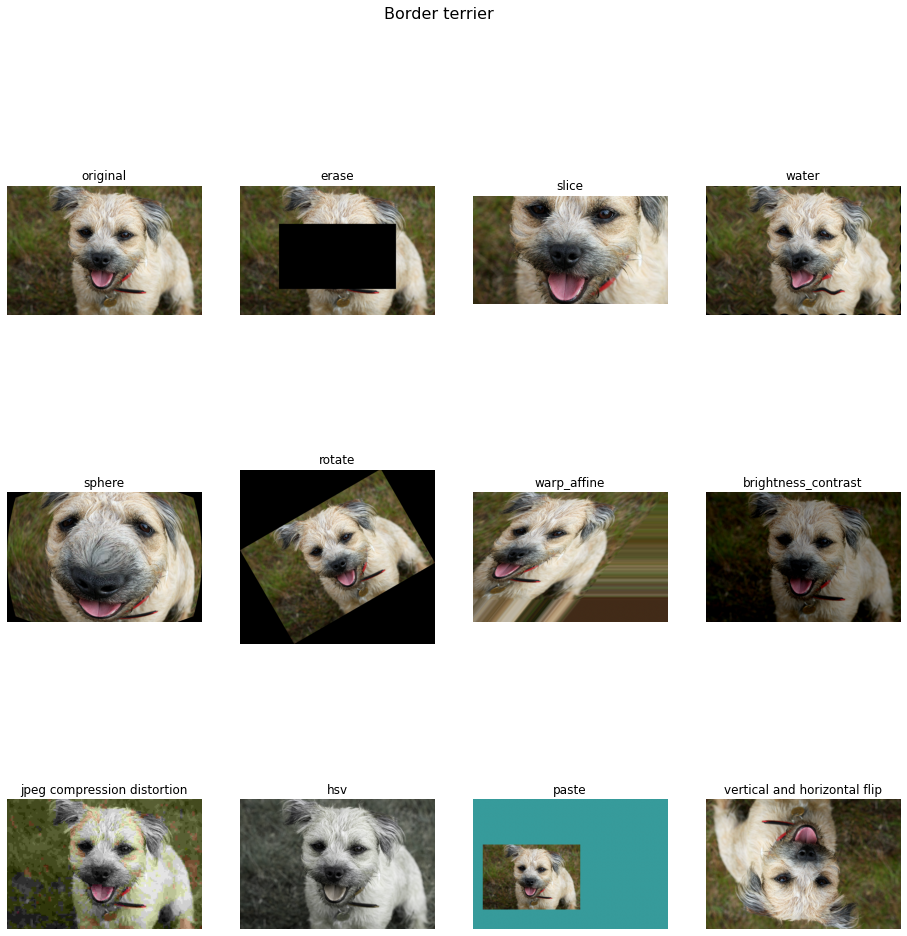
This example showcases different augmentations possible with DALI.
DALI_EXTRA_PATH environment variable should point to the place where data from DALI extra repository is downloaded. Please make sure that the proper release tag is checked out.
[1]:
from nvidia.dali import pipeline_def
import nvidia.dali.fn as fn
import nvidia.dali.types as types
import matplotlib.pyplot as plt
import math
import os.path

test_data_root = os.environ["DALI_EXTRA_PATH"]
db_folder = os.path.join(test_data_root, "db", "lmdb")

augmentations = {}

# input is sampled randomly for output pixel's neighbourhood
augmentations["erase"] = lambda images: fn.erase(
    images,
    anchor=[0.3, 0.2],
    shape=[0.5, 0.6],
    normalized_anchor=True,
    normalized_shape=True,
    axis_names="HW",
)

augmentations["slice"] = lambda images: fn.slice(
    images, rel_start=[0.3, 0.2], rel_shape=[0.5, 0.6], axis_names="HW"
)

# transforms sampling coordinates to produce wavy patterns
augmentations["water"] = lambda images: fn.water(images)

# applies fisheye distortion
augmentations["sphere"] = lambda images: fn.sphere(images)

# rotates the image, enlarging the canvas
augmentations["rotate"] = lambda images: fn.rotate(
    images, angle=30, interp_type=types.INTERP_LINEAR, fill_value=0
)

# applies affine transform
augmentations["warp_affine"] = lambda images: fn.warp_affine(
    images,
    matrix=[1.0, 0.8, 0.0, 0.0, 1.2, 0.0],
    interp_type=types.INTERP_LINEAR,
)

# manipulates brightness and contrast of the image
augmentations["brightness_contrast"] = lambda images: fn.brightness_contrast(
    images, brightness=0.5, contrast=1.5
)

# Generate JPEG compression artifacts
augmentations["jpeg compression distortion"] = (
    lambda images: fn.jpeg_compression_distortion(images, quality=5)
)

# twists colors of the image
augmentations["hsv"] = lambda images: fn.hsv(images, hue=45.0, saturation=0.2)

# places the image on a larger canvas
augmentations["paste"] = lambda images: fn.paste(
    images, ratio=2.0, fill_value=(55, 155, 155), paste_x=0.1, paste_y=0.7
)

# param flips the image
augmentations["vertical and horizontal flip"] = lambda images: fn.flip(
    images, vertical=1, horizontal=1
)


@pipeline_def()
def augmentation_gallery_pipe(path):
    encoded, labels = fn.readers.caffe(path=path, random_shuffle=True)
    images = fn.decoders.image(encoded, device="mixed", output_type=types.RGB)
    return tuple(
        [labels, images] + [aug(images) for aug in augmentations.values()]
    )
[2]:
pipe = augmentation_gallery_pipe(
    path=db_folder, batch_size=32, num_threads=2, device_id=0, seed=10
)
pipe.build()
[3]:
pipe_out = pipe.run()
[4]:
n = 5
from synsets import imagenet_synsets
import matplotlib.gridspec as gridspec

len_outputs = len(pipe_out) - 1
augmentations = ["original"] + list(augmentations.keys())
fig = plt.figure(figsize=(16, 16))
plt.suptitle(imagenet_synsets[pipe_out[0].at(n)[0]], fontsize=16)
columns = 4
rows = int(math.ceil(len_outputs / columns))
gs = gridspec.GridSpec(rows, columns)
for i in range(len_outputs):
    plt.subplot(gs[i])
    plt.axis("off")
    plt.title(augmentations[i])
    pipe_out_cpu = pipe_out[1 + i].as_cpu()
    img_chw = pipe_out_cpu.at(n)
    plt.imshow((img_chw) / 255.0)