

DSX Air Simulation User Guide
The Config Manager DSX Air simulation guide brings up a live NVIDIA DSX Air simulation, installs Config Manager inside the simulation, loads a demo Nautobot topology, and provisions virtual Cumulus Linux switches through DHCP and ZTP. Use it when you want to validate real device-facing workflows without touching a physical lab.
This is different from the Local Development Quick Start. The local quick start is render-only. The DSX Air simulation runs Cumulus Linux switch nodes and exercises Config Manager against those nodes over the simulated management network.
Most Config Manager workflows that operate on the demo Ethernet Cumulus switches can be exercised in DSX Air. InfiniBand and NVLink workflows are not included because DSX Air does not currently simulate those fabrics for this demo. Switch OS Upgrade is also excluded because the ONIE install path does not work in DSX Air.
Prerequisites
Before running the Config Manager DSX Air simulation, review the public NVIDIA DSX Air documentation:
- NVIDIA DSX Air Account Setup - NGC account, organization selection, free trial, and DSX Air roles.
- NVIDIA DSX Air Quick Start - simulation navigation, services, node consoles, SSH keys, and API authentication.
You also need:
- A local clone of the Config Manager repository
- Python 3.11+ and
uv. sshpassinstalled on the workstation where you run the TUI. The TUI-generated DSX Air SSH and SOCKS proxy commands use it.- An NGC API key for DSX Air API authentication. You can paste it into the TUI or set
NGC_API_KEYin your shell. - Enough DSX Air capacity for the selected demo. The DSX Air free trial preset is resource-capped for public trial accounts.
- A workstation browser that can run through a SOCKS proxy. Chromium-family browsers are easiest because the TUI prints ready-to-run commands.
Start the TUI
From your Config Manager fork checkout:
The TUI writes ~/.nvcm-air-sim.yaml by default so API keys and generated DSX Air SSH credentials are not saved inside the Git checkout. Treat the file as sensitive if it contains your NGC API key. To use a different location outside the repository, pass --config /path/to/config.yaml or set NVCM_AIR_CONFIG.
You can also run a saved simulation config headlessly:
TUI Walkthrough
The DSX Air simulation TUI has three sections: Topology, Options, and Launch.
Topology
Use the Pre-built Config selector for the built-in demos. For most users, start with DSX Air free trial demo. It creates one OOB management leaf and five TAN-HLEAF Cumulus switches, which is enough to exercise ZTP, backup, deploy, multi-deploy, reprovision, and validation workflows.
The preset enables Mock Topology, points the loader at development/mock_topology, and configures the template plugin paired with the demo topology. Keep the paired template plugin in place; the prebuilt demos require those templates to render valid device configuration.

Important fields:
DSX Air trial topology
SuperPOD demo topology
Options
Use Options to set DSX Air authentication, source settings, and advanced timing values.

Recommended public DSX Air values:
Launch
The Launch screen creates the simulation, starts it, waits for SSH, deploys Config Manager, runs post-deploy Nautobot jobs, monitors pods, and follows DHCP/ZTP logs.

Click Launch Simulation and leave the TUI open. The launch can take a while because it boots the DSX Air nodes, builds and loads local images, installs Config Manager, and lets the switches provision.
TUI responsiveness
During launch, the Activity stream can receive a high volume of log output. Mouse clicks may feel delayed while the TUI is processing those logs. If a click does not respond immediately, wait a moment and try again. This is a known limitation and will be addressed in future enhancements.
During launch:
- Steps shows high-level orchestration progress.
- Progress highlights the Nautobot pod first, then the remaining Kubernetes pods, and labels the ZTP count as Switches Provisioned.
- Activity has separate Deploy, DHCP, ZTP, and Access tabs. Deploy output appears first. DHCP and ZTP events populate while the switches request leases, pull ZTP data, and report provisioned state.
- DSX Air, SSH, and Access panels appear as soon as the TUI has enough information to show them. The deploy log path remains visible after completion or failure.

Use the DHCP tab to follow lease activity as the switches boot and request management addresses.

Use the ZTP tab to follow switch callbacks into the ZTP service and confirm each device reports progress.

When bringup completes, the Access panel shows commands for reaching the simulation.

Access the Simulation
Config Manager runs inside the oob-mgmt-server node in DSX Air. The TUI creates a DSX Air SSH service to that server and prints copyable commands. The Access panel also shows the generated nvcm SSH password under OOB SSH credentials.
For Linux and macOS:
- Copy the Linux / macOS - SOCKS tunnel command from the Access panel and run it in a terminal.
- If
8080is already in use on your workstation, change SOCKS Port in the Access panel before copying commands or launching a browser. - Copy the Linux / macOS - browser command, or manually launch a browser with
socks5://localhost:<SOCKS_PORT>. - Open the Config Manager and Nautobot URLs through that browser session.
Common service URLs inside the SOCKS-proxied browser are:
The demo disables SSO. Nautobot credentials are demo / demo. Config Manager workflow RBAC is opened for the demo so the workflow forms can be exercised without identity-provider setup.
DNS resolution for *.nvcm.air must go through the SOCKS tunnel. If a browser resolves names locally before using the proxy, the URLs will fail even though the services are healthy.
You can also SSH directly to the DSX Air server with the SSH command shown at the top of the Launch screen. This is useful for kubectl checks, pod logs, and low-level troubleshooting.
What to Check After Bringup
After launch completes:
- Open Nautobot and confirm the demo site, devices, interfaces, IP addresses, cables, roles, platforms, and config contexts exist.
- Open Config Manager and confirm workflow forms are available.
- Open Config Store and confirm intended configs exist for
tan-leaf-01throughtan-leaf-05. - In Nautobot, confirm the TAN leaf devices have status Provisioned after ZTP completes.
- In the TUI, use the Activity panel to inspect DHCP and ZTP service activity if a device is still provisioning.
Workflow Support
The DSX Air demo is intended for Ethernet and Cumulus Linux workflows. Useful workflows to try include:
- Configuration Backup
- Configuration Deploy
- Batch Deploy
- Multi-Device Deploy
- Tenant Deploy, if you scope it to demo devices with tenant data
- Cable Validation
- Hardware Validation
- Device Reprovision
- Workflow lifecycle actions such as approve, reject, retry, and terminate
Do not use the DSX Air demo for:
Try Multi-Deploy
Multi-Deploy is a good first Day-2 workflow because the DSX Air trial demo has five TAN-HLEAF switches that should receive the same diff.
The standard demo context already includes 8.8.8.8 as a DNS server. The example below appends 8.8.4.4 to the site config context. The render service picks up the Nautobot change, produces new intended configs for the TAN leaf devices, and Multi-Deploy groups the identical diffs for approval.
Edit the DNS config context
-
Open
https://nautobot.nvcm.air. -
Log in as
demo/demo. -
Navigate to Extensibility > Config Contexts.
-
Open
air-trial-network-management-services - demo. -
Edit the Data field.
-
Add
8.8.4.4to the existingdns.ipv4list.Example data with a demo DNS server:
-
Save the config context.
-
Wait for render to regenerate intended configs. If no intended config changes appear after a short wait, make a no-op edit to the context or call
POST /v1/render/allfrom the Render API athttps://render.nvcm.air/docs.
Run Multi-Deploy
-
Open
https://nvcm.air. -
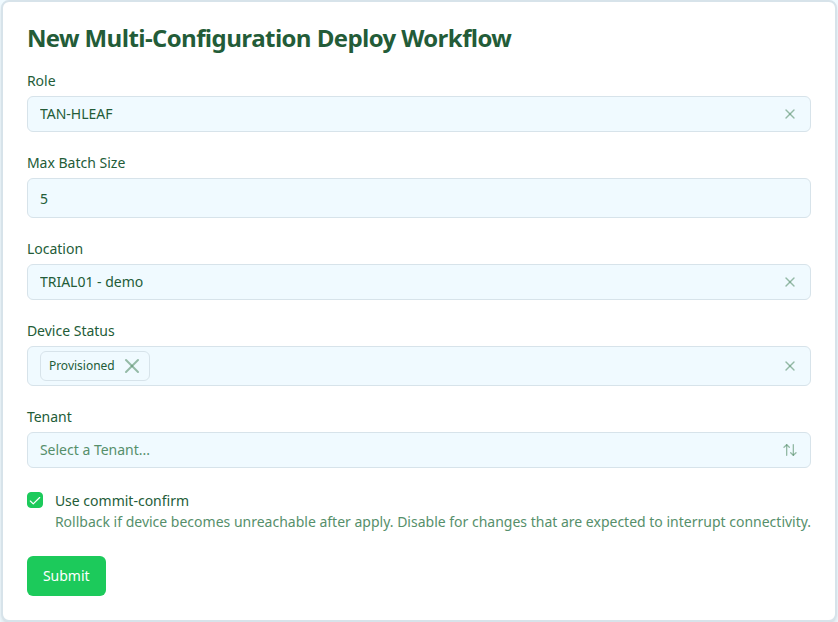
Click the + button and select MultiDeployWorkflow.
-
Set Role to
TAN-HLEAF. -
Set Max Batch Size to
5so all demo TAN leaf devices can be approved together when they share one diff.The populated DSX Air trial form should look similar to this:
-
Submit the workflow.
-
When the parent reaches the batch execution stage, open the child Batch Deploy link.
-
Review the shared diff. It should show the DNS server addition on each
tan-leaf-*device. -
Approve the batch.
-
Confirm the parent workflow completes and the child batch reports successful applies and backups.
For the full workflow behavior, see Multi-Device Deploy and Batch Deploy.
Try Reprovision
Reprovision shows the re-ZTP path for an already-running switch. It factory-resets the target Cumulus switch, waits for DHCP/ZTP to run again, and then triggers a fresh backup.
Device reset
Reprovision intentionally takes the selected switch offline and wipes its running configuration. In the DSX Air demo this is safe, but the same workflow is disruptive in a real environment.
-
Open
https://nvcm.air. -
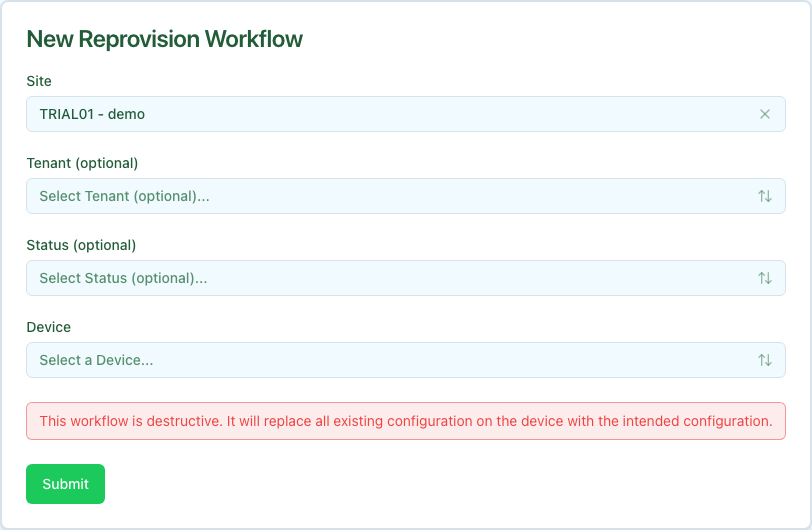
Click the + button and select ReprovisionWorkflow.
-
Select the DSX Air trial site, such as
TRIAL01 - demo. -
Select a TAN leaf device, such as
tan-leaf-01.The populated DSX Air trial form should look similar to this:
-
Submit the workflow.
-
In the DSX Air UI, open the simulation topology.
-
Double-click the same switch node to open its console.
-
On the switch console, tail the Cumulus autoprovision log:
This lets you watch the switch-side ZTP process while Config Manager waits for the device to report provisioned.
-
In the Config Manager UI, watch the three Reprovision stages:
pre_reprovision_backuplinks to the pre-ZTP backup, where configuration drift details are reported.execute_ztpfactory-resets the switch and waits for ZTP to finish.perform_backuplinks to the post-ZTP backup.
-
Confirm the workflow completes after ZTP succeeds and the post-ZTP backup child workflow finishes.
-
In Nautobot, confirm the device status returns to Provisioned.
You can also watch the TUI Activity panel or the ZTP service logs if the switch stalls. For the full production workflow details, see Device Reprovision.
Other Useful Exercises
After Multi-Deploy and Reprovision, try these workflows:
- Configuration Backup against one TAN leaf. Confirm the backup appears in Config Store.
- Configuration Deploy against one TAN leaf after a small Nautobot config context change. Use this before Multi-Deploy if you want to inspect the single-device approval path.
- Cable Validation for the DSX Air trial site. This checks LLDP-reported neighbors against the mock topology’s Nautobot cabling.
Cleanup
DSX Air simulations consume account resources while running. When you are done, stop or delete the simulation in the DSX Air UI. If you expect to resume later, use DSX Air checkpoints according to your account limits. If you only needed a short demo, delete the simulation to free capacity.
The TUI-created Config Manager deployment lives inside the DSX Air simulation. Deleting the simulation removes the demo Kubernetes cluster, Nautobot data, Config Store data, and generated switch state.