

Cisco AI Defense Integration
Cisco AI Defense allows you to protect LLM interactions. This integration enables NeMo Guardrails to use Cisco AI Defense to protect input and output flows.
Overview
The diagram below shows how Cisco AI Defense integrates with the NeMo Guardrails flow to provide comprehensive protection at both input and output stages:
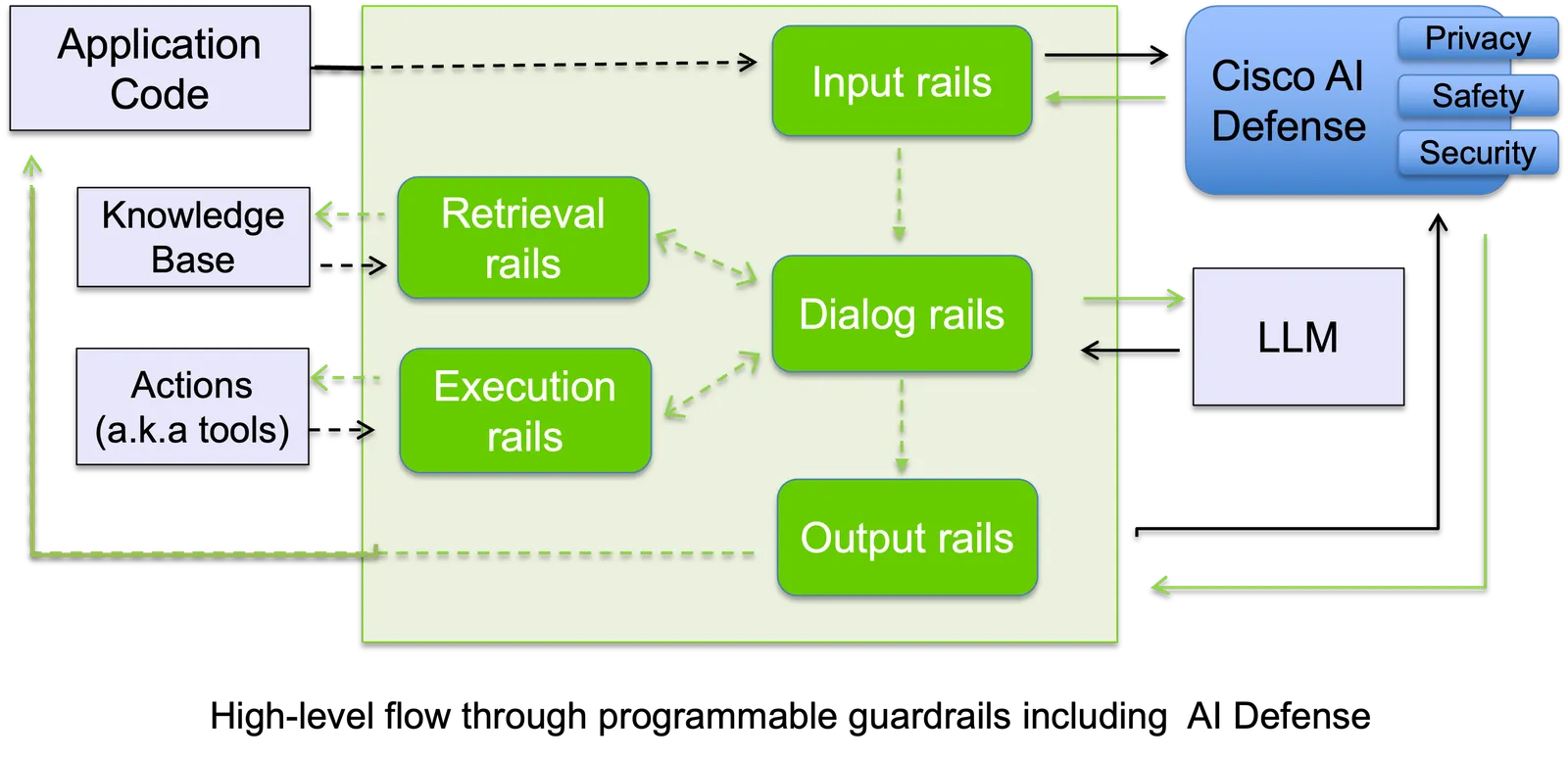
You’ll need to set the following environment variables to work with Cisco AI Defense:
- AI_DEFENSE_API_ENDPOINT - This is the URL for the Cisco AI Defense inspection API endpoint. This will look like https://[REGION].api.inspect.aidefense.security.cisco.com/api/v1/inspect/chat where REGION is us, ap, eu, etc.
- AI_DEFENSE_API_KEY - This is the API key for Cisco AI Defense. It is used to authenticate the API request. It can be generated from the Cisco Security Cloud Control UI
Setup
- Ensure that you have access to the Cisco AI Defense endpoints (SaaS or in your private deployment)
- Set the required environment variables:
AI_DEFENSE_API_ENDPOINTandAI_DEFENSE_API_KEY
For Colang 1.0
Enable Cisco AI Defense flows in your config.yml file:
For Colang 2.x
You can set configuration options in your config.yml:
Example rails.co file:
Configuration Options
The AI Defense integration supports the following configuration options under rails.config.ai_defense:
timeout(float, default: 30.0): Timeout in seconds for API requests to the AI Defense service.fail_open(boolean, default: false): Determines the behavior when AI Defense API calls fail:false(fail closed): Block content when API calls fail or return malformed responsestrue(fail open): Allow content when API calls fail or return malformed responses
Note: Configuration validation failures (missing API key or endpoint) will always block content regardless of the fail_open setting.
Usage
Once configured, the Cisco AI Defense integration will automatically:
- Protect prompts before they are processed by the LLM.
- Protect LLM outputs before they are sent back to the user.
The ai_defense_inspect action in nemoguardrails/library/ai_defense/actions.py handles the protection process.
Error Handling
The AI Defense integration provides configurable error handling through the fail_open setting:
- Fail Closed (default): When
fail_open: false, API failures and malformed responses will block the content (conservative approach) - Fail Open: When
fail_open: true, API failures and malformed responses will allow the content to proceed
This allows you to choose between security (fail closed) and availability (fail open) based on your requirements.
Error Scenarios
- API Failures (network errors, timeouts, HTTP errors): Behavior determined by
fail_opensetting - Malformed Responses (missing required fields): Behavior determined by
fail_opensetting - Configuration Errors (missing API key/endpoint): Always fail closed regardless of
fail_opensetting
Notes
For more information on Cisco AI Defense capabilities and configuration, please refer to the Cisco AI Defense documentation.