

Nanbeige4.3-33B
Nanbeige4.3-33B is a dense
33B-parameter reasoning and agent model from Nanbeige. Its checkpoint declares
the LlamaForCausalLM architecture, so NeMo AutoModel loads it through the
native Llama implementation without remote code.
Model Reference
Model Architecture
Available Models
The base checkpoint uses rope_theta 1e7 and 131,072 maximum positions. The
recipes below target the post-trained checkpoint.
Chat Template
The checkpoint chat template renders every assistant turn as
<think>\n{reasoning}\n</think>\n\n{answer}. Tulu-3 answers have no reasoning,
so each supervised turn starts with an empty think block, which matches the
template’s enable_thinking=False prompt. Without a system message the
template inserts the checkpoint’s default system prompt. AutoModel derives
the loss mask by rendering conversation prefixes, so no custom template is
needed: each assistant turn is supervised from its <|im_start|>assistant
header through <|im_end|>, including the empty think block, and system and
user tokens are masked.
Training Recipes
Follow the installation instructions, then run the LoRA recipe from the repository root:
Launch the full-parameter recipe on each of two nodes:
Both recipes shuffle Tulu-3 with a fixed shuffle_seed before packing and
keep the packed order in the dataloader. Each 131,072-token THD row stores
document boundaries in cu_seqlens, and position IDs restart at every
document, so TE runs block-diagonal causal attention over the pack. A global
batch is four packs, about 510K tokens.
Training Measurements
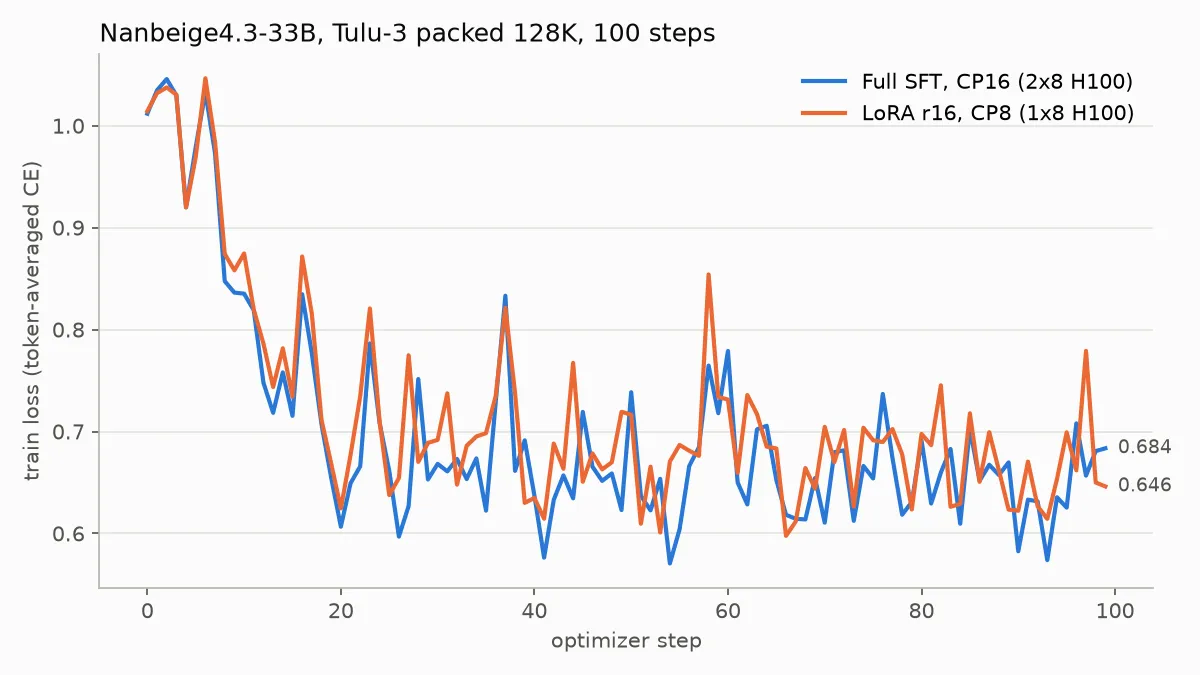
Measured on H100 80 GB with PyTorch 2.14, Transformer Engine 2.19 and Transformers 5.18, running each recipe for 100 steps:
These are training losses, not held-out quality measurements.
Parallelism and Backends
- Packed THD batches run through TE attention (
backend.attn: te). Padded BSHD batches use the Hugging Face attention interface. - Context parallelism shards each packed row across the CP group. The pack
length must be divisible by
2 * cp_size. - Full-parameter training does not fit 16,384 tokens per rank beside the sharded parameters, gradients and optimizer state on one 8x H100 node, so the full-parameter recipe spans two nodes with CP16. LoRA keeps the base weights frozen and fits CP8 on one node.