Fine-Tune Step-3.7-Flash
Fine-Tune Step-3.7-Flash
Introduction
stepfun-ai/Step-3.7-Flash is Stepfun AI’s 198B-A13B Mixture-of-Experts vision-language model. It builds on the Step-3.5-Flash language architecture and adds native image and video understanding for agentic developer workflows.
Step-3.7-Flash is positioned for agentic use cases where image or video context is part of the task. Target workflows include frontend development from mockups, data-processing tasks, screenshot-based debugging, and tool-calling agents that need stable structured outputs.
To set up your environment to run NeMo AutoModel, follow the installation guide.
Model Overview
Architecture
- Model type: 198B total / 13B active MoE vision-language model.
- Language module: Step-3.5-Flash-derived backbone with 45 layers, 288 experts, 8 activated experts per token, and a 256k context length.
- Vision module: 1.8B ViT with 47 layers and 728x728 image inputs.
- Precision targets: BF16 and FP8 planned for Day 0; NVFP4 support is best effort.
- Hardware target: trained on Hopper GPUs.
Agentic Positioning
Step-3.7-Flash targets high-throughput, low-latency inference for real-time developer loops. It continues support for agent frameworks such as OpenClaw, HermesAgent, and KiloClaw, with emphasis on tool-call stability.
Data
Multimodal Supervised Fine-Tuning Data
Use image/video instruction data that matches the target agent workflow. Good candidates include:
- frontend mockup-to-project examples,
- screenshot-debugging conversations,
- structured data-processing tasks with visual context,
- image/video question-answer pairs for bounded task execution.
For a full walkthrough of how multimodal datasets are preprocessed and integrated into NeMo AutoModel, including chat-template conversion and collate functions, see the Multi-Modal Dataset Guide.
Launch Training
Use the checked-in full SFT recipe or LoRA recipe. Both use stepfun-ai/Step-3.7-Flash for the model and processor and configure pipeline and expert parallelism for this large VLM MoE.
NeMo AutoModel supports several ways to launch training: the AutoModel CLI with Slurm, interactive sessions, torchrun, and more. For full details on Slurm batch jobs, multi-node configuration, and environment variables, see the Run on a Cluster guide.
Standalone Slurm Skeleton
Before running, make sure your cluster environment is configured following the Run on a Cluster guide.
Before you start:
- Clone or mirror the model checkpoint locally before launching a multi-node run.
- Ensure
HF_HOMEpoints to a shared cache visible from all nodes. - Cache the dataset locally if running with
HF_DATASETS_OFFLINE=1. - Configure the
wandbsection in the recipe to record loss, throughput, and memory curves.
Training Results
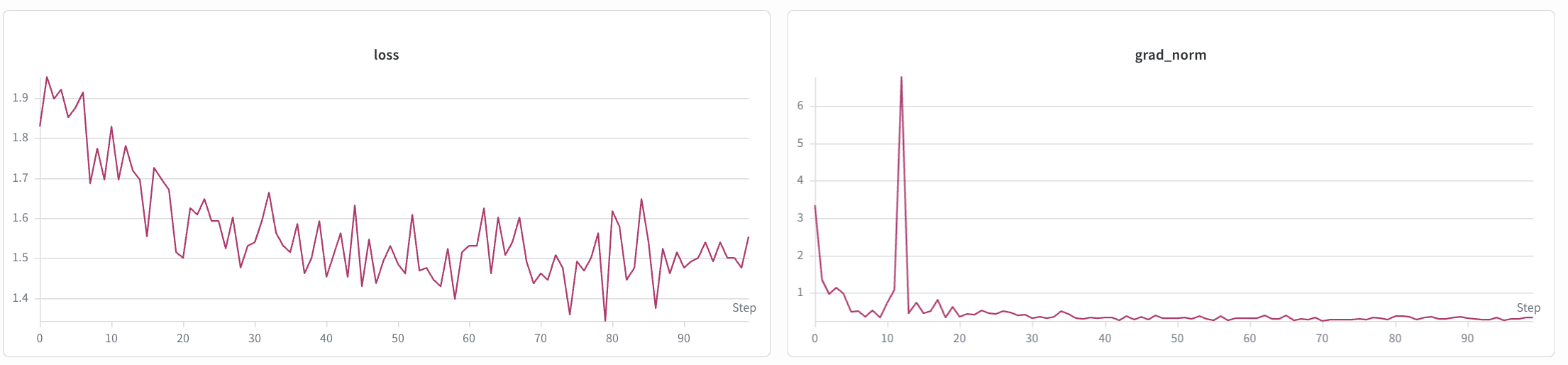
The SFT and LoRA training loss curves are shown below.
SFT
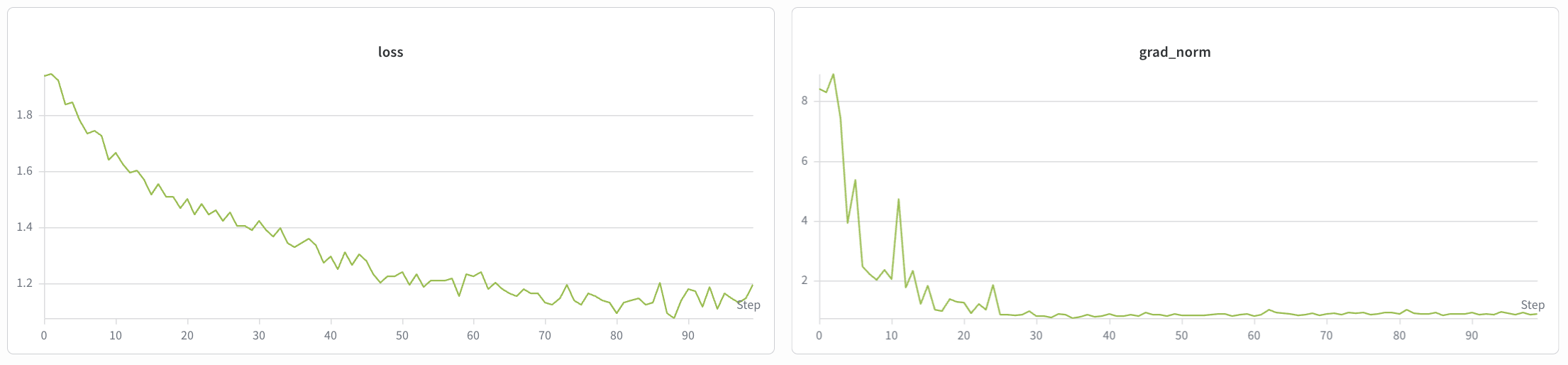
LoRA